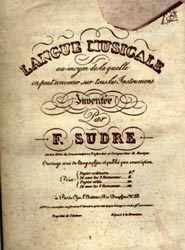
Solresol is an international artificial language based on the names of the seven notes of the diatonic scale . He was invented by the Frenchman Jean Francois Sydr in 1817 . Vensan Gajewski ( Fr. Vincent Gajewski ; d. 1881 ), who invented a special shorthand alphabet for him (see below), and his son Sisal Boleslas Gajewski ( d . Sisal Boleslas Gajewski ; d. 1917 ) made a significant contribution to the further development of solresol. he analyzed the strengths and weaknesses of the Cudra project in the book Examen critique de la langue universelle de Sudre ( 1887 ), and then compiled the Grammar of Solresol ( French Grammaire du Solresol ; 1902 ).
| Solresol | |
|---|---|
 | |
| Self name | Solresol |
| Created by | Jean Francois Sydr |
| Year of creation | |
| Category | and a |
| Type of letter | latin syllable letter |
| Language Codes | |
| ISO 639-1 | - |
| ISO 639-2 | - |
| ISO / DIS 639-3 | - |
Content
Alphabet
The solresol alphabet consists of the names of seven musical notes (do, re, mi, fa, so, la, si / (ti)), where one letter means two inseparable sounds - consonant and vowel. Thus, the language has 7 monosyllabic words, 49 two-syllable words, 343 three-syllable words and 2401 four-syllable words (2800 words in total). There are five complicated words, but they are not mentioned in the Grammar of Solresol. For the study and use of solresol, acquaintance with musical literacy is not required.
Examples
Some words and phrases are translated into solresol like this:
- I'm dore
- you, you are domi
- mine is a redo
- desire, desire - mythal ,
- help, help - dosido ,
- to love, love - milashi ,
- i love you - dore milashi domi ,
- the tongue is solresol .
Parts of Speech
The place of phonetic stress in a word defines a part of speech . In the verb, stress is not put, in the noun it falls on the first syllable , in the adjective - on the penultimate, and in the adverb - on the last. Example:
- midof - prefer
- madofa - preference,
- midofa - preferred,
- midof - preferably.
Gender and number
There are three genera in solresol - male , female, and middle , while all inanimate or asexual objects have a middle gender, while in the rest the gender is the same as gender (similar to English ). In feminine words, the last vowel sound stands out in oral speech. On the letter, the last syllable is emphasized, or after the word, a short horizontal line “¯” is placed above. The words of the middle and masculine gender are not distinguished by anything, therefore it can be said that in the solresol there are two genera - female and non-female.
Plural words are pronounced with lengthening of the last vowel sound as if it were double. On the letter, the diacritical mark of acute stress ( acute ) “´” is placed above the corresponding letter.
- redo - brother
- redō - sister,
- redṓ - sisters.
In many cases, feminine and plural marks may be omitted if the meaning is clear from neighboring words.
Semantic groups
Polysyllabic words are combined into semantic groups according to the initial syllables . For example, words starting with salt refer to science and art ( solresol ), and with salt are to diseases and medicine ( solsolredo - migraine). Six words from the Time group:
- doredo - an hour,
- doremi - day
- Dorefa - a week,
- Doresol - a month,
- dorel - year,
- doresi - century, century.
Antonyms
For the formation of antonyms , inversion is used, that is, the "inversion" of the word.
- fall - good, good,
- Lyafa - bad, bad.
- Domisol is a god.
- Solmido - the devil
Naturally, for the antonyms thus obtained, it is impossible to determine the semantic group from the first syllables.
Synonyms and homonyms
There are no synonyms and homonyms in solresol, that is, different words always mean different things and are written differently.
Morphology and Syntax
The conjugation forms of verbs in tenses , moods , pledges , superlatives of adjectives and adverbs, negative and interrogative sentences are formed with the help of auxiliary words.
Writing and other forms of speech
There are several simple ways to record solresol:
- names of notes
- omitting the vowels for brevity,
- music notation on a stave (or just circles on three horizontal lines),
- the first seven Arabic numerals
- the first seven letters of the latin alphabet ,
- signs of special shorthand, solresol,
- rainbow colors (colored lines on paper).
Speech on solresol can be reproduced in other ways:
- pronunciation of the names of the notes out loud
- sign language of the deaf,
- by a series of knocks and other arbitrary discrete signals (once - before , twice - re , etc.),
- playing a musical instrument with a diatonic scale ,
- singing
- gestures repeating the signs of shorthand solresol,
- signal flags
- rainbow colors (flashes of light or colored lines on paper),
- etc. endlessly.
In oral solresol, short pauses must be made between words, otherwise the recognition of word boundaries will be difficult.
Popularity
The Ciudra project earned the repeated approval of various commissions of the Paris Academy of Sciences and numerous scientific societies, received a prize of 10 thousand francs at the international exhibition in 1851 in Paris and an honorary medal at the international exhibition in 1862 in London, and received recognition from many prominent contemporaries in including Victor Hugo , Lamartine , Alexander Humboldt .
After a short period of popularity, the solresol surrendered its position to more successful artificial languages such as volapuk and Esperanto .
Notes
- ↑ Crystal, David The Cambridge Encyclopedia of Language - Cambridge University Press , 1987. - P. 353. - ISBN 978-0-521-42443-1
Literature
- Alexander Piperski . Solresol // Design of languages. - Alpina non-fiction , 2017 .-- 224 p. - (Post-Science Library). - 3000 copies. - ISBN 978-5-91671-635-1 .