Tagansky district is the district of the Central Administrative District of Moscow . It is located east and southeast of the historical city center - Zaryadye and Kitay-Gorod , on the left (northern) bank of the Moscow River . The district corresponds to the intracity municipality Tagansky municipal district.
| Tagansky district | |||
|---|---|---|---|
| Tagansky municipal district | |||
| |||
| Status | district / municipal district | ||
| Included in | Moscow city | ||
| Administrative District | TsAO | ||
| Area | |||
| Title | Tagansky | ||
| Date of formation | July 5, 1995 | ||
| Head of the Board | Mishakov Alexander Sergeevich | ||
| OKATO Code | |||
| Municipal District | |||
| Title | Tagansky | ||
| Date of formation | October 15, 2003 | ||
| Chapter | Sviridov Ilya Timurovich [1] | ||
| OKTMO Code | |||
| Characteristic | |||
| Square | 8.01 [2] km² (58th place) | ||
| Population ( 2019 ) | ↗ 123 398 [3] people (0.98%, 30th place) | ||
| Population density ( 2019 ) | 15 405.49 people / km² (40th place) | ||
| Housing Area ( 2008 ) | 2722 [2] thousand m² (15th place) | ||
| Metro stations |  Taganskaya Taganskaya China town China town China town Taganskaya Proletarian China town Taganskaya Proletarian Ilyich Square Marxist Ilyich Square Marxist Roman Peasant outpost Roman Peasant outpost | ||
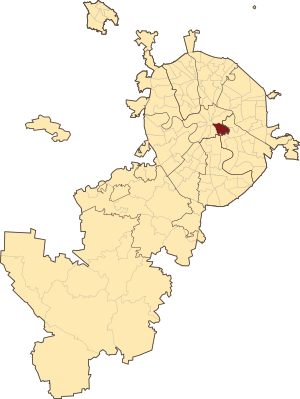 | |||
| Official site of the district | |||
| Official website of the municipality | |||


The territory of the district, inhabited from west to east, starting from the turn of the XIV-XV centuries [4] , includes the Krutitsky Compound founded in the XIII century [5] . In the XVII century , a system of settlements of artisans and cultivators developed in the region, and in the second half of the XVIII century the center of the Old Believers - the Rogozhskaya Sloboda - appeared .
The name of the area comes from the Taganskaya artisan settlement beyond Yauza , located on the site of modern Radishchevsky streets near Taganskaya Square . Its inhabitants, blacksmiths, made tagans - tripods for boilers, which were used by archers [6] .
District Indicators
According to the Federal State Statistics Service, the area of the district is 801 hectares [2] (At the same time, 791.6 hectares [7] are indicated on the CAO website). The resident population in January 2010 was 107.5 thousand people. [8] . The population density is 13420.7 people / km². The area of the housing stock of the district as of 2008 is 2.722 million m² [2] .
Location
District Boundaries
The borders of the modern Tagansky district pass [9]
- from the southwest along the axis of the Moscow riverbed
- from the west on Kitaygorodsky passage
- from the north and northeast along Solyansky passage , Solyanka , Podkolokolny lane , Vorontsov Field , Verkhnyaya Syromyatnicheskaya street , the axis of the Kursk direction of the Moscow Railway , Nizhny Novgorod street
- from east, southeast and south along Skotoprogonnaya street , Malaya Kalitnikovskaya street , Mikhailovsky passage , Volgogradsky prospect , Melnikov street , First Dubrovskaya street , Third Krutitsky lane , Simonovsky Val , Arbatetskaya street .
Landscape
Along the left bank of the Moscow river stretches a chain of hills ("krutitsy"). To the east of the mouth of Yauza is Tagansky hill ; its slopes previously had their own names - Sewing (Sewing) slide , Red Hill, Lishchikova Gora . Modern buildings partially hide the historical relief, and in places (for example, at the high-rise on Kotelnicheskaya ) it is deliberately cut off.
In the central part of the district, the relief is determined both by the Yauza riverbed and by the small river Rachka, flowing from the "Pogany" (Chistye) ponds along the modern Kolpachny and Podkopaevsky lanes and further through the territory of the Educational House . The crustacean cut the land between Zaryadye and Yauza into high-lying “ old gardens ” and low-lying, wooded “ kulishki ” [10] .
To the east, near the Novospassky Monastery and the Krutitsky Compound, the Sarah rivers flowing from Kalitnikov and Podon flowed into Moscow. According to the most common version, the rivers were named after the diocese of Sarskaya and Podonskaya, which belonged to Krutitsy [5] [11] . The surviving Kalitnikovsky pond feeds on the Kalitnikovsky stream, and feeds the Khokhlovka River, which flows into the Beggar, and that into Moscow below Nagatina ). The relatively large (1.5 hectares) Novospassky pond between the walls of the Novospassky Monastery and the Moscow River has also been preserved on the territory of the district, and the once-existing Voxal Pond near Tagansky Park was liquidated at the end of the XIX century .
Historic settlements and tracts
The district unites diverse areas, from populated in the XIII century (Krutitsy) to industrial outskirts, the development of which began at the end of the XIX century. The historical names of these settlements and tracts are partially preserved on the city map. When moving from the city center to the outskirts, this:
- Within the Garden Ring on the right bank of the Yauza :
- Kulishki
- Former Vasilievsky meadow , occupied by the Orphanage since 1760s
- Hitrovka on the border with the Basmanny region
- Vorontsovo Field
- Serebryanicheskaya Sloboda and the village of Vorobino (see Serebryanichesky Lane , Bolshoi Nikolovorobinsky Lane )
- Behind the Garden Ring on the right bank of the Yauza - Syromyatnicheskaya Sloboda (see Upper Syromyatnicheskaya Street )
- Behind Yauza within the Garden Ring and directly behind the Garden Ring is Taganka itself , the historical Zayauzye:
- Shvyivaya Gorka and Kotelnicheskaya Sloboda (see Kotelnicheskaya Embankment )
- Pottery settlement (see Pottery street )
- Taganskaya square
- From the Garden Ring to the Kamer-Kollezhsky shaft :
- Alekseevskaya settlement
- Rogozhskaya Yamskaya Sloboda
- Vorontsovskaya Sloboda (see Vorontsovskaya Street )
- Kamennaya Sloboda (see Bolshoi Masons Street )
- Beyond the Chamber-College shaft :
- Rogozhsky village
- Kalitniki (see Bolshaya Kalitnikovskaya street )
- Krutitsy with Krutitsky Compound
- Dubrovsky village (see 1st Dubrovskaya street )
History
XIII — XVI Century
In Zayauzye, there are the oldest human traces in Zemlyanoye city - even the Domoski settlements on Shvivaya Gorka ( Bolshaya Vatin Lane - Goncharnaya Street ) and Lyshchikova Gora ( Nikoloyamskaya Street - Lishchikov Lane ) [12] . Soon after the foundation of the city, roads to Kolomna and Vladimir extended along the territory of the district, supplementing the water connection. To Yauza, two roads went together, along the modern streets Solyanka and Yauzskaya , then they diverged; in their place in the 15th century the main radial streets of Zayauzya appeared - the modern Nikoloyamskaya and Upper Radishchevskaya [12] .
In 1272, under Prince Daniil of Moscow (the son of Alexander Nevsky ), Krutitsky hill was given to the courtyard of the Sarsk diocese , which nurtured the Orthodox population of Sarai-Batu . Subsequent rulers - Ivan II Red , Dmitry Donskoy - supported the diocese with cash contributions and privileges.
In fact, the city of Moscow went beyond the borders of the Kremlin and Zaryadye only at the turn of the XIV - XV centuries . At the beginning of the 15th century, a grand-ducal estate with extensive gardens and the Church of St. Vladimir “in the old gardens” was built on a hill above the Rachka stream (see Starosadsky Lane ) [4] . Near the estate was founded the Ivanovo Monastery ; the estate itself and the adjoining boyars' yards and settlements of ministers gradually expanded eastward to the royal village of Vorontsov. By the end of the sixteenth century, of all the royal gardens in this part of the city, only one remained - on the Vasiliev Meadow (south of the modern Solyanka). By this time, Solyanka, connecting the Barbarian gates of Kitai Gorod and the bridge over Yauza, had become an important shopping street with Rybny and Salt Yards [13] .
Zayauzie began to be actively settled at the turn of the XV — XVI centuries, primarily due to the artisans who were evicted from the city engaged in flammable crafts: potters and blacksmiths - armored workers and boiler workers (see Kotelnicheskaya Embankment ). The masters who made the tagans gave the name to Taganka. Since 1476, the Temple of Nikita the Martyr on the Shiva Hill is known (rebuilt in stone in the 16th century) [14] . In the same XV century, grand-princely and boyar villages appeared in Zayauzye, and in 1490 the Novospassky monastery was founded near Krutits. In the XVI century, a fast-growing settlement of Kotelniki pushed the potters' settlement to the eastern part of the modern Goncharnaya Street , which arose as a branch from the large Kolomenskaya road [15] .
XVII century
Unlike Zamoskvorechye , where the destruction of the Time of Troubles and the construction of fortifications of Zemlyanoy Val completely changed the network of radial streets, [16] the main radial streets of Zayauzya that arose in the 15th - 16th centuries remained in their original place. In the XVII century, a network of Zayauzya lanes formed, steeply falling from the hills to the rivers. In many ways, this network survived to the 21st century, excluding those lanes that were destroyed or turned into intra-quarter driveways during the large-scale development of the post-war years.
In the middle of the XVII century, the population density in Zayauzie became one of the highest in Moscow [17] . At this time, Zayauzie was bounded from the east by Zemlyanoy Val, with the only gate on Taganskaya Square. The Tagansky market was formed on it, and most of the shops in the XVII century were kept by archers . Modern Teterinsky Lane recalls their commander, Colonel Teterin. The largest settlement of the 17th century was the Semenovskaya black settlement of plowmen (189 yards in 1639, 238 yards in 1653); [6] part of it in the middle of the century moved beyond Zemlyanoy Val, to the modern Taganskaya street.
After the construction of the Skorodom (1591-1592), settlement began also in the territories east of Taganskaya Square. In 1635, the Pokrovsky Monastery was founded (Taganskaya Street, 58). In 1639, part of the drafters of the black Vorontsov settlement moved from the Vorontsov Field to the city wall; approximately in the same years south of the new Vorontsov settlement, a settlement of palace masons was founded. On the way to Vladimir, the Rogozhskaya Yamskaya Sloboda appeared with the original center near the Church of St. Nicholas in the Yamas (modern 39 Nikoloyamskaya street). Was in Zayauzye and the settlement of the "Germans" - " Kukuy- city" [18] . The “Kukuy-city” mentioned on the Nesvizh plan is not identical with Kukuy in the German settlement . Probably, for the compiler of the drawing, the toponym “Kukuy” was a household name that denoted any settlement of foreigners in general. </ref> The “German” cemetery was built behind Zemlyanoy Val, along Vorontsovskaya Street [19] .
Thus, by the middle of the XVII century , a settlement system had developed in the region, recorded by scribe books of 1651-1652: [20]
| Sloboda | Occupation | The number of yards | Modern location |
|---|---|---|---|
| Alekseevskaya | Black settlement | 166 | Alekseevsky streets |
| Vorontsovskaya (I) | Black settlement | Vorontsovo Field | |
| Vorontsovskaya (II) | Black settlement | 135 | Vorontsovskaya street |
| Pottery | Pottery | Potter Street near Zemlyanoy Val | |
| Stone | run by the Stone Order | Big Masons Street | |
| Kuznetsk | blacksmith craft | Yauzskaya street from the Yauzsky bridge | |
| Foreign Staropanskaya | Ethnic settlement of Poles | 52 | Vorontsovo Field, near Yauzsky Boulevard |
| Foreign Greek | Ethnic settlement of the Greeks | Zayauzye, outside the Earthshaft | |
| Rogozhskaya Yamskaya | Yamskoy service | Nikoloyamskaya street behind Zemlyanoy Val and Voronya street | |
| Garden | Delivery of berries and fruits to the yard | 25 [21] | Vorontsovo Field, near Zemlyanoy Val |
| Semenovskaya (I) | Black settlement | 238 | Nikoloyamskaya street from the Yauz bridge |
| Semenovskaya (II) | Black settlement | Taganskaya street | |
| Streletskaya | Archery Settlement | Zayauzye, near Vysokoyauzsky bridge | |
| Rawhide Stable [22] | Making saddles and harnesses for the yard and troops | 53 | Rawhide streets |
| Tagannaya | blacksmith craft | 93 [23] | Radishchevsky streets near Zemlyanoy Val |
| Teterinskaya | run by the Stone Order | 10 [24] | Teterinsky Lane |
18th Century and First Half of the 19th Century
The events of the time of Peter the Great - the physical destruction of the archers after the rebellion of 1698 , the disbandment of the streltsy troops, the withdrawal of the capital to St. Petersburg and the ban on stone construction - had little effect on the development of Zayauzya. After the official abolition of the Sloboda system, the uneven, mosaic structure of the settlement of the region was actually preserved here [25] . As construction was restored in Moscow during the reign of Elizabeth, large stone construction - noble estates - concentrated in the western part of Zayauzya, along Yauzskaya Street; in the rest of the district, the houses of merchants and bourgeois dominated. In 1771, the Old Believers Rogozh cemetery was founded outside the city limits, and merchants-schismatics began to settle on the outskirts of Taganka. Thanks to the cultural isolation of the Rogozh Old Believers, the Sloboda patchwork organization of the eastern outskirts of the city lasted longer in Tagansky district than anywhere else in Moscow [26] .
Under Catherine II , in 1764, an Orphanage was founded on Vasilievsky Meadow, and in the "noble" part of Zayauzya there were large city estates by T. I. Tutolmin on Goncharnaya (begun in 1788, completed after 1801) and I. R. Batashev between Yauz and Nikoloyamskaya (completed in 1805, from 1878 - Yauz hospital ). Tutolmin’s house , set on top of the Shivaya Gorka, visually crowned the panorama of Zayauzya from all points of view. “In its urban development role, Tutolmin’s house was not inferior to Pashkov’s house ” [27] . The development of the outskirts, not marked by bright monuments, has long remained in the shadows. However, at the turn of the eighteenth and nineteenth centuries, the founders of future merchant dynasties Morozovs and Shelaputins already advanced in the Old Believer suburban community. In the first decade of the 19th century, entrepreneurship was undermined by a continental blockade , but after Napoleon’s exile , the business climate improved, and the first factory of S.V. Morozov appeared between Nikoloyamskaya Street and Yauza. In 1817, the founder of another dynasty , the Yegoriev peasant Ivan Khludov , moved to Moscow, on Shvivaya Gorka [28] .
But before this happened, Zayauzye and the center of Moscow almost completely burned out during the fire on September 2-6, 1812 . Here, on the retreat of the Russian army, was one of the centers of the fire. 36 houses were preserved in the Yauz part, 63 in Rogozh, and only 13 in Taganskaya. [29] Managed to defend the Educational Home and the Estate of Ivan Rodionovich Batashev from the fire (it was occupied by Murat’s headquarters). [thirty]
After the fire, Tutolmin’s house was restored (in a more modest than initially, form), next to it was the empire house of Rakhmanov (1816-1823, Goncharnaya, 16) [31] . In the years 1822-1824. Prince S. M. Golitsyn paid for the construction of the Temple of St. Nicholas in Kotelniki according to the project of O. I. Bove literally a hundred meters from the two estates mentioned [32] . The same Osip Bove in the 1820s re-planned Taganskaya Square and built on it stone two-story buildings of the shopping arcade that divided Upper and Lower Taganskaya Square and stood until the 1960s. Around 1830, continuous development was formed along Zemlyanoy Val from the square to Yauza - the area became attractive for developers with the construction of the Vysokoyauzsky bridge [33] .
The three largest temples of Taganka appeared also during this period (two of them behind the Zemlyanoy Val - in old merchant settlements). These are the classic domed Church of Martin the Confessor , the Temple of Simeon Stolpnik behind Yauza (both designed by architect R.R. Kazakov ) and the Church of St. Sergius of Radonezh in Rogozhskaya Sloboda (1838). All of them were preserved and returned to the Russian Orthodox Church in the 1990s.
Memories of Taganka from the mid-19th century
The famous Taganka is something wild, awkward. Maybe it was so from the point of view of the rest of Moscow, in truth, it didn’t know Taganka at all, far from the city center, but those who looked at Taganka like that were hardly right. Zamoskvorechye and all the outskirts were not at all more enlightened than Taganka, but only on her one was the “lump” of censure, as on poor Makar.
Taganka was a large rich market, not much inferior to the well-known Moscow markets - German and Smolensky - and far surpassing all others. There were rich meat, fish, flour shops where you could find everything that could satisfy the most delicate gastronomic taste. A rich people lived around, who saw the kinds, led trade with foreigners and adopted their external "education" ... Companies such as the Alekseevs, Zalogins, Mushnikovs, Belovs, Ashukins occupied one of the most prominent places in the Russian commercial world, and they were all born, lived and died near Taganka. And besides them, there were a lot of rich people who lived “at home”, maybe “in the gray”, but in society who were not “wild” people. Taganka was laughed at in comedies, in humorous magazines, and even in songs.
And in Taganka they lived and lived and made money and secretly laughed at their “scoffers” [34] .
From Peasant Reform to the October Revolution
The rapid industrialization of the region was due to both the activity of local business families (Alekseevs, Konshins , Morozovs, Khludovs, Shelaputins and others), and the development of railways . Already in 1861, the Nizhny Novgorod station appeared behind the Rogozhskaya Sloboda, linking Taganka with the traditional textile regions east of Moscow, and then with the southern provinces . Heavy industry gravitated to the railways, but the Alekseyev smelter appeared in the very center of the Alekseevskaya Sloboda ( Stanislavsky Street ). On Vorontsovskaya Street, the tobacco industry ( A.I. Katyk factory), perfumery (Ermans factory), and the food industry were concentrated [35] .
A big blow was the fire of 1886, which destroyed the Rogozhskaya settlement. “Rogozhskaya is completely empty, and drive Kubars even along the Telezhnaya” [36] . The Rogozhskoye cemetery , where relics of the Old Believers were kept, has been preserved - here in 1906 NP Likhachev discovered the Rogozhsky chronicler of the 15th century [37] .
In 1885, 32-year-old N.A. Alekseev, a native of Alekseevskaya Sloboda, was elected the mayor of Moscow. Alekseev launched large-scale urban development programs. Alekseev devoted a special place to improving the city - in the literal sense. Under him, the Mytishchi water supply system was reconstructed, numerous urban slaughterhouses were closed, and centralized slaughterhouses were established in Kalitniki (modern Talalikhina Street ). At the site of a sewage dump near Krutits, a sewage pumping station was built, a sewer network was built. With his own money, Alekseev built a school building on Nikoloyamskaya (a modern music school named after him); schools and hospitals, following Alekseev, were funded by other entrepreneurs. The most notable buildings of this kind are the ruinous Morozov almshouse in Shelaputinsky Lane (architect M. I. Nikiforov ; in Soviet times, the Clara Zetkin maternity hospital) and the former hospital named after L. N. Sumbul in Bolshoy Rogozhsky Lane (architect N. N. Blagoveshchensky ; [38] modern museum of public catering).
Housing reconstruction in the area was slow: at the turn of the 20th century in the western areas of the city apartment buildings of five to six floors became the rule, but on Taganka they were built by units and nowhere (with the possible exception of the northern side of Narodnaya Street ) did not form a solid building front. Telzhnaya Street , burnt out in 1886, was rebuilt anew with stone two-story houses with benches on the ground floor.
Taganka sidesteps the modernist fashion, buildings in this style are sporadic: Ermans factory (architect V. I. Eramishantsev ), apartment building on Bolshaya Kommunisticheskaya 14, a mansion on Bolshaya Kommunisticheskaya 36. Houses were built here in the neoclassical style of the early 20th century - Zimin’s mansion on Goncharnaya 34, (architect V. D. Adamovich ), Andre’s mansion on Goncharnaya, 23 and apartment building on Vorontsovskaya, 50 (both - architect C.F. Voskresensky ), tenement house on Narodnaya, 4 (architect V. M. Piotrovich ) and Zemlyanoy Val, 66 (architect E.K. Nirnzee ) and others [39] .
From the October Revolution to the Great Patriotic War
The first residential building, built after the revolution in Moscow, appeared on Taganka. On October 14, 1923, the house of the Dynamo plant, No. 9, was solemnly settled on Sorokosvyatskaya Street, which was renamed Dynamo in 1924. The L-shaped house, consisting of five- and four-story [42] buildings, was laid for the gymnasium back in 1914; in 1923, 350 people entered it [43] . In the second half of the 1920s, on the far outskirts of the district ( 1st Dubrovskaya Street , No. 1-8), a whole housing estate for workers was built [44] . To the east, in Kalitniki, on the site of old slaughterhouses, the buildings of a new meat-packing plant , known today as Mikoyanovsky , were laid. He issued the first production in December 1933 [45] .
The " Stalin " master plan of 1935 proposed to break through Zayauzye one of the three main highways of the capital ( Leningradskoye Shosse - Stalin Plant ), passing along Solyanka, Yauzskaya, Verkhnyaya Radishchevskaya, Krutitsky and Simonovsky shafts [46] . It was supposed to cut through the Tagansky Hill tunnel of the Garden Ring, and to build a large-scale ensemble on Tagansky Square itself. As the plans were being worked out, the main highway route moved to Goncharnaya Street and Bolshoi Kamenshchiki, and Vorontsovskaya and Radishchevskaya streets were to become driveways inside new, enlarged neighborhoods [47] . In the square and adjacent streets there would not be a single house of the old construction. From this project, only house 36-38 on Goncharnaya Street was implemented [48] .
Between Goncharnaya Street and Kotelnicheskaya Naberezhnaya, on a hill, it was planned to build a front front of residential buildings with green terraces descending to the river. According to this project, the architect I. I. Loveyko (workshop of D. F. Fridman ) built a single house - No. 25/8 on Kotelnicheskaya [40] . The same I. I. Loveyko before the war completed the western wing of the Orphanage. In 1938-1940, a residential building was built on the red line of Kotelnicheskaya Embankment, after the war it became the wing of a skyscraper at the mouth of Yauza, and at the end of Goncharnaya Embankment - a residential building, in the courtyard of which the 2nd Goncharny Lane was "mothballed" [49] . So the project of a uniform design of the Zayauzya embankments was rejected. The reconstruction of the central districts of the district was just as fragmentary: the market was broken up, the technical school was built in its place, the front door on Yauzsky Boulevard (architect I.A. Golosov ) was nearby, and two-story buildings were left around - it survived to the 21st century.
The most visible contribution of the prewar decade to the architectural appearance of Taganka was the arrangement of embankments and the new Bolshoi Ustinsky and Bolshoi Krasnokholmsky bridges . Their long approaches from the left-bank side required the clearing of adjacent areas; the church of St. Nicholas in Purses [50] on Yauzskaya and the unique three-hipped church of the Resurrection in Gonchary were demolished [51] . In the early thirties, the churches of St. Nicholas in Vorobin, [52] the Savior in Chigasy, [53] and others disappeared, blew up the bell towers of Andronikov and Pokrovsky monasteries, and the temple of Simeon Stolpnik was rebuilt under the office. But in general, Taganka suffered less from the reconstruction of the thirties than the western regions of the city, where the efforts of builders were concentrated in those years.
Post-war years
The largest post-war construction of Taganka was a residential building on Kotelnicheskaya embankment . In the rest, until the end of the 1950s, the district retained its two-story appearance - new construction was carried out sporadically. В конце этого периода заметным событием стала не стройка, а снос — Таганской тюрьмы .
С переходом к дешёвому массовому жилому строительству на рубеже 1950-х и 1960-х годов в Таганском районе появились хрущёвки . Массовое пятиэтажное строительство развернулось на месте бывшего Нижегородского вокзала (Рогожский посёлок) и в Калитниках; на месте тюрьмы появились отдельные пятиэтажки, а на задворках высотки на Котельнической — блочные девятиэтажки. Несколько позже появились четыре типовые девятиэтажки на Николоямской (№ 39-43; под них была сломана церковь Николы на Ямах ) и типовая 14-этажная башня на Яузском бульваре. На Таганской площади снесли торговые ряды работы Бове, прорыли предусмотренный ещё генпланом 1935 года тоннель.
В 1973 году городские власти утвердили создание девяти заповедных зон в центре Москвы; под № 8 в список вошло Заяузье в пределах Садового кольца [54] . С этого момента в Заяузье допускалась только застройка «зданиями, архитектура и этажность которых определяются в композиционной увязке с существующей застройкой» — то есть исключалась массовая, типовая застройка [55] . Среди построек «по новым правилам» внутри Садового кольца — новая сцена Театра на Таганке .
За пределами Садового кольца, напротив, именно во второй половине 1970-х годов развернулась массовая панельная застройка , полностью разрушившая историческую среду слобод, прилегавших к Камер-Коллежскому Валу.
В районе Новоспасского моста были пробиты две перекрещивающиеся магистрали — сквозной проезд с Абельмановской к Новоспасскому мосту (ему оставили прежнее имя — 3-й Крутицкий переулок ) и проспект на месте старой улицы Большие Каменщики и Новоспасской площади. Крутицкий Вал стал внутриквартальным проездом, а при укрупнении кварталов исчезла примыкающая к нему и к Симоновскому Валу сеть переулков. Плотную дореволюционную застройку Марксистской улицы также снесли ради устройства многорядного проспекта.
Сеть улиц и переулков Рогожской слободы между Добровольческой улицей и Рогожским Валом формально сохранилась, но место малоэтажной застройки заняли типовые панельные дома. В качестве неравнозначной компенсации была устроена «историческая» зона по Школьной (бывшей Тележной) улице — два ряда купеческих двухэтажных домов перестроили с сохранением исторических фасадов; непосредственно за фронтом реконструированных домов — башни КОПЭ . Отдельные панельные дома были выстроены по Таганской улице, Большому Факельному переулку , Николоямской набережной , в Калитниках и Сыромятниках.
Modernity
В 1994 году части улиц Таганки вернули исторические названия (Николоямская, Гончарная и др.) [56] . Затем возвращение старых имён было надолго заморожено; в 2005 году было принято спорное решение о переименовании Малой Коммунистической (б. Малой Алексеевской) в улицу Станиславского ; [57] Большая Коммунистическая (б. Большая Алексеевская) стала улицей Александра Солженицына.
В 1990-е и 2000-е годы было продолжено многоэтажное (фактически — высотное, см. [58] ) строительство по улице Сергия Радонежского, Марксистской улице, Большим Каменщикам и у Крестьянской заставы; на место 20-этажных панельных домов пришли конструкции из монолитного железобетона . За Рогожской заставой был сломан «хрущёвский» Рогожский посёлок; на его месте выстроены типовые панельные и монолитные 25-этажки — в пять раза выше снесённых домов [59] .
В заповедной зоне Заяузья появилась только одна высотная башня (в Тетеринском переулке); на Котельнической набережной, в окружении застройки 1940-х и 1970-х годов, появился модернистский , с цитатами из конструктивизма , офис МДМ-Банка . На Таганской улице, ещё в 1990-х, был перестроен квартал вдоль Таганского парка («Mos Enka », № 15-23), «сохранивший» бутафорские двухэтажные фасады; в 2008 году продолжается расширение этого квартала в сторону центра (№ 11-5). Более частое явление — надстройка и расширение «старого фонда», c разной степенью разрушения исторических зданий и окружающей среды [60] и малоэтажный «самострой» [61] . В 2007 году город лишился знакового особняка, увенчивавшего Таганский холм при виде с Гончарной набережной: здание на Таганской площади, 88, объявленное памятником в 2004 году, [62] потеряло ампирные портики , зато приобрело мансарду из гофрированного железа. Ансамбли Гончарной, Радищевских и Алексеевских улиц пока сохраняют свою самобытность, несмотря на надстройки и евроремонты. Относительно хорошо сохранились и кварталы в районе Яузского бульвара и Воронцова Поля: «… культура инвесторов в Старых Садах выше средней» [63] .
Восстановлены, |archiveurl = https://archive.is/20130417112529/www.izvestia.ru/moscow/article3094645/ ]</ref>.
Восстановлены, |archivedate = 2013-04-17 |deadlink = yes }}] акцент: Болгарское патриаршее подворье при храме Успения в Гончарах (Гончарная улица, 29) построило дом с деревянными галереями, а Афонское подворье на участке храма Никиты Мученика (Гончарная, 4-6) превратилось в площадку византийских стилизаций » [64] .
В |archiveurl = https://archive.is/20130416234524/www.izvestia.ru/moscow/article3112035/ ]</ref>.
В |archivedate = 2013-04-16 |deadlink = yes }}] [65] . Несмотря на реакцию общественности [66] и антимонопольных органов , [67] [68] в 2001 году решение было выполнено, а новый рынок был открыт в Капотне , рядом с МКАД [69] . Высказывались мнения, что старый рынок был закрыт только для того, чтобы вдохнуть жизнь в неудавшийся, не окупавший себя проект рынка в Капотне [70] . По состоянию на январь 2008, строительство на площадях старого рынка так и не начато, земля используется под автостоянку. Аналогичные явления происходят и в старых кварталах Таганки — между сносом ветхих домов и постройкой новых проходят многие годы; пустуют расчищенные участки в Дровяных переулках , на пригорке над Николоямской набережной и другие. Морозовская богадельня пустует и ожидает ремонта почти двадцать лет [71] .
В 2007 году стало известно о предстоящей передаче Покровскому монастырю территории общедоступного Таганского парка , что вызвало протесты граждан [72] . В октябре 2007 мэр Москвы дал поручение городскому правительству подготовить распорядительный документ о передаче монастырю части парка. В январе 2008 года префект ЦАО Москвы огласил компромиссное решение — парк будет передан монастырю, при этом «часть парка будет передана Покровскому женскому монастырю, но туда не входит стадион, и подразумевается возможность использования территории парка жителями округа» [73] [74] . В октябре 2008 года под давлением жителей района и депутата Мосгордумы Сергея Митрохина решение о передаче парка было отменено. Летом 2009 года, в ответе на обращение патриарха Кирилла о передаче парка монастырю префект ЦАО Алексей Александров сообщил, что законных оснований для этого нет.
Population
| Population | ||||||
|---|---|---|---|---|---|---|
| 2002 [75] | 2010 [76] | 2012 [77] | 2013 [78] | 2014 [79] | 2015 [80] | 2016 [81] |
| 109 993 | ↗ 116 744 | ↗ 117 228 | ↗ 117 543 | ↗ 117 932 | ↗ 119 094 | ↗ 119 862 |
| 2017 [82] | 2018 [83] | 2019 [3] | ||||
| ↗ 119 989 | ↗ 120 943 | ↗ 123 398 | ||||
Schools
Первым высшим учебным заведением за Яузой стал открытый 10 (23) сентября 1912 года Старообрядческий учительский институт в Николоямском тупике . Его первым ректором был профессор А. С. Рыбаков — отец историка Б. А. Рыбакова . Вскоре, однако, институт переехал за пределы современного Таганского района, на Рогожское кладбище (в его здании — № 2 по Подъёмной улице — располагается современная школа № 459 [85] ).
В Таганском районе действуют:
- 19 [86] муниципальных и 4 ведомственных детских садов;
- 25 [87] общеобразовательных школ;
- 2 медицинских училища и 7 [88] профессиональных колледжей;
- Колледж связи №54 ;
- 10 [89] высших учебных заведений, в том числе государственные:
- Государственный музыкально-педагогический институт имени М. М. Ипполитова-Иванова ;
- Московский государственный академический художественный институт имени В. И. Сурикова ;
- Московский авиационно-технический институт имени К. Э. Циолковского;
- В здании Воспитательного дома размещается Военная академия РВСН им. Петра Великого .
В начале Николоямской улицы расположена библиотека иностранных языков имени М. И. Рудомино .
Local government
Внутригородское муниципальное образование Таганское учреждено в ноябре 2003 года [90] на основании Закона города Москвы от 06 ноября 2002 г. № 56 «Об организации местного самоуправления в городе Москве». Положение о муниципалитете принято в ноябре 2004 года [91] .
Согласно уставу, выборный орган власти — муниципальное собрание — состоит из 15 депутатов, избираемых на 5 лет. Район поделен на 3 избирательных округа, от каждого избирается 5 депутата. Очередные выборы состоялись 4 марта 2012 года, в день выбора Президента РФ [92] .
Глава муниципального округа избирается Советом депутатов муниципального округа из своего состава на срок полномочий. Действующий Глава муниципального округа Таганский, руководитель аппарата Совета депутатов муниципального округа Таганский, председатель Совета депутатов муниципального округа Таганский — Свиридов Илья Тимурович . Заместитель председателя Совета депутатов муниципального округа Таганский — Уткина Мария Борисовна. Начальник отдела по юридической кадровой и административной работе аппарата Совета депутатов муниципального округа Таганский — Орлов Евгений Валерьевич . Муниципалитет действует в здании управы района по адресу Воронцовская улица, дом 21, строение 1 [93] .
Глава управы Таганского района — Мишаков Александр Сергеевич .
Public Transport
По территории района и в непосредственной близости от его границ проходят линии метрополитена :
- Таганско-Краснопресненская линия (станции « Китай-город », « Таганская », « Пролетарская », « Волгоградский проспект» [94] );
- Кольцевая линия (станции « Таганская» , « Курская» [94] );
- Калининско-Солнцевская линия (станции « Марксистская» , « Площадь Ильича »);
- Люблинско-Дмитровская линия (станции « Чкаловская », [94] « Римская» , « Крестьянская застава »);
- Калужско-Рижская линия (станция « Китай-город» ).
По северо-восточной границе района проходят линии Горьковского и Курского направлений МЖД , расходящиеся от Курского вокзала , с пассажирскими платформами « Серп и Молот », Москва-Товарная-Курская и Калитники . В XIX веке, с постройкой дороги на Серпухов в 1861 году, в районе был свой, временный, Нижегородский вокзал (к востоку от Рогожского Вала), обслуживавший пассажиров до открытия Курского вокзала в 1896 году. Станции Москва-Пассажирская Курская, Москва-Товарная Курская, платформа Калитники имеют прямое беспересадочное сообщение со Смоленским (Белорусским) и Рижским направлениями.
В районе действуют все виды наземного общественного транспорта, в том числе трамвайные линии по Бульварному кольцу , Абельмановской улице и Рогожскому Валу , Большой Калитниковской улице и Андроньевской площади . На восточной окраине района, в Калитниках, расположено Октябрьское трамвайное депо .
Religion
Православные храмы
Православные храмы Таганского района входят в состав Покровского благочиния Московской городской епархии Русской православной церкви .
Список храмов :
- Собор Богоявления бывшего Богоявленского монастыря на Никольской
- Собор Казанской иконы Божией Матери на Красной площади
- Храм апостола Иоанна Богослова под Вязом
- Храм Петра и Павла в Лефортове ( Солдатская улица , 15/2)
- Храм Варвары Великомученицы на Варварке ( улица Варварка , 2)
- Храм Василия Исповедника у Рогожской заставы ( Международная улица , 10)
- Храм Зачатия праведной Анны, что в Углу ( Зарядье , Москворецкая набережная, 3)
- Храм Иерусалимской иконы Божией Матери за Покровской заставой
- Храм иконы Божией Матери «Всех скорбящих Радость» на Калитниковском кладбище
- Храм иконы Божией Матери Знамение бывшего Знаменского монастыря
- Храм Никиты Мученика на Швивой горке ( Гончарная улица , 4—6)
- Церковь Максима Исповедника на Варварке
- Храм пророка Илии на Воронцовом поле
- Храм пророка Илии на Новгородском подворье
- Храм Святителя Алексия в Рогожской слободе
- Храм Святителя Николая в Котельниках
- Церковь Николая Чудотворца «Красный звон»
- Храм Святителя Николая на Студенце
- Храм Святых Апостолов Петра и Павла у Яузских ворот
- Храм Сергия Радонежского в Рогожской слободе
- Храм Симеона Столпника за Яузой
- Храм Сорока мучеников Севастийских , напротив Новоспасского монастыря
- Храм Спаса Нерукотворного образа бывшего Заиконоспасского монастыря
- Храм Троицы Живоначальной в Никитниках
- Храм Троицы Живоначальной в Серебряниках
- Храм Успения Пресвятой Богородицы в Гончарах
- Храм Успения Пресвятой Богородицы на Чижевском подворье (Москва)
- Собор Успения Пресвятой Богородицы на Крутицах на Крутицком подворье
- Храм Воскресения Словущего на Крутицах на Крутицком подворье
- Церковь Всех Святых на Кулишках
- Церковь Георгия Победоносца на Псковской горе
- Церковь Косьмы и Дамиана в Старых Панех
- Церковь Николая Чудотворца на Болвановке
- Церковь Покрова Пресвятой Богородицы на Лыщиковой горе
- Церковь Рождества Иоанна Предтечи у Варварских ворот
- Церковь Рождества Пресвятой Богородицы на Кулишках
- Церковь Святого Мартина Исповедника [95]
Храм Богоявления бывшего Богоявленского монастыря
Успенский храм на Чижевском подворье
Храм мученицы Варвары на Варварке
Храм мученика Никиты на Швивой горке
Храм Святителя Николая в Котельниках
Храм Покрова Богородицы на Лыщиковой горе
Храм Рождества Богородицы на Кулишках
Скорбященский храм на Калитниковском кладбище
Notes
- ↑ Официальный сайт Муниципалитета Таганского района - Муниципалитет (недоступная ссылка) . Дата обращения 31 марта 2013. Архивировано 4 апреля 2013 года.
- ↑ 1 2 3 4 Показатели муниципальных образования. Таганское (недоступная ссылка) . Территориальный орган Федеральной службы государственной статистики по г. Москве. Дата обращения 18 октября 2010. Архивировано 24 августа 2011 года.
- ↑ 1 2 Population of the Russian Federation by municipalities as of January 1, 2019 . Date of treatment July 31, 2019.
- ↑ 1 2 Памятники архитектуры Москвы. Белый город. — М.: Искусство, 1989 . — С. 309.
- ↑ 1 2 Официальный сайт Крутицкого Патриаршего подворья. Крутицкое подворье в древности [1] Архивная копия от 24 февраля 2008 на Wayback Machine
- ↑ 1 2 Сытин П. В. Из истории московских улиц. — М.: Московский рабочий, 1948. — С. 206.
- ↑ По данным сайта ЦАО Москвы на 01.01.2006 (недоступная ссылка — история ) .
- ↑ Error in footnotes ? : Invalid
<ref>; no text fornasfootnotes - ↑ Law of Moscow of July 5, 1995 N 13-47 “On the territorial division of the city of Moscow” as amended on July 31, 2007
- ↑ Monuments of architecture of Moscow. White City. - M.: Art, 1989 .-- S. 309.
- ↑ Pospelov E. M. Names of Moscow Region Cities, Villages, and Rivers. Series "About Moscow and Muscovites." - M.: Publishing House "Ant", 1999. [2] , [3]
- ↑ 1 2 Monuments of architecture of Moscow. Earth city. - M .: Art, 1989 .-- S. 290.
- ↑ Monuments of architecture of Moscow. White City. - M.: Art, 1989 .-- S. 310.
- ↑ Monuments of architecture of Moscow. Earth city. - M.: Art, 1989 .-- S. 302.
- ↑ Monuments of architecture of Moscow. Earth city. - M.: Art, 1989 .-- S. 291.
- ↑ Monuments of architecture of Moscow. Zamoskvorechye. - M .: Art, 1994 .-- S. 15-16. ISBN 5-210-02548-9
- ↑ Monuments of architecture of Moscow. Earth city. - M.: Art, 1989 .-- S. 294.
- ↑ Monuments of architecture of Moscow. Earth city. - M.: Art, 1989 .-- S. 295.
- ↑ Sytin P.V. From the history of Moscow streets. - M.: Moscow Worker, 1948 .-- S. 254.
- ↑ Sytin P.V. From the history of Moscow streets. - M.: Moscow Worker, 1948. - S. 248-249.
- ↑ Data of 1638 (Sytin, - S. 248.)
- ↑ On the development of the Syromyatnicheskaya settlement in the 17th-19th centuries, see Romaniuk S. K. On the lands of Moscow villages and settlements. Part I - M., 1998 [4]
- ↑ Data of 1632 (Sytin, - S. 206.)
- ↑ Data of 1632 (Sytin, - S. 248.)
- ↑ Monuments of architecture of Moscow. Earth city. - M .: Art, 1989, - S. 295
- ↑ Sytin P.V. From the history of Moscow streets. - M.: Moscow Worker, 1948 .-- S. 207.
- ↑ Monuments of architecture of Moscow. Earth city. - M.: Art, 1989 .-- S. 317.
- ↑ I. I. Khludov in the Encyclopedia of Russian Merchants
- ↑ "The master plan of the capital city of Moscow", 1813, side table, cit. by V. Kusov. Cartographic images of Moscow: the history of their accumulation and cataloging // Moscow on old maps (XVI – first half of the XX centuries) [Electron. text data]: Catalog of Moscow plans / L.N. Zinchuk, A. S. Zakharova, N. E. Kotelnikova, V. S. Kusov; Open Russian Electronic Library [5]
- ↑ Moscow fire. September 4 (16), 1812 . World War 1812 . Archived December 20, 2018.
- ↑ Monuments of architecture of Moscow. Earth city. - M .: Art, 1989. - S. 317-319.
- ↑ Monuments of architecture of Moscow. Earth city. - M.: Art, 1989. - C. 321-322.
- ↑ Monuments of architecture of Moscow. Earth City - M .: Art, 1989, - S. 295
- ↑ Bogatyryov P.I. Moscow Antiquity // Moscow Antiquity. - M .: Pravda, 1989, - S. 156-157.
- ↑ Sytin P.V. From the history of Moscow streets. - M.: Moscow Worker, 1948. - S. 255-256.
- ↑ Romaniuk S.K. Through the lands of Moscow villages and settlements. Part I - M .: 1998, chap. XXII [6]
- ↑ Kuchkin V. A. About the publication of the Rogozhsky chronicler. Reports of participants of the II international conference "An integrated approach to the study of ancient Russia" // Ancient Russia. Problems of Medieval Studies. - M .: 2004, No. 3 (17) [7]
- ↑ Nashchokina M. B. Architects of Moscow Art Nouveau. Creative portraits . - 3rd ed. - M .: Giraffe , 2005 . - S. 74-77. - 2500 copies. - ISBN 5-89832-043-1 .
- ↑ Nashchokina M.V. Monuments of neoclassicism architecture in Moscow. Catalog // Borisova E.A. , Sternin, G. Yu. Russian neoclassicism. - M .: Galart, 2002 .-- S. 251-265. ISBN 5-269-00898-X
- ↑ 1 2 See outline drawings of the development project.
- ↑ Soviet architecture for XXX years. RSFSR. - M., publishing house of the Academy of Architecture, 1950. - C. 82, 84.
- ↑ After the war, built up to six floors
- ↑ Aleksandrov Yu. N., Zhukov K.V. Silhouettes of Moscow. - M.: Moscow Worker, 1978. - S. 12-13.
- ↑ See the history of the Dubrovsky village on the website of the South Port District Administration [8]
- ↑ Official site of Mikoyan Meat Processing Plant CJSC
- ↑ Decree of the Council of People's Commissars of the USSR and the Central Committee of the All-Union Communist Party of Bolsheviks of July 10, 1935, section "Layout of the City of Moscow", Ch. eight
- ↑ See the reconstruction project of Taganskaya Square according to the general plan of 1935 from the archives of the TsANTD [9]
- ↑ See project
- ↑ Soviet architecture for XXX years. RSFSR. - M .: publishing house of the Academy of Architecture, 1950. - S. 82, 84.
- ↑ See the card of the Temple of St. Nicholas in Purses at temples.ru
- ↑ See the card of the Resurrection Church in the Potters at temples.ru
- ↑ See the card of the Temple of St. Nicholas in Vorobin at temples.ru
- ↑ See the card of the Church of the Savior in Chigasy at temples.ru
- ↑ Decision of the Moscow City Executive Committee No. 45/3 of November 28, 1973 “On the creation of protected areas in the central part of Moscow within the Garden Ring and the regime of their development”
- ↑ Decision 45/3, annex 2, paragraph 3
- ↑ Decree of the Government of Moscow of October 25, 1994 No. 968 “On the Return of Historical Names, Assignment of New Names and Renaming of Moscow Streets”
- ↑ Decree of the Government of Moscow of September 20, 2005 N 714-ПП “On renaming a street in the Tagansky district of the city of Moscow”
- ↑ See the description of the monolithic house on Marxist, 7 www.emporis.com
- ↑ See the description of a typical house on Novorogozhskaya street www.emporis.com
- ↑ See, for example, a recent discussion of the “regeneration” project of a two-story corner house on the corner of Nikoloyamskaya and Pestovsky Lane // Session of the Joint Expert Working Group at the Moscow Architecture Committee, October 11, 2007 [10]
- ↑ In February 2008, 92 objects of unauthorized construction were registered on the territory of the Central Administrative District, of which 48, it was decided to legalize, and 44 to demolish. The court decision on the demolition of the self-building on Goncharnaya, 21 and on Comradely Lane, 1 p. 3., came into force, see Vestnik Zamoskvorechya, 2008, No. 2 - P.8
- ↑ Order of the Government of Moscow N 1608-RP of August 10, 2004 “On Acceptance of State-Identified Objects of the Cultural Heritage of the City of Moscow” [11]
- ↑ Rustam Rakhmatullin. In the Old Gardens, old Moscow is still alive. Izvestia, July 14, 2006 {{cite web | title = renovated and the largest temples of Taganka. “The exotic feature of modern church construction in these places has become [[Balkans | Balkan | url = www.izvestia.ru/moscow/article3094645/]
- ↑ Rustam Rakhmatullin. What is building a new merchant class on Taganka. Izvestia, January 17, 2008 {{cite web | title = late 2000, the Moscow government decided to liquidate Kalitnikovsky [[Bird Market | Bird Market | url = www.izvestia.ru/moscow/article3112035/]
- ↑ The order of the Prime Minister of Moscow Government 1225-RP dated December 15, 2000 "On the withdrawal of trade from the territory of the Kalitnikovsky (Bird) market [12]
- ↑ Merchants of live goods are fighting for “The Bird”, “Kommersant”, 07.20.2001
- ↑ MAP conducts additional study of materials on the transfer of the Bird Market. Interfax, July 15, 2001 [13]
- ↑ The situation around the "Birds", "Business Moscow", 08/13/2001
- ↑ “Bird” will be taken out of the family nest, “Kommersant”, 12.19.2001
- ↑ “Bird” on the 14th km of the Moscow Ring Road is barely alive. Russian News, No. 9, 2002
- ↑ Order of the Mayor of Moscow 252-RM dated December 18, 1991 “On the use of the 19th-century monument of architecture“ Morozov Almshouse ””, and subsequent, for example, the order of the Mayor of Moscow 111-RM dated February 7, 1997
- ↑ See, for example, RTR news dated January 18, 2008
- ↑ News from 1/31/2008 on patriarchy.ru
- ↑ See the version of events on the website of the initiative group of citizens
- ↑ 2002 All-Russian Population Census. Tom. 1, table 4. The population of Russia, federal districts, constituent entities of the Russian Federation, regions, urban settlements, rural settlements - district centers and rural settlements with a population of 3 thousand or more . Archived February 3, 2012.
- ↑ VPN-2010. Appendix 1. Population by districts of the city of Moscow . Date of treatment August 16, 2014. Archived on August 16, 2014.
- ↑ Population of the Russian Federation by municipalities. Table 35. Estimated resident population as of January 1, 2012 . Date of treatment May 31, 2014. Archived May 31, 2014.
- ↑ The population of the Russian Federation by municipalities as of January 1, 2013. - M.: Federal State Statistics Service of Rosstat, 2013. - 528 p. (Table 33. The population of urban districts, municipalities, urban and rural settlements, urban settlements, rural settlements) . Date of treatment November 16, 2013. Archived November 16, 2013.
- ↑ Table 33. The population of the Russian Federation by municipalities as of January 1, 2014 . Date of treatment August 2, 2014. Archived on August 2, 2014.
- ↑ The population of the Russian Federation by municipalities as of January 1, 2015 . Date of treatment August 6, 2015. Archived on August 6, 2015.
- ↑ Population of the Russian Federation by municipalities as of January 1, 2016
- ↑ The population of the Russian Federation by municipalities as of January 1, 2017 (July 31, 2017). Date of treatment July 31, 2017. Archived July 31, 2017.
- ↑ The population of the Russian Federation by municipalities as of January 1, 2018 . Date of treatment July 25, 2018. Archived July 26, 2018.
- ↑ October 11, 2007
- ↑ See the website of school No. 459
- ↑ See the full list on the district government website
- ↑ See the full list of schools on the district government website
- ↑ See the full list on the district government website
- ↑ See the full list of universities on the website of the district government
- ↑ See WMO Taganskoe Statute [14] , adopted on November 27, 2003, as amended on September 27, 2006
- ↑ Regulation on the municipality of the intracity Tagansky municipality in the city of Moscow, decision MC No. 11-4 / 82 of November 24, 2004 [15]
- ↑ Decision on the municipal elections of WMO Taganskoe
- ↑ See the structure of the municipality on its official website.
- ↑ 1 2 3 The station is located outside the Tagansky district
- ↑ Temples of the Intercession of the Intercession of Moscow
Literature
- Sytin P.V. From the history of Moscow streets. - M.: Moscow Worker, 1948
- Romanyuk S.K. On the lands of Moscow villages and settlements. - M .: Svarog, 1999.
- Romanyuk S.K. Moscow behind the Garden Ring. - M .: AST, 2007. ISBN 978-5-17-046864-5
- Kolodny L.E. Taganka. Behind Yauza. - M .: Golos-Press, 2007. ISBN 978-5-7117-0176-7
- Muravyov V. B .. Moscow streets. Renaming Secrets. - M .: Algorithm, Eksmo, 2006 .-- 336 p. - (People's Guide). - ISBN 5-699-17008-1 .
Links
- Official site of the district council
- Official site of the Tagansky municipal district
- - Community of Tagansky district residents in LiveJournal
- Taganka is our area! - History, culture and modernity of Taganka