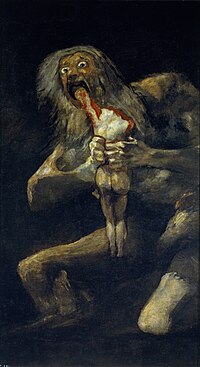
“ Gloomy paintings ” ( Spanish Pinturas negras , the literal translation is “ Black paintings ”; 1819 - 1823 ) - the name of a series of fourteen frescoes by Francisco Goya , written in al secco technique (on the wall, on moistened plaster). They were created for the walls of his house, which he acquired in February 1819 , with the interesting name Deaf House , which was named during the lifetime of the former owner, who was probably deaf. These frescoes were transferred to the canvas since 1874, today they are stored in the Prado Museum in Madrid .
A series of paintings that Goya did not give names was cataloged in 1828 by a friend of the artist Antonio Brugada [1] and includes the following works: Atropos or Fate , Two Old Men or Old man and monk , Two old men eat soup , Duel on clubs , Witches' Sabbath , Reading men , Judith and Holofernes , Festival in San Isidro , Laughing Women , Pilgrimage to the source of San Isidro , Dog , Saturn devouring his son , Doña Leocadius Sorrilla and Fantastic visions or Asmodeus .
In 1823, Goya's house, together with wall paintings, became the property of his grandson Mariano Goya, most likely in this way Goya tried to save his property from possible confiscation after the restoration of the absolute monarchy and repression by Ferdinand VII . For 50 years after its creation, Gloomy paintings were unknown to the general public (with the exception of several experts, as described by Charles Iriarte ) [2] . In 1874, Salvador Martinez Cubells at the request of the French banker Frederic Émile d'Erlanger began the transfer of paintings from plaster to canvas [3] . This process took several years. D'Erlanger intended to sell paintings at the World Exhibition in Paris , but in 1881 he brought them as a gift to the Prado Museum , where they are exhibited in our time.
Content
- 1 "Gloomy pictures" and their history
- 2 Analysis
- 3 notes
- 4 Literature
- 5 Links
Gloomy Pictures and Their History
In February 1819, Goya acquired a manor on the banks of the Manzanares River , not far from the Segovia Bridge overlooking the meadows of San Isidro. He hoped that he could live there with Leocadia Weiss, without attracting attention and avoiding gossip, since she was married to the merchant Isidoro Weiss. Leocadia, probably from a relationship with the artist, had a daughter, Rosarita. Between February and November 1819, before Goya is seriously ill - this is evidenced by the painting of Goya by Dr. Arrieta (1820) - the artist begins to paint the walls of his house. It is well known that Gloomy paintings were painted on top of earlier images, which Goya used as a basis, such as for the Fight on clubs .
If the original paintings in their carefree mood were similar to the works of the Aragonese period, it can be assumed that Goya’s decision to paint over them was affected by bouts of illness, possibly together with the turbulent events of the Liberal three-year period [4] . Bosal inclined to believe that the originally painted paintings belong to the brush of Goya, and he used his materials a second time; however, Glendinning suggests that the paintings "already adorned the walls of Quinta del Sordo when the estate was acquired." [5] In any case, Goya could work on paintings in his villa since 1820. The completion of the work cannot be dated after 1823, since at that time Goya moved to Bordeaux and left the estate to his grandson Mariano, [6] possibly fearing reprisals from the authorities after the fall of Riego . In 1830, Mariano de Goya transfers his property to his father, Javier de Goya.
There was a theory attributing the creation of Gloomy paintings to Javier de Goya (the son of the artist); however, Bosal and Glendinning, the largest scholars of Goya, rejected this theory. It is hard to imagine that such an unusual fact would not be known to contemporaries. The technique of drawing, the quality of the smear, the grotesque depiction of people, the obsessive themes that are also present in previous and subsequent works make the attribution of authorship to Javier de Goya unreasonable.
Antonio Brugada indicated the presence of seven paintings on the ground floor and eight on the second, but subsequently only fourteen got into the Prado Museum. Charles Iriarte , who visited the farm later, also describes the paintings that are currently known and indicates that a large piece was torn from the wall. Many art critics believe, based on the similarity of style and theme, that the fifteenth painting is the Heads in the landscape (New York, Stanley Moss collection). [7]
Another unresolved issue is the original location of the painting. Two old men eat soup , which is unknown whether she hung on the first or second floor. Excluding this detail, the initial placement of the paintings in Quinto del Sordo was as follows: [8]
- Ground floor : It was a large rectangular room. On the long walls there were two windows next to the short walls. Two large paintings hung on them: the San Isidro Festival on the right when viewed from the front door, and the Sabbath of the Witches on the left. On the far short wall, opposite the entrance in the center, there was a large window, to the right of it was Judith and Holofernes and on the left is Saturn devouring his son . Near the door hung Doña Leocadia Sorrilla (opposite Saturn ) and Two old men or Old Man and Monk across from Judith .
- Second floor : The room was the same size as on the first floor, but on the long walls there was one window in the center, each of which surrounded one picture to the right and left. On the right side closer to the entrance was Fantastic Visions or Asmodeus and the Pilgrimage to the source of San Isidro further from the entrance. On the left side were respectively Atropos or fate and Duel on clubs . On the far short side were Laughing Women to the right and reading men left. On the wall closest to the entrance to the right was “ Dog ”, and on the left there was another picture, presumably “ Heads in the landscape ”.
Two old men eating soup probably were above the front door, Glendinning believes that this painting was on the ground floor.
The location and condition of the paintings in Quinto del Sordo are known thanks to photographs taken by renowned photographer Jean Laurent in 1874. The photographs were ordered by one of the owners of the house (Rodolfo Cumont or Baron d'Ehlanger) to preserve for posterity images of these works of art, the existence of which was threatened by active speculation in real estate in the area and therefore art historians Krusada Villiamil and Charles Iriarte feared that Gloomy paintings will disappear in a very short time. [9] Thanks to these photographs, we know that the paintings were framed with plaster molding, like doors, windows and friezes. The walls were pasted over, as was customary in the palaces and houses of the bourgeois at that time, with the wallpaper of the Royal Wallpaper Factory established by Ferdinand VII . Fruits and plants were depicted on the ground floor on the wallpaper, and a geometric ornament on the second floor. In addition, the photographs depict the state of the paintings before being transferred to the canvas, for example, we can see in the photograph that there was a right fragment of the Sabbath of the witches , which has not survived to this day.
Photo of the Sabbath of the Witches (1874) by Jean Laurent . | Sabbath of witches , modern condition. |
Analysis
Beginning in 1820, when Goya turns to the style of the sublime and beautiful , in which the Gloomy paintings are written, the artist’s contemporaries awaken interest in his works. The concept of this artistic direction was developed by Edmund Burke in his work A Philosophical Study of the Origin of Our Ideas of the Exalted and Beautiful (1757) and it spread throughout Europe in the second half of the 18th century. The spread of romanticism led to the fact that the public began to appreciate the originality of the artist in comparison with others, and such art connoisseurs as Felipe de Guevara , wrote that for a modern public taste, moody melancholy works full of "unimaginable fear and tears" are preferable. [5]
Among art historians, the point of view is widespread that Gloomy paintings were created by Goya in a state of psychological and social pressure. One of the most important factors was the artist’s awareness of the decline in physical strength that he could not help but feel, living with Leocadia Weiss, a woman who was much younger than him, and also due to a serious illness in 1819, when he was dying, which was reflected in colors and themes.
On the other hand, Goya painted these paintings in the 1820s (which, however, there is no documentary evidence), and by this time he had already recovered from his illness. A satirical depiction of religious scenes (pilgrimages, processions, inquisition ) or civil unrest (for example, in the Duel on clubs or in the alleged image of a meeting or plot in Reading Men ; there is also a political interpretation of Saturn 's plot: the state devours its subjects) is consistent with political instability in Spain after the military, led by Riego, demanded that the king comply with the constitution of 1812. The period 1820-1823 chronologically coincides with the completion date. Apparently, themes and a palette of paintings became possible in the absence of political censorship during the restoration of the absolute monarchy. On the other hand, many characters of the Gloomy paintings (duelists, monks and nuns, inquisitors) represent the old order that existed before the ideals of the French Revolution .
Notes
- ↑ Several variations of the names of the paintings have been proposed. Early versions belonged to Antonio Brugada and appeared after the death of Goya.
After the death of Goya, Antonio Brugada made an inventory of his works and offered his names for each of the paintings of this cycle, which in some cases were later specified or changed by art critics.
Original text (Spanish)Después de la muerte de Goya, Antonio Brugada había realizado un inventario de estas obras y había propuesto una serie de nombres para cada una de ellas, nombres, que en algunos casos, fueron completados o cambiados posteriormente por la crítica es Prado Museum, online educational publication Mirar un cuadro: The Sabbath of the Witches . - ↑ Charles Yriarte, Goya, sa vie, son oeuvre (1867).
- ↑ Cfr. Valeriano Bozal (2005), dsg. 2, c. 247:
Salvador Martinez Cubels (1842–1914), restorer of the Prado Museum and academician of the Royal Academy of Fine Arts of San Fernando, transferred paintings to the canvas by order of Baron Frederic Émile d'Erlanger, who bought the estate in 1873 (1832-1911). Martinez Cubels did this work with his brothers Enrique and Francisco Valeriano (...)
Original text (Spanish)Salvador Martínez Cubells (1842–1914), restaurador del Museo del Prado y académico de número de la Real Academia de Bellas Artes de San Fernando, trasladó las pinturas a lienzo por encargo del que en aquel momento, 1873, era propietario de la quinta, el barón Fréderic Emile d'Erlanger (1832–1911). Martínez Cubells realizó este trabajo ayudado por sus hermanos Enrique y Francisco (...) Valeriano Bozal, Francisco Goya, vida y obra (2 parts.), Madrid, Tf. Editores, 2005, no. 2, p. 247, ISBN 84-96209-39-3 .] - ↑ Valeriano Bozal (2005), vol. 2, ss 248-249.
- ↑ 1 2 Glendinning (1993), p. 116.
- ↑ Arnaiz (1996), p. 19.
- ↑ Heads in the landscape with comments. Archived on September 23, 2015. (Spanish)
- ↑ Reconstructions can be found on the websites artarchive.com and theartwolf.com
- ↑ María del Carmen Torrecillas Fernández, “Las pinturas de la Quinta del Sordo fotografiadas por J. Laurent,” Boletín del Museo del Prado , Volume XIII, issue 31, 1992, p. 57 onwards.
Literature
- ARNAIZ, José Manuel, Las pinturas negras de Goya , Madrid, Antiqvaria, 1996. ISBN 978-84-86508-45-6
- BENITO OTERINO, Agustín, La luz en la quinta del sordo: estudio de las formas y cotidianidad , Madrid, Universidad Complutense, 2002. Edición digital ISBN 84-669-1890-6
- BOZAL, Valeriano, Francisco Goya, vida y obra , (2 vols.) Madrid, Tf., 2005. ISBN 84-96209-39-3 .
- -, “Pinturas negras” de Goya , Tf. Editores, Madrid, Tf., 1997. ISBN 84-89162-75-1
- GLENDINNING, Nigel, “The Strange Traslation of Goya's Black Paintings”, The Burlingon Magazine , CXVII, 868, 1975.
- -, The Interpretation of Goya's Black Paintings , London, Queen Mary College, 1977.
- -, Goya y sus críticos , Madrid, Taurus, 1982.
- -, “Goya's Country House in Madrid. The Quinta del Sordo, Apollo , CXXIII, 288, 1986.
- -, Francisco de Goya , Madrid, Cuadernos de Historia 16 (col. "El arte y sus creadores", nº 30), 1993. DL 34276-1993
- HAGEN, Rose-Marie y Rainer Hagen, Francisco de Goya , Colonia, Taschen, 2003. ISBN 3-8228-2296-5 .
- YRIARTE, Charles, Goya, sa vie, son oeuvre , París, Henri Plon, 1867; trad. al español por Enrique Canfranc y Lourdes Lachén, Goya , Zaragoza, Departamento de Educación y Cultura, 1997. ISBN 84-7753-644-9 .
Links
- Blanca Flaquer (dir.), Valeriano Bozal (asesor), Las pinturas negras, de Francisco de Goya [vídeo en línea], La mitad invisible , www.rtve.es, January 3, 2011. (Spanish)
- Virtual tour at Quinta del Sordo. (Spanish)
- Las Pinturas negras de Goya en su ubicación original. (Spanish)
- Goya, la razón y la noche. (Spanish)
- Catalog of paintings by Francisco Goya on the website of the University of Zaragoza. (Spanish)
- "Pinturas negras" , poema de Antonio Buero Vallejo. (Spanish)
- Pinturas negras .
- Valeriano Bozal, Pinturas negras , Enciclopedia en línea , Museo del Prado, 2004-2008. (Spanish)