The pink-headed motley pigeon [1] ( lat. Ptilinopus jambu ) is a bird of the pigeon family . Distributed only in Southeast Asia.
| Pink-headed motley pigeon |
 |
| Scientific classification |
|---|
| No rank : | Bilateral symmetrical |
| View: | Pink-headed motley pigeon |
|
| International scientific name |
|---|
Ptilinopus jambu Gmelin , 1789 |
| Security status |
|---|
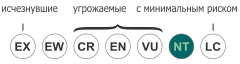
Close to vulnerableIUCN 3.1 Near Threatened : 106002662 |
|
Unlike other motley pigeons, pink-headed motley pigeons are rarely kept in zoos or private estates. The first import of birds into Europe took place already in 1870, however, it has still not been possible to obtain offspring of this species [2] .
Content
The pink-headed motley pigeon reaches a length of 24 cm. [3] Sexual dimorphism is weakly expressed.
The plumage of the upper body is dark green. The outer feathers of the tail have a gray stripe at the end. Characteristic is the color of the face. The head is bright pink, with the exception of the green nape. The throat is black-brown. Chest and belly are white. The middle of the chest may have a pink tint. The undertail is red-brown in color. The beak is yellow. The rainbow is red-brown. The circles around the eyes are bright. In general, the female is a little duller. In young birds, the pink color of the face may be completely absent.
The pink-headed motley pigeon is distributed from the southern tip of Thailand through Malaysia to Borneo and Sumatra up to the west of Java [4] . This is generally not a very common species of pigeons, although locally and seasonally it is common. Prefers primary and secondary forests, as well as mangrove swamps. Migratory view. Birds ringed in Malaysia were then found 800 km away in Sumatra [4] . In winter, they are announced in large numbers on Borneo.
The bird eats only fruits. She collects them both on the litter of the forest, and directly on the branches of trees.
The nest is built on a tree or bush. There is only one egg in the clutch, which both parent birds hatch. The duration of hatching is not known exactly, however, is at least 10 days.
- ↑ Boehme R. L. , Flint V. E. The Bilingual Dictionary of Animal Names. Birds. Latin, Russian, English, German, French / Ed. ed. Acad. V. E. Sokolova . - M .: Rus. lang., "RUSSO", 1994. - S. 106. - 2030 copies. - ISBN 5-200-00643-0 .
- ↑ Rösler, S. 280
- ↑ Gibbs, S. 465
- ↑ 1 2 Gibbs, S. 466
- David Gibbs, Eustace Barnes und John Cox: Pigeons and Doves - A Guide to the Pigeons and Doves of the World . Pica Press, Sussex 2001, ISBN 90-74345-26-3
- Gerhard Rösler: Die Wildtauben der Erde - Freileben, Haltung und Zucht . Verlag M. & H. Schaper, Alfeld-Hannover 1996, ISBN 3-7944-0184-0