Donskoy button [1] ( lat. Benthophilus durrelli ) is a freshwater and brackish-water ray-finned fish from the family of goby perch-like order. A specific Latin name is given in honor of the English naturalist and writer Gerald Darrell .
| Don Button |
 |
| Scientific classification |
|---|
| No rank : | Bilateral symmetrical |
| Subfamily : | Benthophilinae |
|
| International scientific name |
|---|
Benthophilus durrelli
Boldyrev et Bogutskaya , 2004 |
| Area |
|---|

|
| Security status |
|---|
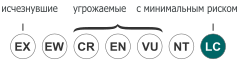
Least ConcernedIUCN 3.1 Least Concern : 135516 |
|
Content
Until 2004, this species was identified with a stellate head , from which the Don is distinguished by a more posterior position of the second dorsal fin relative to the anal fin, 17–21 neuromasts in the lateral line (versus 20–25) and some other signs.
Body length up to 6.6 cm. On each side there are 3 dark spots, the first of them is narrow, semicircular, on the back and second dorsal fin there are many small dark spots. In the lateral line 17-21 neuromasts, usually 18-20. In the second dorsal fin there are 7.5-8.5 segmented rays, its base is not wide, the caudal stem is without granules. Vertebrae 28-29.
Don donut is an endemic of the European part of Russia . The natural range of the species is located in the lower reaches of the Don from the upper Tsimlyansk reservoir to the Taganrog Bay and in its left tributary - Western Manych along with Manych-Gudilo Lake. It prefers fresh water, it is especially abundant in river mouths , found in brackish waters of the gulf with a salinity of up to 3 ‰ , and does not enter the Sea of Azov . After the Volga-Don Canal was built, following the mysid crustaceans, the Don head penetrated the Volga and spread far upstream from the canal to Kineshma and the lower Unzhi , as well as in the lower Kama to the confluence of the Vyatka . Benthic fish lives in areas with a muddy and sandy bottom.
Spawning in May-August. Females lay eggs, probably 2-3 portions, inside or under the mollusk shells. Soon after spawning, producers die. Bentophagus feeds mainly on small mollusks, crustaceans and insect larvae. Life expectancy is about a year.
- ↑ Bogutskaya N.G., Naseka A.M. Catalog of jawless and fish of fresh and brackish waters of Russia with nomenclature and taxonomic comments. - M .: Partnership of scientific publications of KMK, 2004. - S. 216. - 389 p. - 1000 copies. - ISBN 5-87317-177-7 .
- Boldyrev VS, Bogutskaya NG 2004. Description of two new species of tadpole-gobies (Teleostei: Gobiidae: Benthophilus ) // Zoosystematica Rossica. Vol. 13. No. 1, pp. 129-135. Full text
- Boldyrev VS, Bogutskaya NG 2007. Revision of the tadpole-gobie of the genus Benthophilus (Teleostei: Gobiidae). // Ichthyological Exploration of Freshwaters, Vol. 18, No. 1, pp. 31-96. [one]
- Kottelat M., Freyhof J. 2007. Handbook of European freshwater fishes. Publications Kottelat, Cornol, Switzerland. 646 p.