Alexander Arkadyevich Galich (real name Ginsburg ; October 19, 1918 , Yekaterinoslav - December 15, 1977 , Paris ) - Russian poet , screenwriter , playwright , novelist, author and performer of his own songs. Member of the People’s Labor Union of Russian Solidarians (NTS). "Galich" - a literary pseudonym, composed of the letters of his own surname (" G "), name (" Al ") and middle name (" ich ").
| Alexander Arkadyevich Galich | |
|---|---|
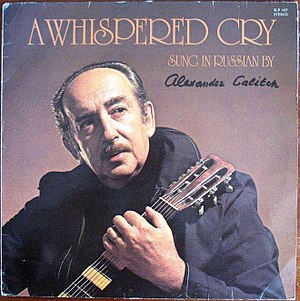 A. Galich on the front cover of the plate A Whispered Cry . Norway , Oslo , 1975 | |
| Birth name | Alexander Ginzburg |
| Aliases | Galich |
| Date of Birth | October 19, 1918 |
| Place of Birth | Yekaterinoslav , UNR |
| Date of death | December 15, 1977 (59 years) |
| Place of death | Paris |
| Citizenship |  the USSR the USSR |
| Occupation | poet , screenwriter , playwright , singer , songwriter , composer , guitarist , songwriter |
| Genre | author's song , play , song, poem |
| Language of Works | Russian |
| Awards | Diploma of the KGB of the USSR (1964) [1] |
Content
Biography
Alexander Ginzburg was born on October 19, 1918 in Yekaterinoslav (now the Dnieper ) into a Jewish family. The father, Aron Samoilovich Ginsburg (1894–?), Was an economist; her mother, Feiga (Fanny, Faina) Borisovna Veksler (1896–?), worked as an administrator at the conservatory [2] . Grandfather was a pediatrician ; Uncle - literary critic Lev Samoilovich Ginzburg (1879-1933) [3] [4] . The family lived in the house number 74 on Cossack Street, erected in 1911 by the forces of the residents themselves (Ekaterinoslav house-building society, the first housing cooperative in the city). The younger brother is the cameraman Valery Ginzburg .
In 1920, the Galich family moved to Sevastopol , and in 1923 - to Moscow , where they settled in the house of Dmitry Venevitinov in Krivokolenny Lane . In this house, once Alexander Pushkin first read his tragedy " Boris Godunov ." In Moscow, Galich graduated from school 24 BONO (now number 1227 ).
The first publication is the poem “Peace in the Shout” ( Pioneers Truth - May 23, 1932; signed by Alexander Ginzburg).
After the ninth grade, Galich almost simultaneously entered the Literary Institute and the Stanislavsky Opera and Drama Studio , which became the last course of Stanislavsky, which he did not have time to release. The Literary Institute soon abandoned, and after three years left the Opera and Drama Studio. He moved to the Studio Theater Alexei Arbuzov and Valentin Pluchek (1939). In February 1940, the studio debuted with the play "City at the Dawn" with collective authorship. One of the authors of the play was Galich. It was his debut in drama. For this play and performance, he also wrote songs. In the play, he played the role of the Komsomol of the Borschagovsky construction site.
When the war began , Galic was drafted into the army. But the medical commission found that he had a congenital heart disease and was released from service. Galich got a job in the exploration party and went south. In the south, in the city of Grozny, he got into the local drama theater, in which he worked until December 1941. From here Galich went to Tashkent , where Arbuzov began to form a theatrical group of his former students.
Family
- Uncle (mother's brother) - Mark Borisovich Weksler (1903-1980), from 1932 he was the director of the Great Hall of the Moscow Conservatory [5] . His son is a journalist Igor Markovich Veksler, an honored cultural worker of the Russian Federation [6] .
- A cousin is Alexander Osipovich Ginzburg (1917–1973), theater director, People’s Artist of the Uzbek SSR (his son is a television director Yevgeny Ginzburg ).
Personal Life
In Tashkent, Galich meets with actress Valentina Dmitrievna Arkhangelskaya (08/20/1919 - 12/28/1999), younger sister of composer and conductor Rostislav Dmitrievich Arkhangelsky (1918–2006) [7] , whose marriage was registered in 1942, after returning to Moscow .
May 21, 1943 they had a daughter, Alexandra (Alyona). Grandson - theater and film actor Pavel Pavlovich Galich (born October 20, 1983).
In 1945, Valentina Arkhangelskaya received the position of the leading actress in the Irkutsk Dramatic Theater and left Moscow. This eventually leads them to divorce.
In 1947, Galich marries Angelina Nikolaevna Shekrot (Prokhorova).
On September 3, 1967, his son Grigory was born out of wedlock, who received the surname of his mother Mikhnov-Voitenko (Sofya Mikhnova-Voitenko, 1934-1972, costume designer at the Gorky film studio , and was previously married to non-conformist artist Yevgeny Mikhnov-Voitenko ) [8] .
Dramaturgy
In the early period of his work, Galich wrote several plays for the theater:
- 1946 - “ Boys Street ”,
- 1946-1947 - " Marching march " (or " An hour before dawn "),
- 1947-1948 - “ Taimyr Causes You ” (in collaboration with KF Isaev ; the film was shot in 1970),
- 1954 - "The Paths We Choose " (or " Under the lucky star "),
- 1958 - “ The steamer name is Orlyonok ”,
- 1959 - “ How much does a person need ?”
and movie scripts:
- 1954 - “ True Friends ” (together with K. F. Isaev ),
- 1962 - " At the seven winds ",
- 1964 - “ Give me a complaint book ”,
- 1964 - " State criminal ",
- 1965 - The Third Youth ,
- 1967 - " Running on the waves ."
The play " Sailor's Silence ", written in 1958 for the Sovremennik Theater , which was opened at that time, was first staged only in 1988, after the death of the author, O. Tabakov .
Poems and Songs
In the late 1950s, Galich began composing songs, performing them to his own accompaniment on a seven-stringed guitar . Starting from Alexander Vertinsky's romance tradition and art, Galich became one of the brightest representatives of the Russian author's song genre (along with Vladimir Vysotsky and Bulat Okudzhava ), which the bards soon developed, and which became very popular with the advent of tape recorders . In this genre, Galich has formed a special direction.
Galich did not include his early songs of the 1940-1950s in the compilations.
The first songs - “Helen” (1962), “About painters, stoker and the theory of relativity” and “Law of nature” (both 1962) - being relatively politically innocuous, did not coincide with the official Soviet aesthetics. Thus began a turning point in the work of a prosperous Soviet writer. He was also helped by the story of the failed premiere of the Galich play “The Sailor’s Silence” written for the contemporary theater created. An already rehearsed play was banned from showing, stating to the author that he distortedly represents the role of the Jews in the Great Patriotic War . Galich later described this episode in the autobiographical novel “Dress Rehearsal” (completed in 1973).
Conflict with the Soviet authorities
| Galich was actually the only writer who for a long time was at the top of the Soviet writers nomenclature, but found the courage to give up a safe life and choose freedom [9] . |
Later on, his songs became more and more deep and politically sharp, which led to a conflict with the authorities. Galich was forbidden to give public concerts. It was not printed and was not allowed to release the record. In fact, it was a ban on any professional activity and work.
He performed with his songs in apartments, at the so-called "home concerts" , collecting him very small earnings. His songs were distributed and transmitted to each other in tape recordings, thanks to which he became more and more popular, and which were seized by KGB officers during searches.
Once Valentin Nikolaevich Pluchek decided to invite Galich, as his former student in the studio, to perform songs for the actors of the Theater of Satire , which he then headed, on the occasion of a celebration on a skit , where the audience was not allowed at all. Galich happily agreed. A self-made announcement was posted in the interior of the theater, where outsiders, including the audience, were not allowed. But even this purely internal concert was categorically banned by the authorities. Bucheku was called from the Ministry of Culture and demanded to cancel the speech of Galich.
March 8, 1968 in the Akademgorodok of Novosibirsk, a festival of art song, held by the Under the Integral Club, was held. At this festival, Alexander Galich held the only public concert in the USSR, where he also performed his song “ In Memory of B. L. Pasternak ” [10] [11] [12] . On April 18, an article appeared in the newspaper " Evening Novosibirsk ", in which Galic was accused of all sins. Threats, a ban on singing their songs, fell on him; then the repression began.
In 1969, his first book “Songs” was published in the “anti-Soviet” foreign publishing house “ Posev ” . This was the reason for his subsequent expulsion from the Union of Writers of the USSR (December 29, 1971), the Union of Cinematographers of the USSR, and even from the Literary Fund (1972). The play " Sailor's Silence " (1957) is prohibited, persecution in print is open, publications in the official press are discontinued.
Corresponding Member of the dissident Committee of Human Rights in the USSR (1970-1973). Member of the petition campaigns.
In 1973 [13] he was baptized in the Orthodox Church by Father Alexander Menem [14] . The godfather of Galich became the composer Nikolai Karetnikov .
Exile and death
On January 14, 1972, Galich was expelled from the Union of Writers of the USSR , of which he had been a member since 1955 (the song “ From my trifling misfortune ... ” is devoted to this event). In the same year he was expelled from the Union of Cinematographers , in which he has been a member since 1958 . In 1972 , after the third heart attack , Galich received a second disability group and a pension - 54 (according to other data, 60) rubles per month.
June 25, 1974 Galich was forced to emigrate from the USSR . In the details of emigration sources diverge. According to one version, he nominally left for Norway to participate in the workshop on the works of K. S. Stanislavsky , but immediately after crossing the border he was deprived of Soviet citizenship . According to another - he emigrated according to the so-called. " Israeli visa".
On October 22, 1974, by a resolution of Glavlit in agreement with the Central Committee of the CPSU, all his previously published works were banned in the USSR .
Norway became its first refuge abroad, then he moved to Munich , where he worked for a while on the American radio station Liberty , became a member of the NTS [15] . Then Galich settled down and lived in Paris .
December 15, 1977 , at about 14:00, according to the official version - as a result of an accident, in the 60th year of life A. Galich tragically died from an electric shock when the antenna was connected to a TV .
There is also a version that this was a carefully planned and prearranged murder [16] . Meanwhile, the Parisian acquaintances of Galich ( Vladimir Maksimov , Vasily Betaki ) stated that the accident was the cause of his death:
| I, Vasily Betaki, came with V. Maximov, the editor of Continent magazine, to Galich’s apartment 20 minutes after his death. There were firemen and a doctor in the apartment. The doctor showed me and V. Maximov the black stripes on the hands of the antenna (two-legged), which Galich began to correct by first sticking its plug into the socket under voltage, but he did not notice the desired socket and, in order to plug the antenna, he squeezed the contacts of the plug with such pliers I stuck the plug in the nest that was forbidden to her. This was the conclusion of the emergency doctor. All other statements about the cause of the death of A. A. Galich, in my opinion, are conjectures. |
Mikhail Shemyakin [17] gives a slightly different version:
| Of course, no KGB, no one hunted him. Just illiteracy, because he bought the equipment, we wanted to make a record with him. But he decided to do the master tape himself at home. The wife went to the store, he began to tinker with the equipment, not understanding what to include. You know, in Russian: include here. And, in general, made it so that he closed somewhere this equipment, and when he touched it - everything, he was killed by a current. He was beaten and he could not ... And when his wife came running from the store, she saw that he was already beating in convulsions, but already the blood, apparently, decomposed into components, and Sasha died. |
Angelina Nikolaevna said: “Sasha has long dreamed of some kind of unusual Grundig stereo system. When they brought her to us, the workers said that an expert should connect it tomorrow. I went to the store, and Sasha began to connect something, took up the radiator, was electrocuted, and when I returned, he lay unconscious, but alive. I rushed to call, but the whole matter was decided by the minutes, and while the doctors were driving, Sasha died in my arms ” [18] .
After a week-long investigation, the French police closed the case on the death of Alexander Galich for 50 years - until December 15, 2027.
The next day after the death of the poet, two Moscow theaters — on Taganka and Sovremennik — held intermissions in intermissions for his memory. After the performance, a memorial evening was held at the Theater of Satire ; Galich's poems were read by Alexander Shirvindt [8] .
Alexander Arkadyevich Galich was buried on December 22, 1977, not far from Paris, in the Russian cemetery of Sainte-Genevieve-des-Bois ( Fr. cimetière communal de Sainte-Geneviève-des-Bois ). Year of birth of the poet on the plate is wrong - 1919th [8] . The inscription on the tombstone is a quotation from the Gospel of Matthew: "Blessed are you to expel the truth for the sake of . "
On May 12, 1988, at the request of the poet’s daughter, Alena Arkhangelskaya, Alexander Galich was reinstated in the USSR Union of Cinematographers , and on May 15, 1988, in the USSR Writers' Union [19] . In the summer of 1993, Russian citizenship was returned to Alexander Galich [19] .
On October 17, 1998 , on the eve of the 80th anniversary, M. Menem installed a memorial plaque on the house number 4 on Chernyakhovsky Street in Moscow and opened it: “In this house from 1956 he lived until his exile in 1974 a Russian poet and playwright Alexander Galich . Blessed is the exile of truth for the sake of
Bibliography
- Books
- Ginzburg A. Boys and girls. Poems. - M., 1942 (autumn)
- The collection is reproduced by typewriting (RGALI, 2590, 1, 445) in the book: The World of Vysotsky. Issue 4. - M .: GKTSM BC Vysotsky, 2000. - p. 450-466
- Galich A. Scenarios, plays, songs. - M .: Art, 1967. Preface I. Grekova (the collection has not been published.)
- Galich A. "Songs". - Frankfurt am Main : Sowing , 1969. - 132 p. ; dust jacket
- Galich A. "Poems of Russia". - Paris, 1971
- Galich A. "Generation of the Doomed." - Frankfurt am Main: Sowing, 1972, 1974
- Galich A. "General Rehearsal". Autobiographical book of memories. - Frankfurt: Seeding, 1974. (with the parallel text of the play " Sailor's Silence" )
- Galich A. "When I return." - Frankfurt am Main: Sowing, 1975, 1977
- In the collections " Songs of Russian Bards " . texts. Series 1-4. - Paris, YMCA-Press , 1977–78; 40 audio cassettes of songs (115 songs by A. Galich)
- A. A. Galich “When I Return”: The Complete Collection of Poems and Songs. - Seeding, 1981.
- Galich A. "When I return ...". Poems and excerpt from an autobiographical story. - Frunze: Ala-Too, 1989. - 106 p. - ISBN 5-660-00163-7 .
- Galich A. “Return” / Compiled by I. Vinokurova. - M .: All-Union Creative Production Association "Cinema Center", 1989. - 320 p.
- Galich A. "Selected Poems". - M .: Press Agency News, 1989. - 240 p.
- Galich A. "Petersburg Romance" / Compiled by the author of the preface A. Shatalov . - L .: Fiction, 1989.
- Galich A. “The Return”: Poems, Songs, Memories / Compiled by G. Solovyov, author of the preface A. Shatalov. - L .: Music, 1990. - 320 p. - ISBN 5-7140-0404-3 .
- Galich A. Poems and Songs / Compiler, author of the preface A. Velikorechin. - M .: Art, 1990. - 158 p. - ISBN 5-210-00398-1 .
- Galich A. "At the microphone, Alexander Galich ...". Selected texts and notes / Editor Julian Panic . - Ann Arbor. USA: Hermitage, 1990. - p. 178. - ISBN 1557790345 , ISBN 9781557790347 .
- Galich A. 87 poems and songs. - Krasnoyarsk: Krasnoyarsk University Press, 1990, - 208 p.
- Galich A. "I choose Freedom." Speeches on Radio Liberty. / Compiler, author of the preface A. Shatalov . - M .: Verb, 1991. - 255 p.
- Galich A. “I choose Freedom” (verse 41). - IPP Kostroma, 1991, 256 p. (Verb magazine N ° 3)
- Galich A. "I believed in a miracle" (129 verses) / Comp. Leonid Vilensky. - M., 1991, - 243 p., 24 000 copies.
- Galich A. “General Rehearsal” / Compiled by A. Shatalov , foreword by A. Zverev. - M .: Soviet writer, 1991. - 560 p. - ISBN 5-265-02168-X .
- Galich A. “Pain”. - Alma-Ata: Verbol MP, 1991. - 186 p.
- Galich A. “Clouds”, “We are not worse than Horace”, “Immortal Kuzmin”, “In the image and likeness”, “Song without a name”, “Queen of the mainland”, “I choose Freedom”, “Kitezh” - In the book: There is a tape system "Yauza" ...: Sat. songs magnitizddat / Comp. Al Uklein. - Kaluga, 1991, photo
- “The spell of Good and Evil”: A. Galich - articles and memoirs of friends and contemporaries, as well as stories and poems, which he composed himself, tell about his work, life and destiny. / Compiler, author of the preface N. G. Kreitner. - M .: Progress, 1991, - 576 p. - ISBN 5-01-003474-3
- Galich A. “Clouds float to Abakan” (39 verses). - SPb .: Publishing house "Penaty", 1996, - 288 p., With / region. (series “Russian bards”)
- Galich A. "Here I stand before you, as if naked ...". Songs and poems (51 lyrics). - SPb .: Publishing house "Penaty", 1997, 288 p., With / region. (series “Russian bards”)
- Galich A. Songs. Poems. Poems Kinopovest Play. Articles. - Ekaterinburg: U-Factory, 1998. - 656 p. - ISBN 5-89178-073-9 .
- Galich A. "True friends." - Yekaterinburg: U-Factory, 1998.
- Galich A. 49 poems. - M .: SLOVO, 1998, 96 p. (series “My most poems”)
- Galich A. "When I return." Poems and songs. - Nizhny Novgorod, 1998, 267 p.
- A. Galich. Works in 2 tonnes. - M .: ZAO Lokid, 1999 (series “ Voices. Century XX ”):
- Volume 1. 205 poems and poems. Compiled by A. Petrakov. - 528 s.
- Volume 2. Film scripts. Plays Prose. - 512 s.
- Galich A. “The wind returns in the evening”. - M .: Eksmo, 2003. - 610 p. - ISBN 5-699-03971-6 , ISBN 5-699-04102-8 .
- Galich A. "Sailor's silence." - M .: Eksmo, 2005. - 640 p. - ISBN 5-699-11862-4 .
- Galich A. Anthology of satire and humor of Russia of the XX century. Volume 25. - M .: Eksmo, 2005. - 576 p. ISBN 5-699-03456-0
- Galich A. Poems and poems. - 2006. - 384 s. - ISBN 5-7331-0305-1 .
- Galich A. “Clouds” / Compiler, author of the preface N. G. Kreitner. - SPb. : ABC, 2008. - 208 p. - (“Russian poetry”). - ISBN 978-5-91181-676-6 .
- Galich A. “When I Return” / Compilation, preparation of text, biographical chronicle and comments by P. V. Matveyev. - SPb. : Vita Nova, 2016. - 592 p. - (Manuscripts). - 800 copies - ISBN 978-5-93898-581-0 .
- Plays
- City at the dawn (1939−40). Together with A. N. Arbuzov and the Studio Theater collective. // Journal Theater, 1957, No. 11. (Songs were also written for the play and the performance on it).
- Duel (1939 - Spring 1941). Together with Isay Kuznetsov, Vs. Bagritsky.
- Dawn (1945−46; sketch ). Under the pseudonym " A.Gay ".
- Sailor's Silence (1945−56, 1974)
- Boys Street (1946). Together with I. Kuznetsov. Songs were also composed for the play.
- March march, or an hour before dawn (1946−47). // Theater journal, 1957, No. 3. (Songs were also composed for the play).
- Taimyr is calling you (1947). Together with K. F. Isaev . // Magazine Ogonyok, 1948, No. 22
- Moscow does not believe in tears, or the Regulation obliges (1949−50). Together with G. N. Moonblit
- The ways that we choose (1953−54). Dr. name - "Under the happy star."
- August (1956)
- The steamer is called "Orlyonok" . // magazine "Modern drama", 1958, № 6
- Does a person need a lot? (up to 13.7.1959)
- Weekdays and holidays (1967). Together with I. Grekova (E. Wentzel), in her story "Beyond the Pass" .
Screenplays
- 1951 - In the steppe (short) . Together with Peter Pavlenko , in his story “The Steppe Sun ”.
- 1953−54 - On a raft. Together with K. F. Isaev . Dr. title - " True friends . "
- 1955 - Stubborn dough (cartoon) (with A. Zubov)
- 1956 - The heart beats again ...
- 1956 - Peter Ilyich Tchaikovsky
- 1958 - The Boy from Naples (cartoon; after the fairy tale by Gianni Rodari )
- 1958 - Steamer name is "Eaglet"
- 1959, 1965−66 - " Third youth " (Petipa). Together with the French playwright Paul Andreott.
- 1960 - Three Risen
- 1962 - On the seven winds
- 1962 - Flying Proletarian (cartoon)
- 1964 - State criminal
- 1964 - Good city . Songs were also written for the film.
- 1964−65 - Give a complaint book . Together with B. Laskin.
- 1965 - Third Youth
- 1967 - Running through the waves . According to the novel by A. Green .
- 1968 - The Little Mermaid (cartoon; after the fairy tale by Hans Christian Andersen )
- 08.21.1968; 1969 - until the summer of 1971 - Fyodor Shalyapin. Together with M. Donskoy; not finished
- 1970 - Taimyr calls you (together with KF Isaev). Lyrics were also written for the film.
- 1971 , before the summer - 7.2.1972 - The very last shot
- 1971, until the summer - February 1972 - Various wonders (musical). Dr. title - " I can do wonders ."
- 1976 - When I return (documentary, dir. Goldin, Rafail Yulievich . Norway). Dr. name - " refugees of the XX century ".
- 1982 - The Adventures of the Magic Globe, or the Witch's Trick (cartoon)
- 2004 - Pope (a death film based on the play " Sailor's Silence ")
- Interviews, open letters
- 7.2.1972. To the editorial office of the newspaper " Literary Russia ". An open letter to Moscow writers and filmmakers.
- 3.2.1974; M. Extreme danger. To the International Human Rights Committee.
- 06/23/1974. Interview.
- June 1974, Frankfurt. Song, life, struggle . Interview magazine "Sowing".
- February 1975. We consider it ours . Appeal in defense of M. Mikhailov (A. Galich and others)
- 4.7.1976. A little bit about political voyage (A. Galich and others)
- 8/7/1976. Another writer's fate (A. Galich and others)
- July 1976. In memory of a friend (A. Galich and others)
- 03/17/1977. From " Continent" (A. Galich and others)
- 27.4.1977. Freedom to Anton Peipe! (A.Galich, V.Maksimov)
- after 11/19/1977. Culture and the struggle for human rights . Interview with a journalist of the newspaper " Russian Thought ".
- Other
- Children's poems (1926)
- Songs for the play “The Guy from Our City” (Autumn – Winter 1941)
- Plays (1942−45)
- 3 fairy tales; songs, poems, sketches, interludes (1943)
- Dramatic etude "The Partisans are coming " (M. Green, A. Ginzburg; 13–14.9.1943)
- Sketch “ Kings in the wagon train ” (M. Green, A. Ginzburg; 13–14.9.1943)
- Hitleriad (1943; comedy sketch signed by A.Ginzburg )
- On the cruelty and kindness of art (1967; an article for the newspaper " Soviet Culture ")
- The cycle of medical ditties
- Songs " Easy Life "
- The song "Along the road" from the movie "Old Old Tale" (1968), performer - Oleg Dal
- “ History in 4 acts and 5 chapters”
- 157 performances on Radio Liberty (September 6, 1974 - 10/17/1977)
- Publications in the Russian Thought newspaper (1974–77)
- Publicism (1976)
- Flea market . Almost fantastic, but not a scientific novel (1976−77; I part)
- Once again about the devil (1976−77; the beginning of the novel)
Filmography
Discography
- "A Whispered Cry." Sung in Russian by Alexander Galitch. ("Creek whisper"). Recorded in 1974 at The Arne Bendiksen Studios, Oslo, Norway
- " Unpublished songs of Russian bards ". Produced by Hed-arzi ltd., Israel (1975). 2 songs by A. Galich are included.
- “Galich in Israel” (“Galich in Israel”). Recorded at GALTON Studios, production of Gal-Ron (Israel), Stereo 5838, November 1975. The web often mentions the title “Russian Songs of the Holocaust” in connection with this disc, but there’s nothing like that on the disc itself.
- "Alexander Galich - Cheerful Talk" (Live Concert version, 1975). “A Merry Talk” (direct recording from the Frederick Mann AUDITORIUM hall in Tel Aviv, December 1975). Record - "GALTON" Studios, production of Gal-Ron (Israel), Stereo 5846, 1975.
- "Alexander Galich - The laughter of the tears of tears" ("Laughter through tears"). Fortuna, Made in USA (1981-?)
- Alexander Galich “ When I return ” (1989, the company Melody - M60 48605 001)
- Alexander Galich (1989, the company "Melody" - M60 48609 000, 2xLp) [20]
- Alexander Galich " Night Watch " (1990, the company "Melody" - C60 29897 001)
- Memory (Firm Melody, CD, 1994) [21]
- Novosibirsk 1968 (SoLyd Records, CD, 1994) [21]
- Sand of Israel (Private Edition, 1995) [21]
- Internal emigration (Russian disk, 1995) [21]
- Talk with the muse. On the rivers of Babylon (Aprelevka Sound Production, CD, 1996) [21]
- Talk with the muse. Female Songs (Aprelevka Sound Production, CD, 1996) [21]
- Talk with the muse. Poem about Stalin (Aprelevka Sound Production, CD, 1996) [21]
- Talk with the muse. Clouds float to Abakan (Aprelevka Sound Production, CD, 1996) [21]
- Talk with the muse. Literary Bridges (Aprelevka Sound Production, CD, 1996) [21]
- Talk with the muse. A conversation with the muse (Aprelevka Sound Production, CD, 1996)
- Talk with the muse. Waltz of His Majesty (Aprelevka Sound Production, CD, 1996)
- Talk with the muse. Russian laments (Aprelevka Sound Production, 1996) [21]
- Talk with the muse. Song of Exodus (Aprelevka Sound Production, 1996) [21]
- Talk with the muse. Father House Song (Aprelevka Sound Production) [21]
- Concerts for friends (Concerts for friends. Release 1) (Compact Disk Ltd., CD, 1996) [21]
- In the image and likeness (Concerts for friends. Release 2) (Compact Disk Ltd., CD, 1996)
- It was bad for me (Concerts for friends. Release 3) (Compact Disk Ltd., CD, 1996)
- Literary Bridges (Complete Collection of Songs. Disc 1) (SoLyd Records, 1996)
- The Sand of Israel (Complete Songs. Disc 2) (SoLyd Records, 1996)
- Night Watch (Complete Collection of Songs. Disc 3) (SoLyd Records, 1996) [21]
- A whisper of cries (Complete Songs: Disc 5) (SoLyd Records, 1996) [21]
- Christmas fantasy (Muzprom, 2001)
- Queen of the Mainland (Muzprom, 2001)
- Kolomiytsev in full growth (Muzprom, 2001)
- Farewell to the guitar (Muzprom, 2001)
- Merit Walker (Muzprom, 2001)
- Traveling pastoral (Muzprom, 2001)
- Requiem for the Unkilled (Muzprom, 2001)
- I choose freedom (Muzprom, 2001)
- Hospital gypsy. 1 (Artel "East Wind", CD-R, 2002)
- And I went to the White pillars. 2 (Artel "East Wind", CD-R, 2002)
- Princess from the Lower Maslovka. 3 (Artel "East Wind", CD-R, 2002)
- Fantasies on Russian themes. 4 (Artel "East Wind", CD-R, 2002)
- Behind the seven fences. 5 (Artel "East Wind", CD-R, 2002)
- Sleep, Semyon, sleep ... 6 (Artel "East Wind", CD-R, 2002)
- A raven arrives at night ... 7 (Artel East Wind, CD-R, 2002)
- Draft epitaph. 8 (Artel "East Wind", CD-R, 2002)
- Train leaves from Warsaw. 9 (Artel "East Wind", CD-R, 2002)
- On the rivers of Babylon (1974) (All Alexander Galich. Disk 1) (Moroz Records, 2003)
- Princess from the Lower Maslovka (1974) (All Alexander Galich. Disk 2) (Moroz Records, 2003)
- Songs about Alexandras (1974) (All Alexander Galich. Disc 3) (Moroz Records, 2003)
- Russian Crying (1974) (All Alexander Galich. Disk 4) (Moroz Records, 2003)
- Poem about Stalin (1974) (All Alexander Galich. Disk 5) (Moroz Records, 2003)
- Queen of the Mainland (1974) (All Alexander Galich. Disc 6) (Moroz Records, 2003)
- Draft epitaph (1974) (All Alexander Galich. Disk 7) (Moroz Records, 2003)
- “At the Microphone Galich ...” (1974) (All Alexander Galich. Disk 8) (Moroz Records, 2003)
- “At the Microphone Galich ...” (1975) (All Alexander Galich. Disk 9) (Moroz Records, 2003)
- “At the Microphone Galich ...” (1976-1977) (All Alexander Galich. Disk 10) (Moroz Records, 2003)
- Songs and poems of different years (1962–1966) (All Alexander Galich. Disk 11) (Moroz Records, 2003)
- Songs and poems of different years (1967-1970) (All Alexander Galich. Disk 12) (Moroz Records, 2003)
- Songs and poems of different years (1971-1975) (All Alexander Galich. Disk 13) (Moroz Records, 2003)
- Variants and drafts (1961–1968) (All Alexander Galich. Disk 14) (Moroz Records, 2003)
- Variants and sketches (1969–1973) (All Alexander Galich. Disk 15) (Moroz Records, 2003)
- Concert at the request of radio listeners (1973) (All Alexander Galich. Disk 16) (Moroz Records, 2003)
Facts
- In October 1964, for the screenplay of the film The State Criminal , A. Galich was awarded a diploma of the KGB of the USSR.
- In Galich's song “ Red Triangle ”, the character “Comrade Paramonova” acts. In film circles, it was believed that this name was derived Galic is not accidental. Among his acquaintances were “Comrade Paramonova” - Kira Konstantinovna Paramonova (June 4, 1916 - October 19, 2005), the editor of the State Committee for Cinematography and a teacher of the scriptwriting department of VGIK. Once she had to urgently take the place of the chairman of the jury of the children's film competition at the Moscow Film Festival - for some reason the cinematographer from the country of the socialist camp refused from this post. Such a post had to “deserve”. According to rumors, Paramonova actively opposed the scripts of Galich [22] .
Here is what Renata Litvinova, who studied with her, told about Kira Konstantinovna: “Beauty. Blonde. Film Week Even Galich sang some songs about her ” [23] . - Galich's younger brother Valery Ginzburg became a famous cameraman. Among the films he shot were Soldier Ivan Brovkin , When the Trees were Big , Such a Guy Lives , Commissioner [24] .
- The Ginzburg apartment in Moscow , Krivokolenny Lane , in 1926 held a closed meeting of the Pushkin Commission of the Society of Amateur Russian Literature at Moscow University , dedicated to the centenary anniversary of Pushkin ’s reading of Boris Godunov at the Venevitinovs. See House of Venevitinov .
Literature
- Meisak Nikolay . A song is a weapon. Listening to the recordings of the "bards" speeches // the newspaper "Vecherny Novosibirsk" of 18.4.1968
- Rassadin Art. "I choose freedom." - M .: Knowledge, 1990, 56 p. - (New in life, science, technology. Series "Art"; № 8) ISBN 5-07-001378-5
- Krylov A. Galich - "co-author". - M .: Charitable Foundation of Vladimir Vysotsky, 2001, 124 p. ISBN 5-93038-005-8
- Galich: Problems of poetics and textual. Issue 1. Comp. A. Krylov. - M .: GKTSM V. S. Vysotsky, 2001, 232 p. (Appendix to the V issue of the World of Vysotsky almanac). ISBN 5-93038-006-6
- Krylov A. “The land is not watered with kvass ...”: Notes to the “human tragedy” of Alexander Galich. 2nd ed., Rev. and add. - Uglich: Industrial Design K, 2003, 92 p.
- Galich: New articles and materials. Issue 2. Comp. A. Krylov. - M .: YuPAPS, 2003, 288 p. ISBN 5-89467-016-0
- Galich: New articles and materials. Issue 3. Comp. A. Krylov. - M .: Bulat, 2009, 368 p. ISBN 978-5-91457-005-4
- Korman Ya. I. Vysotsky and Galich. - M., Izhevsk: SIC “Regular and chaotic dynamics”, 2007. - 396 p.
- Aronov M. Alexander Galich. - M. — Izhevsk: SEC “Regular and chaotic dynamics”, Institute of Computer Science; 2010. - 1035 p., 50 copies.
- Aronov M. Alexander Galich. Full biography. / 2nd ed., Corr. and add. - M .: New Literary Review, 2012. - 904 p., Il .; 2000 copies
Sources
- Kazak V. Lexicon of Russian literature of the XX century = Lexikon der russischen Literatur ab 1917 / [trans. with him.]. - M .: RIK "Culture", 1996. - XVIII, 491, [1] p. - 5000 copies - ISBN 5-8334-0019-8 .
Notes
- ↑ Mikhail Aronov. Alexander Galich. Full biography . - M .: New Literary Review, 2015. - ISBN 978-5-4448-0369-1 ].
- ↑ Ekaterinoslav Chronicles : “Help. Aaron Ginzburg and his wife Feiga on October 20/7, 1918, had a son named Alexander. ”
- ↑ N. Bogomolov. From Pushkin to Kibirov. Archived copy of May 24, 2013 on Wayback Machine
- ↑ Krivokolenny, 4 C1. House Venevitinovyh
- ↑ 105 years since the birth of Mark Wexler
- ↑ Mikhail Aronov “Alexander Galich. Full biography
- ↑ Valentina Arkhangelskaya - biography - Soviet actresses - Kino-Theater. RU
- ↑ 1 2 3 Alexander Arkadyevich GALICH
- ↑ Jacob Korman. Galich and Vysotsky
- ↑ VALENTIN GLAZAN MEMORIES OF THE FIRST FESTIVAL OF THE SELF-SONG IN THE NOVOSIBIRSK ACADEMGORODOK
- ↑ Read "Sociological Romance" - Sailor Larisa - Page 82 - Litmir.net
- ↑ Alexander Galich performs the song “ In Memory of B. L. Pasternak ” in the Academgorodok of Novosibirsk (the film “Forbidden Songs”).
- ↑ Abelskaya R. Sh. He understood the truth as a ministry (A. Galich about the poet’s mission) // News of the Ural State University. Ser. 1, Problems of education, science and culture. - 2009. - № 4 (68). - p. 175-182.
- ↑ Gospel as a power. In memory of Alexander Galich. Archive dated May 18, 2013 on Wayback Machine
- ↑ Biography
- ↑ Aronov Michael. Alexander Galich. Full biography. - 2nd ed., Corr. and add. - M .: New Literary Review , 2012. - 880 p. - (Criticism and essay). - 2000 copies - ISBN 978-5-86793-931-1 .
- ↑ Ether with M. Shemyakin on Finam-FM 4.09.2012
- ↑ Vasily Katanyan - Touching idols - page 93
- ↑ 1 2 Alena Arkhangelskaya-Galich . I remember everyone who turned away from dad
- ↑ Disks of the company "Melody" "
- ↑ 1 2 3 4 5 6 7 8 9 10 11 12 13 14 15 Megaencyclopedia "Cyril and Methodius" " Archival copy of February 20, 2013 on the Wayback Machine
- ↑ See the biography of K. K. Paramonova: “ Who is who in Russian media education ”.
- ↑ (See Seance Magazine Archival copy of September 22, 2009 on Wayback Machine and Cinefant Club )
- ↑ In the Globa Park, Galich lost his house (“Komsomolskaya Pravda”, 2006, October 27. - p. 19, 22.
Links
- "Unfasten your belts forever." A documentary film on the 100th anniversary of Alexander Galich on the website of the First Channel
- A.Galich's page on the site “ Laboratory of Science Fiction ”
- Russian service BBC. A. Kan. 100 years since the birth of Alexander Galich. Truths and myths about the poet
- "We felt a KGB eye on us." How Alexander Galich was poisoned before exile from the USSR
- Alena Galich, Andrei Kolobaev. "Denunciations to the KGB on Galich wrote a friend of his youth, People's Artist of the USSR."
- Galich, Alexander Arkadyevich in the library of Maxim Moshkov
- Alexander Galich on the portal bards.ru
- Alexander Galich on the site www.peoples.ru
- Alexander Galich on the site of ironic and humorous poetry
- Memories of Vasily Betak
- Alexander Galich. Biography, creativity, photo-video
- Site dedicated to the work of Alexander Galich
- A. Galich in the " Jewish Library "
- Alexander Galich: The Myth of Death
- Alexander Galich: "I choose freedom ..."
- Viktor Nekrasov "Alexander Galich", Viktor Kondyrev "Victor, Galich died!", Photos of Viktor Kondyrev from the funeral of Alexander Galich
- A. Galich. Author's performance (video)
- Rare song: "Trumpeters" by Alexander Galich
- Alexander Galich reads the poem "When I Return ..."
- A. Galich in the film “When I Return” (dir. R. Goldin. Norway)