Wolverine [1] [2] [3] , also Wolverine [2] [3] ( lat. Gulo gulo ) - a predatory mammal of the marten family, the only representative of the genus Gulo (translated from the Latin "glutton"). There are two subspecies: Gulo gulo gulo ( Eurasia ) and Gulo gulo luscus ( North America ).
| Wolverine | |||||||||||||||||||||||||||||||||||||
| Scientific classification | |||||||||||||||||||||||||||||||||||||
|---|---|---|---|---|---|---|---|---|---|---|---|---|---|---|---|---|---|---|---|---|---|---|---|---|---|---|---|---|---|---|---|---|---|---|---|---|---|
| |||||||||||||||||||||||||||||||||||||
| International scientific name | |||||||||||||||||||||||||||||||||||||
Gulo gulo Linnaeus , 1758 | |||||||||||||||||||||||||||||||||||||
| Area | |||||||||||||||||||||||||||||||||||||
| |||||||||||||||||||||||||||||||||||||
| Security status | |||||||||||||||||||||||||||||||||||||
Content
Appearance
A large representative of the subfamily marten . In size in the family of marten second only to sea otter . Weight varies from 11 to 19 kg [2] (according to other sources - from 9 to 30 kg [4] ), females are approximately 10% smaller in size and 30% less in weight. Length 70–86 cm, tail length 18–23 cm. Outwardly, the wolverine resembles a bear or a badger : its body is squat, clumsy; legs are short, hind legs are longer than front ones, due to which the back of the wolverine is curved upward. The head is large, the muzzle is elongated, blunt in front; the tail is short, very fluffy. The feet are disproportionately large - 10 cm wide and 9 cm long, which allows the wolverine to easily move through deep, loose snow. Claws are large, hooked. Wolverine is a stop-walking animal, that is, when moving, it puts its paw on the entire foot, which determines the clubfoot characteristic of it during movement.
The teeth are powerful, have sharp edges. The fur of the wolverine is thick, long, coarse, has a brown or brown-black color with a yellow or golden stripe extending from the crown and further along the shoulders and croup. There are two subspecies of the animal: North American and European.
The Polish historian of the XVI century Matvey Mehovsky describes the Wolverine in this way:
| There is still in Lithuania and Muscovy a very voracious and useless animal, not found in other places, named Wolverine. It is the size of a dog, with a cat's face, body and tail like a fox, black; feeds on corpses.A treatise on two Sarmatians |
Distribution
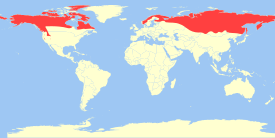
Wolverine is widespread in the taiga, forest-tundra and partly in the tundra of Eurasia and North America .
In Europe, it has been preserved in the north of the Scandinavian Peninsula , in Finland , Estonia , Latvia , Lithuania , Russia , partly in Poland and Belarus .
In Russia, the southern border of its range passes through the Tver , Kirov , Leningrad and Vologda regions and the Perm Territory ; Wolverine is widespread in Siberia and the Far East . It is also common on the Kola Peninsula in the Murmansk Region, Karelia , Pskov and Novgorod Regions, the Komi Republic , and Kamchatka .
One of the US states, Michigan , is nicknamed the " Wolverine State " ( Eng. The Wolverine State ).
Lifestyle
Wolverine spends most of her life alone, actively protecting the borders of her territory from individuals of her gender. The lair settles under the twisted roots, in crevices of rocks and other secluded places; feed goes out at dusk. Unlike the majority of marten , leading a settled lifestyle, the wolverine constantly wanders in search of prey in its hunting area, the total area of which can reach 1,500-2,000 km² . Climbing trees easily. It has sharp eyesight, hearing and instinct. It makes sounds similar to fox yapping.
Wolverine is not picky: it often eats the remains of prey for wolves and bears , catches squirrels , black grouse , hazel grouse , mouse-like rodents . Less commonly hunts large ungulates: it can attack deer , roe deer , musk deer , elk , and mountain sheep . In this case, usually young calves, wounded, weakened or sick animals become its victims. He chases prey on the run: Wolverine does not run fast, but is very hardy, and takes his victim by starvation. Often ruins the winters of hunters (often leaving sharply smelling marks) and steals prey from traps. There have been times when large wolverines attacked lone wolves.
In the summer it eats bird eggs, wasp larvae, berries and honey . He catches fish - at wormwood or during spawning, eagerly picks up black-fish. It preys on birds, grabbing them on the ground when they sleep or sit on nests.
Wolverines climb trees no worse than they move on the ground. Wolverine is able to kill prey 5 times more than herself, however, provided there is a sufficiently deep snow cover where large animals get stuck. It can attack a person, but only if cornered. Wolverine is a rather fearless and dangerous beast (only the Indian honey badger, also from the marten family, is comparable with it), so even a bear, when meeting with a wolverine, tries to avoid her.
In natural conditions, the wolverine can live up to 10 years, in captivity it lives up to 17 years [5] .
Reproduction
Coupling takes place only during the breeding season from May to August. The female brings posterity once every two years. Male and female stick together for only a few weeks. A fertilized egg, however, does not begin to divide immediately. Normal embryonic development begins only after 7–8 months, and after about 30–40 days of an effective pregnancy, most often in February or March, in sheltered places the female gives birth to two to four cubs. Each weighs about 100 grams. After 4 weeks, they open their eyes and feed on their mother’s milk for 10 weeks. Then the mother gives them half-digested food. After 3 months, at the beginning of the summer period, the cubs first leave the den. Young individuals are with their mother for another 2 years, and then begin the adult life of loners [5] .
Economic value
Wolverine is a rare hunter prey, and therefore quite valuable. Collars, couplings, hats and other men's and women's clothes are made from wolverine skins. A distinctive property of furs is that it does not freeze in the cold [6] .
Wolverine cubs taken in nature, very well get used to humans and become completely tame and not malicious [7] .
According to other statements, the wolverines are not tamed even after several generations of life in captivity and are extremely aggressive towards humans [8] .
Wolverine in Culture
Marvel Comics character James Howlett has, among others, the nickname Wolverine.
Gallery
Wolverine at Moscow Zoo
Notes
- ↑ Sokolov V.E. The pagan dictionary of animal names. Mammals Latin, Russian, English, German, French. / edited by Acad. V. E. Sokolova. - M .: Rus. lang., 1984. - S. 98. - 10,000 copies.
- ↑ 1 2 3 Wolverine // Great Soviet Encyclopedia ( 3rd edition ). - M .: Soviet Encyclopedia, 1969-1978.
- ↑ 1 2 Wolverine // Explanatory Dictionary of Ushakov
- ↑ Wolverine . Encyclopædia Britannica.
- ↑ 1 2 Encyclopedia of Wild Animals Wildfauna.ru - Wolverine
- ↑ Nagretsky L.N., Stakhrovsky E.V., Zamakhaev V.A., Vorobyeva M.P., Mitrofanova L.A., Pichugin Yu.V., Moskov V.A. Organization and technique of hunting. - Timber industry. - M. , 1977 .-- 240 p.
- ↑ Ternovsky D.V. Biology of Mustelids (Mustelidae). - Novosibirsk: Science, 1977.
- ↑ Kamchatka demon. Wolverine . www.moya-planeta.ru. Date of treatment May 21, 2017.