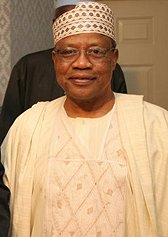
Ibrahim Babangida ( eng. Ibrahim Babangida ; August 17, 1941 , Minne ) - Nigerian statesman, head of state from 1985 to 1993. He played an important role in most of the armed coups in the country (in 1966, 1976, 1983, August and December 1985 and 1990).
| Ibrahim Babangida | |||||||
|---|---|---|---|---|---|---|---|
| English Ibrahim babangida | |||||||
 | |||||||
| Predecessor | Mohammad Bukhari | ||||||
| Successor | Ernest Schonekan | ||||||
| Birth | August 17, 1941 (77 years) Minna ,  Nigeria Nigeria | ||||||
| Spouse | Mariam | ||||||
| The consignment | |||||||
| Education | |||||||
| Religion | Islam | ||||||
| Awards | |||||||
| Rank | |||||||

Content
Personal Life
Born in 1941 in the city of Minna , the capital of the Niger . Belonged to the Gbari ethnic group. [1] He professed Islam . Parents - Muhammad and Aisha Babangida. On September 6, 1969 , he married Maryam King (first lady of Nigeria 1985–1993), from whom he had four children: Muhammad, Aminu, Aishatu, Khalimat. [2] Maryam died of a complication of ovarian cancer on December 27, 2009.
Army service
Babangida graduated from military school in India in 1964, studied at the Royal Armored Center from January 1966 to April 1966, passed the Advanced Armored Officer Course at the officers' school from August 1972 to June 1973, then completed the Senior Officer's course on command of the armed forces from January 1977 until July 1977; and Senior International Defense Management Course at the Naval Graduate School in the United States in 1980 [3] .
President
On August 27, 1985, he came to power through a bloodless coup, when President Mohammad Bukhari was removed from office by the military. From December 29, 1989 also the Minister of Defense. Babangida made a promise to stop human rights violations (which were permitted under the Bukhari government) to quit smoking and to give up power in 1990 . Initially, a fairly liberal policy was carried out, but repression of dissidents and mass corruption persisted under the new regime. Subsequently, massive human rights violations and political assassinations of unwanted people began in the country. The democratization of society, initiated by Babangida upon coming to power, ended in failure.
The attempted coup in 1990
On April 22, 1990, Babangida survived an attempted coup under the leadership of Major Gideon Orkar. The rebels attacked the barracks in the capital Abuja , the headquarters of the military leadership of the country and the residence of the president. Babangida was not injured in the assassination attempt, as his guards shot dead all five attackers.
1993 Presidential Election
As part of a return to civilian government program in 1990, local elections were held, and in 1992 parliamentary elections were held. The election of a civic president was scheduled for June 1993. These were the first presidential elections after the military coup. Moshud Abiola, the leader of the Social Democratic Party (which won the parliamentary elections), was the main candidate to win the presidential election. Abiola won, receiving 58% of the vote, second place went to Bashir Tofa with 41% of the vote. Although the elections were generally regarded as free and democratic, their results were canceled by General Babangida. After the cancellation of the elections, the military regime began mass cleansing and set off different ethnic groups of a multinational country with the help of propaganda .
Removal from office
In the summer of 1993, mass protests began against the Babangida regime. At the end of August 1993, the protests took on the character of a massive national strike, with the result that the Nigerian economy sharply declined. In connection with the increase in public pressure on Babangida, on August 27, the military transferred the right to govern the country to an interim government headed by Ernest Shonekan, who three months later was removed by General Sani Abacha .
See also
- Operation Leopard
Notes
- ↑ Martin P. Mathews. Nigeria: Current Issues and Historical Background. - Nova Science Publishers, 2002. - p. 122. - 206 p. - ISBN 1-59033-316-0 .
- ↑ Thomson Gale. Babangida, Ibrahim (English) . Encyclopedia.com:. www.encyclopedia.com. The appeal date is May 22, 2017.
- ↑ Babangida, Ibrahim 1941– - FREE Babangida, Ibrahim 1941– information | Encyclopedia.com: Find Babangida, Ibrahim 1941– research
Links
- The Babangida Government (eng.)
- Library of Congress Country Studies : Nigeria - The Babangida Government (eng.)
- Gideon Orkar's 1990 speech (English)
- Palace Coup August 1985 (eng.)
- ibrahim babangida (eng.)