
b - a truncated cone.
As an example, the symbol of the taper according to GOST 2.307-68 is given.
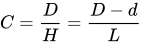
Taper ( C ) - the ratio of the diameter of the circle ( D ) of the base of the cone to its height ( H ) for full cones or the ratio of the difference in the diameters of the two end cross sections of the cone ( D and d ) to the distance between them ( L ) for truncated cones. Taper, as a rule, is expressed in relation to two numbers, for example, taper 1:10 means that the height of the full cone is 10 times the diameter of the base.
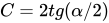
Also, the taper can be determined by the angle of the vertex of the cone (α). Half the angle of the vertex of the cone is called the slope of the cone (α / 2).
In some countries (mainly countries with a wide imperial length system ), the taper is defined as the diameter of the base of a cone of unit height. For example, 0.6 inches per foot or 0.05 inches per inch , which corresponds to a taper of 1:20.
The taper can be specified in percent and ppm.
GOST R 53440-2009 (GOST 8593-81 has lost force in the Russian Federation since 01/01/2012) provides for the following tapers:
1: 500, 1: 200, 1: 100, 1:50, 1:30, 1:20, 1:15, 1:12, 1:10, 1: 8, 1: 7, 1: 6, 1: 5, 1: 4, 1: 3, 30 °, 45 °, 60 °, 75 °, 90 °, 120 °
| Taper | Angled taper | Cone slope |
|---|---|---|
| 1: 200 | 0 ° 17 '12 ” | 0 ° 8 '36 ” |
| 1: 100 | 0 ° 34 '23 ” | 0 ° 17 '11 ” |
| 1:50 | 1 ° 8 '45 ” | 0 ° 34 '23 ” |
| 1:30 | 1 ° 54 '35 ” | 0 ° 57 '17 ” |
| 1:20 | 2 ° 51 '51 ” | 1 ° 25 '56 ” |
| 1:15 | 3 ° 49 '6 ” | 1 ° 54 '33 ” |
| 1:12 | 4 ° 46 '19 ” | 2 ° 23 '9 ” |
| 1:10 | 5 ° 43 '29 ” | 2 ° 51 '45 ” |
| 1: 8 | 7 ° 9 '10 ” | 3 ° 34 '35 ” |
| 1: 7 | 8 ° 10 '16 ” | 4 ° 5 '8 ” |
| 1: 5 | 11 ° 25 '16 ” | 5 ° 42 '38 ” |
| 1: 4 | 14 ° 15 '0 ” | 7 ° 7 '30 ” |
| 1: 3 | 18 ° 55 '29 ” | 9 ° 27 '44 ” |
| 1: 1,866 | 30 ° | 15 ° |
| 1: 1,207 | 45 ° | 22 ° 30 ' |
| 1: 0.866 | 60 ° | 30 ° |
| 1: 0.652 | 75 ° | 37 ° 30 ' |
| 1: 0,500 | 90 ° | 45 ° |
| 1: 0.289 | 120 ° | 60 ° |