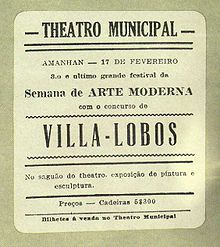

The week of contemporary art ( port. Semana de Arte Moderna ) is an art festival held in Sao Paulo , Brazil , from February 11 to February 18, 1922 . This festival is considered the starting point of Brazilian modernism . Although many Brazilians worked in this style before the festival, he clearly defined the boundaries of the genre and demonstrated it to the public. This event of importance for Brazil is often compared with the International Exhibition of Modern Art (Armory Show) in 1913 in New York , which was a legendary milestone in the history of US art.
A week of contemporary art was held in the building of the Municipal Theater in São Paulo, it exhibited works of plastic art, lectures, concerts, and listening to poems. This festival differs from the Armory Show , with which it is often compared, since the latter exhibited exclusively works of visual art. The festival was organized primarily by the artist Emiliano di Calvacanti and the poet Mario de Andrade in order to put an end to the protracted conflict of young modernists with the country's cultural establishment , headed by the Brazilian Academy of Literature, which adhered to academic art [1] . The event was initially seen as controversial or even provocative [1] , and one of the members of the academy, Graça Aranya, was ostracized for a report entitled “Aesthetic Emotions in Contemporary Art”. Due to the radicalism (at that time) of some of the poems and musical works, the audience often booed the authors, and most critics unanimously condemned them [1] .
The group that took part in the festival, despite their original intentions, did not remain holistic. Numerous groups broke away from her. In general, two areas dominated among them: the “ anthropophagists ” (cannibalists), led by Osvald de Andrade , agreed to European and American experience to create their own styles (where the name comes from - they tried to devour foreign works and use to create their own). Nationalists generally rejected outside influence and sought "purely Brazilian" art forms. The leader of the group was Plinio Salgado , who later became the political leader of the radical fascist movement of integralism and was arrested by dictator Jetuliu Vargas for attempting a coup.
Before the Week, São Paulo was the richest, but culturally insignificant city of Brazil. This week turned the city into the center of the modernist movement and put the more culturally conservative Rio de Janeiro in opposition.
The Week of Contemporary Art continued in subsequent years. For example, on May 27, 1935, as part of the Week, the first public performance of the works of Camargue Guarnieri took place, when his 1st sonata for cello and piano (1930), some songs and pontejs (Ponteios - preludes from volume 1, created in 1931) were presented —1935), the 1st string quartet with the participation of Zakarias Autuori [2] .
Notes
- ↑ 1 2 3 Amaral, Aracy; Kim Mrazek Hastings. Stages in the Formation of Brazil's Cultural Profile (English) // Journal of Decorative and Propaganda Arts: journal. - 1995. - Vol. 21 .
- ↑ Verhaalen M. Camargo Guarnieri: expressões de uma vida : [ port ] / Verhaalen, Marion; tradução de Vera Silvia Camargo Guarnieri. - São Paulo: Editora da Universidade de São Paulo / Imprensa Oficial, 2001 .-- P. 30. - 498 p. - ISBN 9788531406348 .
Links
- Brazil Body and Soul Guggenheim Museum
- Semana de Arte Moderna (Port)