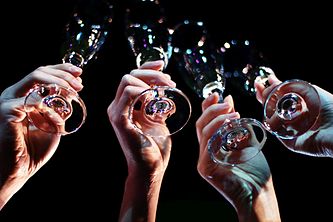
Toast (from English toast [1] ) is a short speech before the audience, preceding the drinking of alcoholic beverages, intended to emphasize the importance of the moment.
Content
Etymology of the word
In Russian, the word was borrowed from English; historically in Russia, toasts were called " toasts " [1] . The borrowing took place in the first half of the 19th century, the word “toast” as a “table wish” was already recorded in the Dictionary of Church Slavonic and Russian , published in 1847 [2] .
The Oxford Dictionary deduces the use of English. toast in the sense of a toast from another meaning, " toasted slice of bread " [3] [4] . The dictionary explains that a piece of bread often floated in a bowl of wine or ale , and the meaning passed at the end of the 17th century [4] first to the lady in whose honor the toast was offered (cf. English toast of the town ), since the mention of her name gave the taste of the collection, just as a spicy slice of bread gives the taste of the drink [3] . A direct transition from a piece floating in the bowl to the face in honor of which the bowl rises is also possible [3] .
Actually English. toast came to Middle English through Old French toster , “fry” [4] from lat. tostus , " grill ", in turn, from the form of the verb lat. torreo , "burn."
Toast Etiquette
A speech or a toast may include a greeting to the guest of honor, the general situation that served as the occasion for the meeting, the generally accepted form of wishing guests good health.
In the response toast (speech), the honored guest expresses gratitude for the hospitality, as well as mutual interest in the meeting and assurance of the reciprocity of friendly feelings, etc.
At official receptions, speeches and toasts are delivered after the dessert , when champagne is poured, at other receptions - not earlier than 10-15 minutes after the start of the reception, and sometimes at the very beginning.
The owner of the house gives the first speech or toast, and then the guest in honor of whom the reception is arranged.
At official breakfasts, lunches, dinners it is not customary to clink glasses ; if they clink glasses, then men keep their glasses below the glasses of ladies.
During speeches and toasts, it is unacceptable to talk, eat, pour wine , light a cigarette. When making a toast, it is necessary that those present hold glasses in their hands, and in especially solemn occasions they listen while standing. A toast is usually worth it.
The person to whom the toast is dedicated, unless it is the president or any other eminent person, usually speaks in response. A woman, unless it is a bride , usually accepts the compliment expressed in the toast, simply with a smile, while lowering her eyes and remaining seated, while the rest stand. She holds her glass of wine, not drinking from it until everyone drinks it. In fact, the person to whom the toast is addressed never touches the drink until everyone else drinks it, because otherwise it turns out that he or she drinks for themselves, which is at least immodest.
Important toasts addressed to the president , management or the newlyweds are drunk immediately to the bottom. Sometimes glasses after especially solemn toasts are thrown into the fireplace or smashed to the floor. Incidentally, refusing to drink a toast in someone's honor means disrespect for this person. If you cannot drink, you should at least pretend that you are drinking. Toast with water is not considered toast at all, but this solution to the problem was introduced at one time by the Swedish king Gustav, who became a convinced teetotaler. Therefore, if you can not or do not want to drink wine, pour into a glass of water and simulate a toast. It is not quite right to propose a toast with a cocktail, but this can be done with punch, beer, ale or whiskey.
In England, some drinks are traditionally still consumed with toast. If the guest made a toast, he should drain his glass to the bottom. The tradition of toasts dates back many centuries and dates back to the time of Caesars.
In one reference book on alcoholic beverages in the culture of different nations, published in 1995, it says: “Toasts are apparently an echo of the ancient rites of libation, which was to offer sacred gifts ... as a sacrifice to the gods in exchange for a wish, that is, a prayer, the essence of which can be expressed by the phrase: “For many years!” or “For your health!” ”.
Most people do not consider a toast a gesture with a religious or mystical meaning. This is not consistent with what the Bible, the Qur'an, and other scriptures teach. However, a number of peoples have the same toast and prayer (Abkhazians, Circassians, and other peoples of the Caucasus) (Gospel of John 14: 6,16: 23)
- fr. Santé or tchin - “Your Health!”
- him. Prost or Prosit - “For Your Health!”
- Spanish Salud
- English Cheers
- Hebrew and Yiddish Lechaim
- polish Na zdrowie
- Swede. Skål
- Ukrainian Budmo!
- fin. Kippis!
- room. “Noroc” (All benefits) or “Sănătate” (Health)
- yap. Kampai!
Silent Toast
A silent toast is also possible, offering it raises its glass and expresses as few words as possible. Usually a silent toast is offered for the deceased, for example, "For John, may the Lord rest his soul."
The silent "third toast" - the tradition of the Soviet army and the armies of the CIS countries - is commemorative of the dead comrades. It is drunk - standing, silently and not clinking glasses [5] [6] [7] [8] [9] .
See also
- For the queen of the fields - the infantry!
- For the Russian people!
- Toast (toast)
- Sovereign's Bowl
Notes
- ↑ 1 2 toast // Russian thought and speech. Own and alien. The experience of Russian phraseology. Collection of figurative words and parables. T.T. 1-2. Walking and well-aimed words. A collection of Russian and foreign quotes, proverbs, sayings, proverbs and single words. SPb., Type. Ak. Sciences .. M.I. Mikhelson. 1896-1912.
- ↑ Marian Vuytovich. English lexical borrowings in Russian dictionaries of the 19th century // Studia Rossica Posnaniensia 27, 187-193. 199. (Rus.) S. 189.
- ↑ 1 2 3 Frances E. Dolan. Chapter 15 - Toast and the Familiar in Children's Literature // Food and Literature. Cambridge University Press, 2018. (Eng.) S. 295.
- ↑ 1 2 3 toast // Oxford English Dictionary
- ↑ "Scout". The third toast. A. Dyshev
- ↑ “Third toast: novel, stories” A. Prokhanov
- ↑ "Blessed by MVIZRU Air Defense." Book Three
- ↑ “B-flat minor” by G. Shapkin
- ↑ “Khaki Color Division” A. Ramazanov p. 1981
Literature
- Etiquette. The art of exquisite manners. M .: AST, 2005.