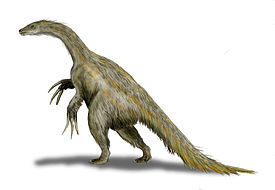
Nothronychus (lat.) - a genus of dinosaurs - theropods from the family Therizinosauridae , who lived during the Upper Cretaceous era ( 99.6-89.3 million years ago) in the territory of the modern USA . It is represented by two species [1] .
| † Nothronychus |
|---|
 |
|
| {{{{{{{{{{{{{{{{{{{{{{{{{{{{{{{{{{{{{{{{{{{| 1}} | 1}} | 1}} | 1}} | 1}} | 1}} | 1}} | 1}} | 1}} | 1}} | 1}} | 1}} | 1}} | 1}} | 1 }} | 1}} | 1}} | 1}} | 1}} | 1}} | 4}} : | Eumetazoi |
| No rank : | Bilateral symmetrical |
| Infraclass : | Archosauromorphs |
| No rank : | Archosauriformes |
| Group : | † Maniraptoriformes |
| Infrastructure : | † Therizinosaurs |
| Superfamily : | † Therizinosaurids |
| Family: | † Therizinosaurids |
|
|
Nothronychus Kirkland & Wolfe, 2001 |
|
- † Nothronychus graffami
Zanno et al. , 2009 - † Nothronychus mckinleyi
Kirkland & Wolfe, 2001 typus
|
|
|
In 1998, paleontologist James Kirkland in the Bobby McKinley ranch area in Catron County, New Mexico, discovered the remains of a dinosaur, which he ranks as a zuniceratops . In the same year, the find was reported in the publication. However, later, comparing the remains of Zuniceratops with new finds, he noticed that the occipital parts of the skulls, squamosum , are very different in shape. More accurate studies of fossil material have led to the conclusion that among the fossil remains are also bones belonging to the representative of the superfamily Therizinosauroidea .
In 2001, Kirkland and Douglas Wolfe described a new species and genus - Nothronychus mckinleyi . The name of the genus comes from other Greek. νωθρός (notchros) - “heavy” or “slow” and ὄνυξ (onyx) - “claw”, referring to large claws . This genus name was chosen because the animal reminded Kirkland of a giant terrestrial sloth. The species name was given in honor of McKinley for assistance in the excavation [2] .
Nothronychus mckinleyi is a fairly large therizinosaurus. Gregory S. Paul in 2010 estimates it at 5.1 meters high and weighs 1.2 tons. He was a warm-blooded animal, moved on two legs and was a herbivore. It is assumed that he had a primitive plumage.
Nothronychus graffami . The holotype UMNH VP 16420 is larger than Nothronychus mckinleyi . Most bone fragments are several percent larger (about ten percent) [3] .
