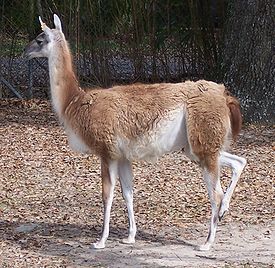
Guanaco ( Latin: Lama guanicoe , from Quechua wanaku ) is a mammal of the genus Lamas of the camelidae family. It is the ancestor of the domesticated llama .
| Guanaco |
 |
| Scientific classification |
|---|
| No rank : | Bilateral symmetrical |
|
| International scientific name |
|---|
Lama guanicoe Statius Müller , 1776 |
| Area |
|---|
|
| Security status |
|---|
Least ConcernedIUCN 3.1 Least Concern : 11186 |
|
Content
In 1553, their first description is given in the book " Chronicle of Peru " by Ciez de Leon [1] .
An animal of a slender, light build, in proportions resembling a deer or antelope, but with a more elongated neck. The long neck of guanaco serves as a balancer when walking and running. Body length 120-175 cm, tail length - 15-25 cm, height at the withers 90-130 cm; weight - 115-140 kg. The limbs are two-fingered, only the third and fourth fingers are preserved. The feet are narrow, mobile, between the fingers deeply dissected.
Europe's first image of a South American camel.
Cieza de Leon .
Here is how Gerald Darrell Guanaco describes in The Land of Rustles:
“He had long, chiseled, like a racehorse, legs, a slender body and a long graceful neck, a bit like a giraffe. The muzzle is much longer and sleeker than the llama, but with the same arrogant expression. The eyes were black and huge. Spinning his little graceful ears and raising his chin, guanaco seemed to be looking at us in an imaginary lorgnet. Behind him, his three wives and two babies, each taller than a terrier, stood in a cramped and timid flock. Huge, wide-open eyes gave them such an innocent appearance that this sight catched the enthusiastic sighs and sussing from the female half of the expedition. The animal fur was not dirty brown, as I expected, but almost red. Only the neck and legs had a light shade, like sand in the sun, and the body was covered with thick wool of a beautiful reddish-brown color. ”
The word guanaco comes from wanaku , the name of this animal in Quechua .
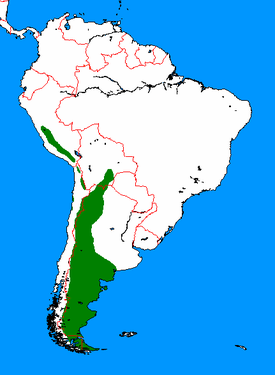
It lives in the pampas , semi-deserts and highlands of the Andes from southern Peru through Chile and Argentina to Tierra del Fuego . There is a small population in western Paraguay . Rises to a height of 4000 m above sea level.
Guanaco capable of speeds up to 56 km / h. Running is important for the survival of these animals, as they live in open areas.
Herbivores are capable of doing without water for a long time.
Natural enemies: dogs, maned wolves and cougars .
Herd of polygamous animal. One adult male drives up to 20 heads of females and young individuals, expelling older males older than 6-12 months, driving away other males and sometimes females. Family groups include only 18% of adult males; the rest live in male groups or singly.
The guanaco race runs from August (in the north of the range) to February (in the south). During this period, fights for possession of females occur between males. Like camels , guanacos rise to their hind legs, crush each other with their necks, bite, beat with their front legs, spit with saliva and stomach contents. Mating guanaco, like camels, occurs in a prone position.
Pregnancy lasts 11 months. One is born, rarely two cubs. Milk feeding lasts 4 months. Females become sexually mature by 2 years.
Life expectancy - 20 years; in captivity until the age of 28.
The number of species is noticeably reduced. The reason lies in the fact that guanaco is an object of hunting for the sake of the skin, valuable wool and meat, and also competes with livestock on pastures. In Chile and Peru, guanacos are under state protection.