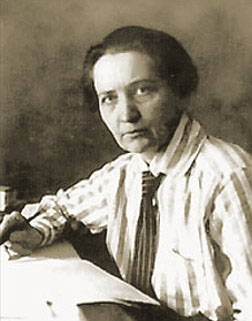
Evgenia Bogdanovna ( Gotlibovna ) Bosch (nee Maish ; , - , ) - an active participant in the revolutionary movement in Russia and Ukraine.
| Evgenia Bogdanovna (Gotlibovna) Maysh-Bosh | |||||||
|---|---|---|---|---|---|---|---|
| Evgeniya Bogdanіvna (Gotlіbіvna) Bosch | |||||||
 | |||||||
| Predecessor | position established | ||||||
| Successor | Nikolai Alekseevich Skripnik | ||||||
| |||||||
| Predecessor | position established | ||||||
| Successor | Karl Petrovich Balod | ||||||
| Birth | |||||||
| Death | |||||||
| Burial place | |||||||
| Spouse | Peter Bosch George Pyatakov | ||||||
| The consignment | VKP (b) (1901) | ||||||

Content
Biography
Born in Ochakovo of the Kherson province (now the Nikolaev region ). She came from the family of the German colonist Gottlieb Meisch, who acquired significant land in the Kherson region, and the Bessarabian noblewoman Maria Parfentievna Kruser. A cousin (the son of his mother’s brother Semyon Parfentievich Krussser) is the Soviet commander of the Civil War, Alexander Kruser [2] . Uncle - 1st-level military engineer Georgy Pafnutievich Kruser (1878-1938), midshipman (1901), captain of the 2nd rank (1913), in Soviet times, head of the naval department of a scientific and test artillery range; repressed.
For three years, Eugene attended the Ascension girls gymnasium. During training, she married the owner of a small carriage workshop Peter Bosch. In the late 1890s. met with the Social Democrats and plunged into revolutionary work. In 1901 she joined the RSDLP . After the Second Congress, the RSDLP identified itself as a Bolshevik .
Participation in revolutionary activities before the revolution
Raising two daughters, E. Bosch was simultaneously engaged in self-education. At the beginning of 1907 she divorced her husband and settled in Kiev . Established contact with the local Bolsheviks, together with her younger cousin Elena Rozmirovich conducted underground revolutionary activities. In February 1911 - Secretary of the Kiev Committee of the RSDLP (b), began a correspondence with V. Lenin and N. Krupskaya .
In April 1912, E. Bosch was arrested. During the year of her previous detention in the Yekaterinburg prison, her health (to this she already suffered from heart and lung diseases) significantly deteriorated. Seriously ill with consumption, E. Bosch, the Kiev Court of Justice, condemned to deprivation of civil rights and lifelong exile to Siberia .
In the remote Kachug volost of the Verkholensk district, a little later in the village of Usolye [3] of the Irkutsk province , where E. Bosch was exiled, she did not stay long. Together with another leader of the Kiev Bolsheviks, who was involved in the same case with E. Bosch, G. Pyatakov , she fled through Vladivostok to Japan , and then moved to the United States and finally to Switzerland . At the Berne Conference of the Overseas Sections of the RSDLP, E. Bosch and G. Pyatakov formed an opposition to V. I. Lenin, joining the so-called “God's group” (named after the Montreux suburbs - God's), which included N. Bukharin , N. Krylenko , E Rozmirovich . After the aggravation of disagreements between the leaders of the Central Committee of the RSDLP (mainly in assessing the national issue), E. Bosch and G. Pyatakov moved to the capital of Sweden - Stockholm , and then to the capital of Norway - Christiania ( Oslo ).
Having returned in the first days after the overthrow of the autocracy in Russia, E. Bosch and G. Pyatakov did a lot to organize opposition to the Leninist course towards the socialist revolution - first in Petrograd and then in Kiev . However, after the April Conference of the RSDLP (b) (E. Bosch was its delegate), she moved to Leninist positions. She was elected head of the district, then secretary of the regional committee of the RSDLP (b) of the South-Western Territory . As a delegate, she participated in the VI Congress of the Bolshevik Party.
Party and State Activities After the Revolution
By that time, the conflict with the secretary of the Kiev Committee of the RSDLP (b) G. Pyatakov had reached its maximum. Ideological disputes even led to the breakdown of their marital relations (they were in a civil marriage). In the October days of 1917, E. Bosch was in Vinnitsa , was one of the leaders of the armed uprising against the troops of the Provisional Government, which was crushed by troops loyal to the Provisional Government, headed by V.A. Kostitsyn . She took an active part in the preparation of the Regional (regional) congress of the RSDLP (b) in Kiev ( December 3 - 5, 1917), which sought to create an all-Ukrainian organization of the Bolsheviks - the RSDLP (b) - the Social Democracy of Ukraine, became part of the main committee elected by the congress this organization.
About the actions of E. Bosch during the armed uprising against the troops of the Provisional Government (November - December 1917) writes one of the figures of the Civil War, Skoropadsky Pavel Petrovich [4] :
| ... The front, in fact, was no longer at this time: all the trenches were abandoned, the whole tree had long been pulled out from there for fuel. There were only units, rather, a bunch of soldiers and officers who stood in the villages nearest to the front and were engaged in rallies. The position of the authorities is the wildest, and almost everywhere it was put aside by committees and replaced by all kinds of crooks. ... Upon arrival at the Derazhnya station, I learned that the 2nd Guards Corps, having passed from the front, as I said above, the Podolsk province under the leadership of the agitator Bosh, was completely concentrated at Zhmerynka and that there were rumors that he was going to go to Kiev . I involuntarily pondered the situation, when even there was no one to defend Kiev from the Bolsheviks, and came to the decision that I would not go to Krylenko’s front and move energetically to Kiev in order to be able to block access to the 2nd Guards Corps in city. |
E. Bosch was one of the organizers of the All-Ukrainian Congress of Soviets , the proclamation of Ukraine by the Soviet Republic - the Ukrainian People's Republic of Soviets (UNRS), and the formation of its public authorities. In December 1917, on her initiative, the Bolshevik delegates and representatives of the leftist movements of several other parties left the Congress of Soviets in Kiev, where they were in the minority, moved to Kharkov , teamed up with the delegates of the III Donetsk-Krivorozhsky Regional Congress of Soviets and held 11 December 12 I All-Ukrainian Congress of Soviets . The congress proclaimed Ukraine a republic of soviets, declared its federal connection with Soviet Russia, declared the power of the Central Rada in the Ukrainian People’s Republic invalid, and laws and orders invalid. The decrees of the Council of People's Commissars of Soviet Russia extended to Ukraine.
E. Bosch became one of the members of the CEC of the Councils of Ukraine - the highest authority in the Soviet Republic, which formed the executive authority - the People’s Secretariat . This turned out to be not easy. To the disagreement between the "owners" (Kharkovites) and the "newcomers" (Kiev) about the norms for representing their supporters, a significant shortage of personnel of Ukrainian origin was added. Finally, they agreed that applicants for government positions should have first of all high business and political qualities and be “as far as possible with Ukrainian surnames”. Since no “real Ukrainian” was found as the head of the government, it was decided “not to elect the head of the Council of People’s Secretaries temporarily”. It was also decided that “the People’s Secretary of the Interior will coordinate the work of the People’s Secretariat”, in other words, will become the acting head of government. This position was taken on December 17 by E. Bosch. On the same day, the CEC of the Councils of Ukraine decided to "organize a management department under the presidium of the CEC, which should work under the leadership of the People's Secretary of the Interior." This decision further confirmed the status of E. Bosch as the de facto head of government. Until the end of January 1918, the government was in Kharkov, on January 30, it transferred its work to Kiev , and in early March to Poltava .
The hasty and unmotivated move of the People's Secretariat to Kiev, E. Bosch, over time, began to be considered erroneous. The conditions for government activities have deteriorated significantly for many reasons. In an atmosphere of continuous chaos, growing internal disagreements, E. Bosch, with her active, restless nature right up to fanaticism, increasingly began to resort to decisive, drastic steps and solutions. Opponents began to call her "dictator" and even take steps to isolation. Understanding this, E. Bosch herself initiated the transfer of her functions to N. Skrypnik , who behaved much more deliberately.
E. Bosch did not agree to leave Kiev to the Austro-German troops without a fight, however, her position was not shared by most colleagues from the political and military leadership of the Ukrainian SSR. She was literally forcefully evacuated from Kiev. A demand was put forward for her removal from the post of actual head of government. Considering the above, and also in disagreement with the signing of the Brest Peace , by which Soviet Russia recognized the peace agreement of the Central Committee with Germany and its allies, E. Bosch resigned on March 4 as People’s Secretary. The government was left without a leader, and therefore, on the same day, N. Skrypnik was elected to the post of head of the People’s Secretariat.
Carried away by “left-communist” views, E. Bosch refused to evacuate with the leading institutions of the Ukrainian SSR in the city of Yekaterinoslav . She became a political worker in the group of troops of V. Primakov , who, with heavy fighting, for two months retreated from the area of Bakhmach (now Chernihiv region ) to Merefa (now Kharkov region ). A new exacerbation of the disease has occurred. Having received some medical treatment in Tambov and Lipetsk , E. Bosch took part in the work of the First Congress of the Communist Party (Bolsheviks) in Moscow .
At the insistence of V.I. Lenin and Ya. M. Sverdlov, E. Bosch was sent to Penza , where she headed the sponge of the RCP (B.). In this region, in the opinion of V.I. Lenin, a “firm hand” was needed to intensify work to seize bread from the peasantry. In the Penza province, the brutality of E. Bosch, manifested in the suppression of peasant uprisings in counties, was long remembered. When the Penza communists, members of the executive committee of the Oblast, prevented her from attempting to massacre the peasants, E. Bosch accused them of "excessive gentleness and sabotage" in a telegram addressed to V. I. Lenin. Researchers are inclined to believe that E. Bosch, being a “mentally unstable person,” herself provoked peasant unrest in the Penza district , where she was sent as an agitator of the food detachment . According to the recollections of a descendant of an eyewitness, allegedly “in sec. Kuchki Bosch during a rally in a rural square personally shot by a peasant who refused to hand over bread. It was this act that angered the peasants and caused a chain reaction of violence. ” The cruelty of E. Bosch towards the peasantry was combined with its inability to stop the abuse of its food detachments, many of whom did not hand over the bread seized from the peasants to the state, but exchanged it for wine and vodka [5] . This episode was recorded from the words of a descendant of an eyewitness to these events by historian Viktor Kondrashin in 1999. In October 2018, in a correspondence with Ukrainian historian Andrei Zdorovy, Viktor Kondrashin confirmed that he did not verify the accuracy of the source, for this reason Kondrashin did not include this episode in his doctoral dissertation “The Peasant Movement in the Volga Region 1918-1922” [6] .
After the aggravation of the situation on the Southern Front, the Central Committee of the RCP (B.) Seconded it to the South of Russia. She headed the political department of the Revolutionary Military Council of the Caspian-Caucasian Front . From the Communists, Astrakhan was a delegate to the VIII Congress of the RCP (B.) . Then she worked in the Defense Council of the Lithuanian-Belorussian SSR , as well as the post of the Special Commissioner of the Council of People's Commissars of the Ukrainian SSR in the frontline zone with Denikin .
The disease made itself felt more and more, every time for a long time bedridden E. Bosch. For some time she worked in the Central Committee of the All-Russian Trade Union of Land and Forests, the People’s Commissariat of Education, in the commission of the Central Union and the People’s Commissariat for the Support of the Starving, in the People’s Commissariat of the Workers and Peasants Inspection. The government has repeatedly sent E. Bosch to Georgia , Germany , and Italy for treatment. There she began to write an autobiography in the form of letters to her daughters (the work was not completed) and the book “Year of the struggle. The struggle for power in Ukraine from April 1917 until the German occupation. "
When the torment of the disease became unbearable, E. Bosch committed suicide in Moscow on January 5, 1925 . She was buried at the Novodevichy cemetery .
The book "Year of Struggle" was published in 1925 after the death of the author (reprinted in 1990 ).
See also
- Peasant uprising in the Penza province
Notes
- ↑ 1 2 3 4 5 6 Bosch Evgenia Bogdanovna // Great Soviet Encyclopedia : [in 30 vol.] / Ed. A. M. Prokhorov - 3rd ed. - M .: Soviet Encyclopedia , 1969.
- ↑ Gilyarova E.A. , Itkis M.B. Alexander Krussser (1893-1919): Historical and biographical sketch. - Chisinau : Cartya Moldovenienasca , 1962.
- ↑ Shamanskiĭ, VF (Vasiliĭ Fedorovich). Usolʹe-Sibirskoe . - Irkutsk: Vostochno-Sibirskoe knizhnoe izd-vo, 1994 .-- 217 pages p. - ISBN 5742406355 , 9785742406358.
- ↑ Skoropadsky P. Pavel Skoropadsky. Memories. Late 1917 - December 1918 = Pavlo Skoropadsky. Guess. Kinets 1917 - chest 1918 / Editor-in-chief J. Pelensky. - K.: AT Book, 1995 .-- 495 p. - ISBN 5-7702-0845-7 .
- ↑ Kondrashin V.V. Peasant movement in the Volga region in 1918-1922 / Ans. ed. V.P. Danilov . - 1st ed. - M.: Janus - K, 2001 .-- S. 279-280. - 544 p. - ISBN 5-94321-001-6 .
- ↑ ≡ Andrey. Eugene Bosch and the Red Terror. Correspondence with Victor Kondrashin . LiveJournal (November 20, 2018). Date of treatment November 20, 2018.
Sources
- Bosch Eugene. Year of struggle. The struggle for power in Ukraine from April 1917 until the German occupation. - M.: State Publishing House , 1925.
- 2nd ed. / Under the scientific. Ed., with a foreword. and note. P.L. Vargatyuk . - Kiev: Political Publishing House of Ukraine, 1990. - ISBN 5-319-00505-9
Links
- Government portal of Ukraine. Bosch Evgeniya Bogdanivna (Gotlіbіvna)
- Biography E. Bosch on hrono.ru
- Biography of E. Bosch on biografija.ru
- Flight Nikolai . Memories
- Healthy Andrey. Evgenia Bosch - head of the first Soviet government of Ukraine (December 1917 - March 1918) // iuprc.livejournal.com. - 2006. - December 19.
- Healthy Andrey. Eugene Bosch and the Red Terror // iuprc.livejournal.com. - 2008. - December 19.