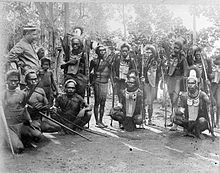
Alorsky (self-name - orang baranusa ), another name: orang-alor , is one of the peoples of Southeast Indonesia . It lives in the north and northwest of the islands of Pantar and Alor, a small island halfway between the islands of Java and New Guinea in the Banda Sea (east of the Lesser Sunda Islands ) (Kardiner 1945: 226).
| Alorians | |
|---|---|
| Abundance and area | |
| Total: 70,000 (estimate) | |
 Indonesia Indonesia | |
| Tongue | Alorian |
| Religion | Islam , traditional beliefs |
| Related peoples | Rotians , Ambonians |

Content
History
Alor, an island north of Timor, lies 8 degrees south of the equator, and between 124 and 125 degrees east longitude from Greenwich. Here, Dr. Dubois chose to study a group of pagan highlanders. Atimelang, whose language has never been officially studied. For this language, she gave the name Abuy (Kardiner 1944: 226).
Language characteristic
Alorians belong to the Ambonian-Timorese peoples , belong to the East Indonesian anthropological group.
Religion
Most Alorians are Sunni Muslims. Islam was adopted in the 17-18 centuries. at the Makassars . Traditional beliefs have also been preserved.
Dubois made the following conclusion about the attitude of the Alorians to religion. Attitudes toward the supernatural are similar to attitudes toward people. The main motive is feeding the gods in a religious ritual with the goal of appeasing them. In her opinion, this is due to systematic deprivation and hunger in childhood (Kardiner 1945: 157).
Traditional chores
Traditional occupations are trade, fishing, gardening. Wood carving is developed.
Culture
Known facts about Alorians do not provide a complete picture of the cultural picture adequate enough to understand the significance of many aspects that are important and underlie the formation of personality.
In the formation of the Alorians in the Middle Ages, migrants from the islands of Solor, Bugis , Makassar , Javanese , and Ternats participated. Until the middle of the 20th century. Alorians were headed by the Rajas . The culture of the Alorians is characteristic of other "trading ethnic groups." Coastal settlements, linear layout. The Iroquois-type kinship system. They are divided into seven patrilineal clans united in two exogamous phratries - the “masters of the earth” and the “late aliens”. Cross-knit marriage, bilateral. In relation to mother-child relations are such that after two weeks of caring for the child, the mother leaves him and continues to work in the field. The cult of dragons-naga is characteristic. [one]
Notes
Literature
- Members M.A. Alorsa. 1999. Peoples and religions of the world / Chap. ed. V.A. Tishkov . M .: Big Russian Encyclopedia. S.39.
- Kardiner A., Oberholzer E. 1944. The People of Alor: A Social-Psychological Study of an East Indian Island by Cora Du Bois. Social Forces . Vol. 23. No. 2. P. 226.
- Kardiner A., Oberholzer E. 1945. The People of Alor: A Social-Psychological Study of an East Indian Island by Cora Du Bois. American Sociological Review . Vol. 10. No. 1. P. 115 - 117.
- Kardiner A., Oberholzer E. 1945. The People of Alor: A Social-Psychological Study of an East Indian Island by Cora Du Bois. American Anthropologist, New Series . Vol. 47. No. 1.P. 155 - 161.