Sea cat [1] , or common stingray [1] ( lat. Dasyatis pastinaca ) is a stingray from the family of stingray, widely distributed in the warm waters of the eastern Atlantic Ocean. Despite the widespread occurrence of this stingray in well-studied seas, its lifestyle is poorly understood.
| Catfish | |||||||||||||||||||||||||||||||||||||
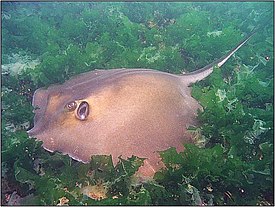 Sea cat at the bottom of the Black Sea | |||||||||||||||||||||||||||||||||||||
| Scientific classification | |||||||||||||||||||||||||||||||||||||
|---|---|---|---|---|---|---|---|---|---|---|---|---|---|---|---|---|---|---|---|---|---|---|---|---|---|---|---|---|---|---|---|---|---|---|---|---|---|
| |||||||||||||||||||||||||||||||||||||
| International scientific name | |||||||||||||||||||||||||||||||||||||
Dasyatis pastinaca Linnaeus , 1758 | |||||||||||||||||||||||||||||||||||||
| Synonyms | |||||||||||||||||||||||||||||||||||||
| |||||||||||||||||||||||||||||||||||||
| Area | |||||||||||||||||||||||||||||||||||||
| |||||||||||||||||||||||||||||||||||||
| Security status | |||||||||||||||||||||||||||||||||||||

Sea cats are found in coastal waters up to a depth of 60 m. The maximum recorded disc width is 60 cm. The pectoral fins of these slopes fuse with the head, forming a diamond-shaped disc, the width of which slightly exceeds its length. On the thin and long tail, the upper and lower fin folds are located. The dorsal surface of the disc is evenly colored; smooth skin is devoid of scales. In large individuals, a series of tubercles can lie along the midline of the disk.
Sea cats prey mainly on bottom crustaceans , as well as mollusks , polychaetes and small bony fish . They reproduce by egg production. Embryos develop in the womb, feeding on the yolk and histotroph . There are 4-9 newborns in the litter. Sea cats are able to inflict painful injections with a poisonous spike, which usually do not threaten life. These skates are not subject to targeted fishing. By- catch in large quantities is found in commercial fishing. Their meat is edible [2] [3] .

Content
Taxonomy and Phylogenesis
Sea cats were well known to people in ancient times. The ancient Greeks called them dr. Greek. τρυγών - " turtledove ", and in ancient Rome the species was known by the name lat. pastinaca - " parsnip " [4] . For the first time, a sea cat was scientifically described by Carl Linnaeus as Raja pastinaca in 1758. He was later assigned to the family of stingrays. There are at least 25 earlier references to this species under various non-binomial names, for example, Raja corpore glabro , aculeo longo anterius serrato in cauda apterygia , Pastinaca marina prima and Pastinaca marina lævis . Some data, as well as partially the description of Linnaeus, refer to other types of stingrays. To clarify the taxonomic status, additional studies are needed [3] .
| |||||||||||||||||||||||||||||||||||||||
| Phylogenetic tree of the genus of stingrays according to Rosenberg (2001). Given modern taxonomic names |
Stingray Dasyatis chrysonota , living off the southern coast of Africa , has long been considered a species of common stingrays. However, the absence of the last blue marks and differences in morphological and meristic characters allowed in 1993 to recognize them as independent species [5] . The differences between the two species and the Tortonese stingray from the Mediterranean are unclear and require further research [6] .
In 2001, a phylogenetic analysis of 14 species of stingrays based on morphology was published. The common stingray was recognized as the most basic member of the genus [7] .
Habitat and habitat
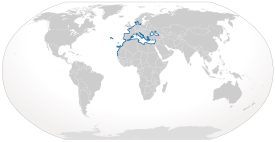
Sea cat can be found up to 61 ° to the north, but in general, this fish gravitates toward subtropical waters [2] . This slope stays mostly near the coast, often entering river estuaries and appearing near coastal cliffs [3] . Its range is concentrated along the coastline of all of Europe, starting from the western part of the Baltic Sea to the south to the Strait of Gibraltar and further along the coast of Africa to Senegal . The range of the sea cat includes the whole Mediterranean (in the western part of the Mediterranean Sea it is more common), it is also found in the Marmara , Black and Azov Seas. In the Atlantic Ocean, sea cats are common in the Canary and Azores . This is one of the few stingrays found in Russian waters and the only stingray of Ukrainian waters ( Black and Azov Sea ) [8] [3] .
A typical biotope of a sea cat is shallow water, with a sandy or silty bottom. It is found mainly no deeper than 60 m, although it was noted at a 200-meter depth [2] .
Description
Sea cat - a typical representative of stingrays; its appearance is characteristic of this family. The pectoral fins of these slopes fuse together with the head, forming a diamond-shaped flat disk, the width of which is only slightly larger than the length, with rounded fins (“wings”). The front edge of the disk is almost straight, the snout is slightly pointed, slightly protruding beyond the disk. The skin of this stingray is generally smooth, but on the back there is a small amount of small bone plaques and blunt spines. The long and flexible tail-shaped tail in adult marine cats is equal in length to the disk, in young ones it is about one and a half times longer than the body [9] . Like other stingrays, a sea cat has a jagged spike on its tail, or a needle connected by ducts with a poisonous gland. Sometimes rajids have 2 or even 3 spikes, since they periodically break off and a new one grows in their place [10] [2] . Behind the spine, the caudal peduncle is covered with shallow upper and deep lower skin folds.
In a sea cat, a poisonous needle is located in the middle of the tail; in large individuals, it can reach a length of 35 cm [2] . The body color of an ordinary stingray is contrasting - the back is dark, brownish, gray, or dirty olive in color, often densely covered with small spots in the form of stripes or rings that form a pattern (spots, as a rule, have the same tone as the main background, but more saturated color and do not stand out much). The belly is light, dirty white, without a pattern [11] . On the ventral surface of the disc are 5 gill slits, mouth and nostrils; behind the eyes, the gill cavity opens with very wide sprays , which are much larger than the eyes and are located close to each other [10] . In the mouth there are 28-38 upper and 28-43 lower dentitions. The teeth are small and dull. The bottom of the oral cavity is covered with tubercles [12] .
The usual length of this slope is about 1 m with its tail, the average weight of an adult is 6-10 kg , but sometimes sea cats are up to 2.5 m long and weigh up to 20 kg, that is, a sea cat belongs to the large representatives of the over- squad. The maximum recorded disk width is 1.4 m [6] . Like all skates, females are somewhat larger than males [8] .
Biology
Like all skates, a sea cat eats small bottom animals such as crustaceans, mollusks and polychaetes , large stingrays can sometimes catch fish. One study in Iskenderun Bay, Turkey, found that crustaceans account for up to 99% of the diet of sea cats. With age, the proportion of fish in the diet increases [13] . Another study off the coast of Cilicia , Turkey, revealed that the most important diet component of these stingrays is the Penaeidae Metapenaeus stebbingi shrimp , followed by the Alpheidae Alpheus glaber shrimp and the Portunidae Charybdis longicollis family crabs; males more often hunt cephalopods, and females fish [14] . In captivity, ordinary stingrays eagerly eat fish, various marine worms, cut into pieces of shrimp and scallops [11] . The shells of the crustaceans and mollusk shells are chipped with powerful teeth fused into a single plate [8] . Sea cats can cause some damage to cultivated mussel or oyster banks [2] [10] . Like many other slopes, a sea cat spends most of its time half-buried in sand or silt. As a rule, sea cats keep one by one, only occasionally forming small clusters [15] . They have some segregation by sex, in general, they are more active at night [10] [16] .
Reproduction
Reproduction of sea cats is poorly studied, despite the fact that this fish has been known to scientists for a long time. Like other tail-tailed sea cat, it belongs to ovoviviparous fish. Embryos develop in the womb, feeding on the yolk and histotroph. Females give offspring twice a year after a 4-month pregnancy , bringing 4–9 cubs at a time (on average 7 [2] ); in the North Atlantic, the sweep of cubs was recorded in July –August, in the Balearic Islands in mid-June – July. Freshly born juveniles are about 20 cm long with a disc width of 8 cm; it holds mainly in places with a sandy bottom [3] . Males and females reach puberty with a disc width of 22–32 and 24–38 cm, respectively [3] [13] . The maximum recorded life expectancy in the wild is 10 years, and in captivity 21 years [17] . On sea cats, the trematodes Heterocotyle pastinacae and Entobdella diadema [18] [19] and the tapeworm Scalithrium minimum [20] parasitize .
Human Interaction
Sea cat is one of the most famous stingrays in Europe. Often under the name "stingray-tail" is meant precisely this species. The ancient Greeks and Romans were very afraid of his poison. For example, Claudius Elian (175–235 AD) considered the wounds inflicted by a stingray thorn to be incurable [10] . The Roman erudite writer Pliny the Elder (23-79 AD) in his Natural History wrote that the spike of a sea cat is capable of killing a tree, breaking through armor, and coating iron with rust [21] [22] . The Greek poet Oppian (172–210 AD) claimed that poison could even dissolve stone [23] . According to ancient Greek mythology, Hercules lost his finger due to a prick with a stingray spike, and Circe armed with a spear with a tip from such a spike his son Telegon , who accidentally killed his father Odysseus [21] [10] [24] [25] .
The British zoologist Francis Day in his work The Fishes of Great Britain and Ireland (1884) noted that ordinary stingrays are inedible due to the fact that “their meat smells bad and tastes bad”, and Welsh fishermen use the fat of their liver for treatment of burns and other wounds [21] .
The handling of the caught ramp, as with all stingrays, requires high care, since the injection of its poisonous tail needle is extremely painful and can cause severe malaise. Sea cats are also dangerous for swimming people, who can step on a ramp, almost invisible at the bottom. According to some reports, up to 3 thousand people suffer from sea cat injections annually [26] .
Fishing value
The meat of a sea cat is of poor quality, it is excessively fatty, stiff, has an unpleasant smell of blubber and does not differ in good taste [11] . Despite this, its commercial fishing [8] [3] previously existed (and still exists in some places). In France, delicious stingray liver is valued, containing up to 63% fat, from which dishes such as fr. beignets de foie de raie and fr. foie de raie en croute [27] . Sometimes in a number of European countries on sale you can find sea cat meat in smoked or dried form [2] . In the past, during spring migrations of sea cats in the Kerch Strait, up to 10 thousand heads of this species were caught for a single net casting [8] .
Captive sea cats
Occasionally ordinary stingrays are kept in aquariums with sea water, but the content of this stingray in a indoor aquarium is difficult - it requires a very large volume (from 1 thousand liters [11] ), in addition, a sea cat is very demanding on the temperature regime and chemical composition of water [ 28] . However, sea cats are successfully kept in large aquariums and aquariums, for example in Alushta . In this aquarium, stingrays receive food, consisting mainly of small sea fish [11] .
Population Status
There is insufficient data to evaluate the conservation status of the species by the International Union for Conservation of Nature . The abundance of the sea cat in various areas of its range has been little studied, but it is known that in most places, stingrays are not numerous fish. In the Mediterranean Sea, sea cats fell in only 0.5% of the total number of castings of the network. However, in the Balearic Islands, ordinary stingrays account for up to 40% by weight of the catch of plate - branchial fish. The main habitats of skates — sandbanks offshore — are among the areas most exposed to the anthropogenic factor, therefore, the sea cat population experiences strong pressure from humans [3] .
Notes
- ↑ 1 2 Reshetnikov Yu.S. , Kotlyar A.N. , Russ T.S. , Shatunovsky M.I. Pentate-linguistic dictionary of animal names. Fish. Latin, Russian, English, German, French. / edited by Acad. V. E. Sokolova . - M .: Rus. Yaz., 1989 .-- P. 44 .-- 12,500 copies. - ISBN 5-200-00237-0 .
- ↑ 1 2 3 4 5 6 7 8 Sea cat (Eng.) In the FishBase database.
- ↑ 1 2 3 4 5 6 7 8 Dasyatis pastinaca (English) . The IUCN Red List of Threatened Species .
- ↑ Dalby, A. Food in the Ancient World From A to Z. - Routledge, 2003. - S. 279. - ISBN 0-415-23259-7 .
- ↑ Cowley, PD and Compagno, LJV A taxonomic re-evaluation of the blue stingray from southern Africa (Myliobatiformes: Dasyatidae) // South African Journal of Marine Science. - 1993. - Vol. 13. - P. 135-149. - DOI : 10.2989 / 025776193784287437 .
- ↑ 1 2 Serena, F. Field Identification Guide to the Sharks and Rays of the Mediterranean and Black Sea. - Food and Agriculture Organization of the United Nations, 2005. - S. 68. - ISBN 92-5-105291-3 .
- ↑ Rosenberger, LJ; Schaefer, SA Schaefer, SA, ed. Phylogenetic Relationships within the Stingray Genus Dasyatis (Chondrichthyes: Dasyatidae) // Copeia. - American Society of Ichthyologists and Herpetologists, 2001. - No. 3 . - S. 615-627 . - DOI : 10.1643 / 0045-8511 (2001) 001 [0615: PRWTSG] 2.0.CO; 2 .
- ↑ 1 2 3 4 5 Animal Life, ed. S.P. Naumov and A.P. Kuzyakin. . - M .: "Enlightenment", 1971. - T. 4. - S. 58. - 655 p. - 300,000 copies.
- ↑ Ordinary stingray, or sea cat Dasyatis pastinaca . Sea fish. Date of treatment September 21, 2011. Archived on August 29, 2012.
- ↑ 1 2 3 4 5 6 Lythgoe, J. and Lythgoe, G. Fishes of the Sea: The North Atlantic and Mediterranean. - MIT Press, 1992. - ISBN 0-262-12162-X .
- ↑ 1 2 3 4 5 Sea cat (stingray) - Dasyatis pastinaca . Alushta Aquarium (February 23, 2014). Date of treatment April 9, 2015.
- ↑ Smith, JLB, Smith, M., Smith, MM and Heemstra, P. Smith's Sea Fishes. - Struik. - ISBN 1-86872-890-0 .
- ↑ 1 2 Ismen, A. Age, growth, reproduction and food of common stingray (Dasyatis pastinaca L., 1758) in Iskenderun Bay, the eastern Mediterranean // Fisheries Research. - 2003. - Vol. 60, No. (1) . - P. 169-176. - DOI : 10.1016 / S0165-7836 (02) 00058-9 .
- ↑ Yeldan, H., D. Avsar and M. Manaşırlı (2008). Age, growth and feeding of the common stingray (Dasyatis pastinaca, L., 1758) in the Cilician coastal basin, northeastern Mediterranean Sea. Journal of Applied Ichthyology: 1-5.
- ↑ Amanda Chancellor. Sting Ray Date of treatment September 21, 2011. Archived on August 29, 2012.
- ↑ Garcia, SAM Identification of Skates, Rays and Mantas Off the coast of São Miguel Island, Azores: preliminary study of potential tourist development . University of the Azores. Date of treatment December 23, 2014.
- ↑ ID Guide: Common Stingray . An Illustrated Compendium of Sharks, Skates, Rays and Chimaera. Chapter 1: The British Isles. Part 1: Skates and Rays. (2009). Date of treatment December 24, 2014.
- ↑ Chisholm, LA A redescription of Heterocotyle pastinacae Scott, 1904 (Monogenea: Monocotylidae) from Dasyatis pastinaca (Dasyatididae), with a neotype designation // Systematic Parasitology. - 1995. - Vol. 30, No. (3) . - P. 207-211. - DOI : 10.1007 / BF00010471 .
- ↑ Kearn, GC Leeches, Lice and Lampreys: A Natural History of Skin and Gill Parasites of Fishes. - 2004. - ISBN 1-4020-2926-8 .
- ↑ Ball, D., L. Neifar and L. Euzet. Description of Scalithrium n. gen. (Cestoda, Tetraphyllidea) with Scalithrium minimum (Van Beneden, 1850) n. comb., a parasite of Dasyatis pastinaca (Elasmobranchii, Dasyatidae), as type species // Parasite. - 2003. - Vol. 10, No. (1) . - P. 31-37. - PMID 12669347 .
- ↑ 1 2 3 Day, F. The Fishes of Great Britain and Ireland. - Williams and Norgate, 1884.
- ↑ Pliny the Elder. Natural History = Collection of articles / Translation from lat., Comments and afterword by B. A. Starostin. - Archive of the history of science and technology. - Moscow: Nauka, 2007 .-- T. 3.
- ↑ Bingley, W. Natural History of Animals (third ed.). - Harvey and Darton, 1880. - P. 279. - ISBN 1-4367-8824-2 .
- ↑ Oppian. II // About fishing. - S. 498.
- ↑ Apollodorus. Epitome / Sir James George Frazer, Ed ..
- ↑ Sea cat (Dasyatis pastinaca) . The most dangerous animals. Date of treatment September 21, 2011. Archived on August 29, 2012.
- ↑ Schwabe, CW Unmentionable Cuisine. - University of Virginia Press, 1979. - S. 315. - ISBN 0-8139-1162-1 .
- ↑ Common Stingray . Saltwater.aqua-fish.net - The Database of Marine Fish. Date of treatment September 21, 2011. Archived on August 29, 2012.