The socialist fatherland is in danger! - the name of the propaganda decree (in Soviet historiography - “decree-appeal”) of the Council of People's Commissars of the RSFSR , issued in connection with the German offensive that began on February 18, 1918 ( see also Committee of the Revolutionary Defense of Petrograd , Brest Peace ). In Soviet times, it was alleged that this document was written by the Chairman of the Council of People's Commissars V. I. Lenin , adopted on February 21 and published on February 22 [1] . However, modern scholars give the authorship of the decree to L. D. Trotsky [2] . The revolutionary himself also claimed that it was he who wrote the draft decree [3] .
| The socialist fatherland is in danger! | |
|---|---|
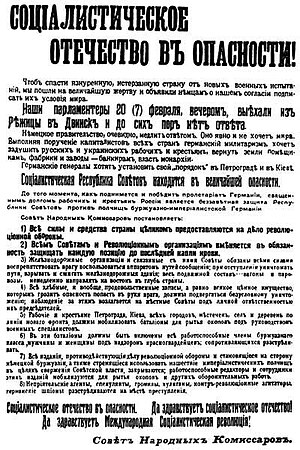 Leaflet with the decree of the Council of People's Commissars "The Socialist Fatherland is in danger" of February 21, 1918 | |
| View | decree |
| State |  RSFSR RSFSR |
| Adoption | The Council of People's Commissars of the RSFSR February 21, 1918 |
| Entry into force | February 21, 1918 |
| First post | February 22, 1918 |
The decree required the "Soviets and revolutionary organizations" to "defend every position to the last drop of blood", to destroy food supplies that could fall "into the hands of the enemy." The railwaymen were ordered to withdraw the rolling stock to the east of the country, to destroy the tracks and railway buildings during the retreat. Mobilization of workers and peasants for digging trenches was also announced [4] . Clause 7 of the decree ordered the closure of "... publications opposing the cause of revolutionary defense and taking the side of the German bourgeoisie, as well as seeking to use the invasion of the imperialist hordes to overthrow the Soviet power ... Workable editors and employees of these publications are mobilized to dig trenches and other defensive works."
On the basis of the decree, appointed by the Bolsheviks as the Supreme Commander-in-Chief N. V. Krylenko signed on February 21, 1918 an order on "revolutionary mobilization."
Richard Pipes, in his fundamental work, The Bolsheviks in the Struggle for Power, draws attention to the last points of the decree. Clause 6 provided for the mobilization of digging trenches "under the supervision of the Red Guards" of "all able-bodied members of the bourgeois class, men and women" under pain of execution. According to the researcher, "the practice of forced labor, which was subsequently applied to millions of citizens of the country, came from here."
Paragraph 8 of the decree declared:
Unfriendly agents, speculators, thugs, hooligans, counter-revolutionary agitators, German spies are shot at the crime scene.
Richard Pipes points out that paragraph 8 thus legalized mass executions on the spot without any trial, opening the “era of communist terror . " The very conduct of these executions was entrusted to the Cheka, February 23, notifying the population that the "counterrevolutionaries" would be "ruthlessly shot by detachments of the commission at the crime scene."
In addition, the persons themselves to be shot were identified by Lenin extremely vaguely and broadly, which immediately provoked the protests of the Left Socialist Revolutionaries , especially the people's commissar I.Z. Steinberg . The People's Commissar himself later recalled:
It was difficult to argue about this with Lenin, and soon our discussion came to a standstill. We discussed the tremendous terrorist potential of this harsh police measure. Lenin was indignant that I objected to her in the name of revolutionary justice and justice. In the end, I exclaimed in exasperation: “Then why do we even need the Commissariat of Justice? Let’s call him honestly the commissariat of social extermination, and this is the end! ”Lenin’s face suddenly brightened, and he replied:“ Well said <...> that’s exactly what we should call him <...>, but we can’t say it directly . ”
The slogan "Fatherland is in danger" was in use even before the revolution (in particular, during the First World War ), and its primary source is the decree of the French National Assembly of July 11, 1792, beginning with the words "Citizens, Fatherland is in danger !" (In the original - Citoyens, La Patrie est en danger ). The slogan “The Fatherland is in danger” was proposed by Pierre Verno , the head of the Girondins , in his speech to the National Assembly on July 3, 1792, calling on citizens to mobilize and rebuff against the armies of Prussia and Austria advancing in France and against the counter-revolution ripening in the country [5] . For the authors of the Council of People’s Decree, the analogy with the situation of Soviet Russia in 1918 was obvious.
Notes
- ↑ "The Socialist Fatherland is in danger!" - an article from the Great Soviet Encyclopedia .
- ↑ Directory of “Political Parties of the Russian Federation” Archived on October 15, 2012. ;
Stadnik I. Who wrote the decree of Vladimir Ilyich // "Moscow News" - March 3, 1991. - No. 9;
Goncharova S. M. On the issue of authorship of the Decree of the Council of People's Commissars “Socialist Fatherland is in danger!” (1918) // “Questions of the history of the CPSU” - 1991. - No. 9. - P. 99−101. - ↑ Trotsky L. Around October (memoirs of 1924) Archived on July 28, 2012.
- ↑ Cherepanov A.I. Under Pskov and Narva - M .: Military Publishing House, 1956. - Ch. 3.
- ↑ L. Geisser . History of the French Revolution 1789-1799 . - SPb. : Printing house A.I. Mamontova and Co., 1870. - S. 243. - 459 p.