The Long-Range Aviation Command is the unification of the Air Force of Russia under the command of the Commander of the Russian Air Force . It is a strategic aviation component of Russia's strategic nuclear forces .
| Long-Range Aviation Command | |
|---|---|
 Russian Air Force flag | |
| Years of existence | 2009 - present vr. |
| A country |  Russia Russia |
| Subordination | Commander-in-Chief of the Russian Aerospace Forces |
| Included in | Russian Air Force |
| Type of | Command |
| Function | protection |
| Dislocation |  Moscow Moscow |
| Equipment | Tu-22M3 , Tu-95MS , Tu-160 bomber bombers |
| Participation in | Russian military operation in Syria |
| Commanders | |
| Current commander | lieutenant general Sergey Kobylash |
| Famous commanders | see list |


History
The date of creation of Long-Range Aviation is December 10 (23), 1914 , when Emperor Nicholas II approved the decision to create a squadron of Ilya Muromets air ships. The head of the squadron was Mikhail Shidlovsky (a former naval officer, chairman of the board of shareholders of the Russian-Baltic Carriage Works, on which Ilya Muromets aircraft were built).
By April 1917, the squadron included four combat detachments, about 20 bombers. In September 1917, German troops approached Vinnitsa , where at that time a squadron of aircraft was stationed, so the planes were burned so that they would not go to the enemy.
By a decree of the Council of People’s Commissars of March 22, 1918, it was prescribed to form the Northern group of Ilya Muromets air ships, consisting of three combat units. Thus began the revival of Long-Range Aviation in the RSFSR.
In 1933, for the first time in the world, heavy bomber aviation corps were formed, which were armed with the TB-3 bomber. In January 1936, the first aviation army of the reserve VGK (Special Purpose Army - GA) was formed. In the same year, DB-3 twin-engine long-range bombers began to enter the troops (after modernization, DB-ZF ( Il-4 )). In 1936-1938, three special-purpose air armies were created, which were directly subordinated to the People's Commissar of Defense of the USSR.
In 1940, the Long-Range Bomber Aviation of the High Command of the Red Army (DBA GK) was created, and the directorates of the special forces were disbanded. By mid-1941, the DBA GK included five air corps, three separate air divisions, and one separate air regiment: with a total of approximately 1,500 aircraft (13.5% of the total fleet of the Red Army Air Force) and almost 1000 combat-ready crews. By the Decree of the GKO on March 5, 1942, Long-Range Bomber Aviation was transformed into Long-Range Aviation (ADD) with direct subordination to the Headquarters of the Supreme High Command. General Alexander Golovanov was appointed commander of the ADD [1] .
On the basis of the 18th Air Army, by decree of the Council of Ministers of the USSR of April 3, 1946, Long-range aviation of the USSR Armed Forces was created. The Long-Range Aviation included air armies with command and control in Smolensk, Vinnitsa and Khabarovsk:
- 1st Air Army of Long-Range Aviation . Formed on April 9, 1946 on the basis of formations of the 3rd Air Army with headquarters in Smolensk. On February 20, 1949, on the basis of a directive of the General Staff of the USSR Armed Forces, it was renamed the 50th Air Army of Long-Range Aviation [2] . In connection with the Air Force reductions, on July 1, 1960, it was reorganized into the 50th Missile Army , and the aviation units were reduced to the 6th separate heavy bomber aviation corps .
- 2nd Air Army of Long-Range Aviation . It was formed on April 9, 1946 on the basis of the formations of the 8th Air Army and the air forces of the Kiev Military District with headquarters in Vinnitsa. On February 20, 1949, on the basis of a directive of the General Staff of the USSR Armed Forces, it was renamed the 43rd Air Army of Long-Range Aviation . In connection with the Air Force reductions, on July 1, 1960, it was reorganized into the 43rd Missile Army , and the aviation units were reduced to the 2nd separate heavy bomber aviation corps .
- 3rd Air Army of Long-Range Aviation . It was formed on April 9, 1946 on the basis of formations of the 7th Air Army with headquarters in the Moscow Region (1945–1946), and from 1946 in Khabarovsk. On February 20, 1949, on the basis of a directive of the General Staff of the Soviet Army, it was renamed the 65th Air Army of Long-Range Aviation . In connection with the reduction of the Air Force in mid-1953 disbanded.
- 5th Air Army of Long-Range Aviation . Formed in 1957 on the basis of parts and formations of the 84th heavy bomber aviation corps with headquarters in Blagoveshchensk. In connection with the reduction of the Air Force on July 1, 1960, it was reorganized into the 8th heavy bomber aviation corps .
Armed in 1948, the Tu-4 bomber became the first Soviet carrier of nuclear weapons. By decision of the Council of Ministers of the USSR of August 29, 1951 No. 3200-1513, the USSR Ministry of War began to form a part armed with atomic bombs, with the code name "Training Unit No. 8" as part of 22 Tu-4 combat aircraft. She was stationed at the Bolbasovo airfield. Colonel V. A. Trekhin was appointed commander of the regiment. In 1954, on the basis of this unit, the first aviation regiment of nuclear carrier aircraft was created - the 402nd Tbap, led by Colonel N. I. Parygin, and a little later, the second such unit - the 291st Tbap of Colonel N. M. Kalinin . Both regiments entered the so-called “special” air division - 160th battalion of Colonel V.A. Trikhin, reporting directly to the Deputy Commander-in-Chief of the Air Force - chief of the 6th Air Force Directorate, Lieutenant General of Aviation N. I. Sazhin.
In 1954, the first Soviet long-range jet bomber Tu-16 entered service with Long-Range Aviation. As of January 1, 1955, there were 30 heavy bomber regiments in Long-Range Aviation, which were part of:
- two Tbad on Tu-16 bombers (54 aircraft with a staff of 130 aircraft);
- ten Tbad on the Tu-4 (63-94 aircraft in the division, 100% equipped).
One division on the Tu-16 (43 aircraft) and one division on the Tu-4 (63 aircraft) were considered special (i.e., formations of aircraft carriers of nuclear weapons) and received appropriate training.
In addition to the bombers, Long-Range Aviation included:
- five aviation regiments of long-range reconnaissance aircraft on Tu-4 aircraft (18 aircraft each with a staff of 22 Tu-4);
- seven MiG-15bis fighter aviation regiments as part of two fighter air divisions (76 aircraft each with a staff of 116 aircraft) and one separate fighter aviation regiment (33 MiG-15bis with a staff of 36 aircraft);
- transport air division (35 Li-2 ) [3] .
As of January 1, 1958, 1,120 Tu-16 jet bombers and 778 Tu-4 piston bombers were in service with Long-Range Aviation.
Since 1958, the so-called “engineering” regiments (the first two on the basis of the 362nd and 454th Tbap), which were actually intended for the operation and combat use of the first Soviet medium-range strategic missiles R-12, began to form in Long-Range Aviation. and R-14 - there were ten such regiments by December 1959. Since 1959, aviation regiments began to be converted directly into missile; in particular, the 37th, 198th, 229th, 250th, 157th Tbap. Several regiments of Tu-16 bombers were transferred to the Navy Aviation (12th, 169th, 172nd and 240th Tbap).
In 1954–1955, the 116th Heavy Aviation Division was formed as part of Long-Range Aviation on Tu-4K aircraft for the first Russian missile aircraft (the term “ cruise missile ” was introduced by order of the USSR Minister of Defense to replace the term “projectile” in 1960 .) KS-1 Comet .
In 1960, in connection with the creation of the Strategic Missile Forces, two of the three Air Force Directorates of the Long-Range Aviation were transferred to the Strategic Missile Forces.
In 1961, the organization of Long-Range Aviation was changed, the basis of which was made up of three separate heavy bombing corps:
- 2nd Separate Heavy Bomber Aviation Corps ( Vinnitsa );
- 6th Separate Heavy Bomber Aviation Red Banner Corps ( Smolensk );
- 8th Heavy Bomber Aviation Corps ( Blagoveshchensk ).
To manage the regiments and divisions of the former 43rd Air Army, they formed the 2nd separate heavy bomber air corps of Long-Range Aviation with a deployment in Vinnitsa.
In 1961, the 2nd hatch included:
- 13th Guards Tbad ( Poltava ) as part of the 184th ( Priluki ), 185th and 225th Tbap on Tu-16 aircraft (both at the Poltava airfield);
- 15th Guards Tbad ( Zhytomyr ) as part of the 250th Tbap ( Stryi ), the 251st Tbap ( Belaya Tserkov ) on Tu-16 aircraft and the 341st Tbap ( Ozernoye ) on Tu-22 aircraft;
- 106th Tbad ( Uzin ) consisting of 182th Tbap ( Mozdok ), 409th and 1006th Tbap (both at the Uzin airfield) on Tu-95K and Tu-95M aircraft ;
- 199th Guards odrap ( Nizhyn ) on Tu-16 aircraft.
To manage the regiments and divisions of the former 50th Air Army, in 1960 formed the 6th separate heavy bomber air corps of Long-Range Aviation with a deployment in Smolensk.
In 1961 it included:
- 22nd Guards Donbass Tbad ( Bobruisk ) consisting of the 121st Tbap ( Machulishchi ), the 200th Tbap (Bobruisk) on the Tu-16 aircraft and the 203rd Tbap ( Baranovichi ) on the Tu-22 aircraft;
- 55th Stalingrad Tbad ( Migalovo ) as a part of the 45th Tbap (Migalovo), the 173rd Tbap (Migalovo) and the 52nd Tbap ( Shaikovka ) on Tu-16 aircraft;
- 201st Tbad ( Engels ) consisting of 1096th and 1230th Tbap on 3M airplanes (both at Engels airfield);
- 326th Tarnopol Tbad ( Tartu ) consisting of 132th Tbap (Tartu), 402th Tbap ( Bolbasovo ) and 840th Tbap ( Soltsy ) on Tu-16 aircraft;
- 290th odrap ( Zyabrovka ) on Tu-22R aircraft ;
- 179th UAE ( Šiauliai ) on M-4 aircraft [4] .
In 1980, on the basis of these corps, three air armies of the Supreme High Command were formed:
- 46th Air Red Banner Army of the Strategic High Command (Smolensk);
- 30th Air Army of the Supreme Strategic High Command (Irkutsk);
- 24th Air Army of the Supreme High Command for operational purposes (Vinnitsa).
The Long-Range Aviation Command was reorganized into the 37th Air Force of the Supreme Strategic High Command with headquarters in Moscow.
The Long-Range Aviation Command was re-established on February 25, 1988. It includes:
- 30th Air Army of the Supreme Strategic High Command (Irkutsk);
- 37th Air Army of the Supreme Strategic High Command (Moscow);
- 46th Air Red Banner Army of the Strategic High Command (Smolensk);
- 43rd center for combat use and retraining of long-range aviation flight personnel (Ryazan).
On April 1, 1998, the Long-Range Aviation Command was transformed into the 37th Air Army of the Supreme High Command (strategic mission) . AT
On August 5, 2009, the 37th Air Force of the Strategic High Command was again reorganized into the Long-Range Aviation Command.
As part of the execution of the state defense order, the Gorbunov Kazan Aviation Plant has been upgrading the Tu-160 (Tu-160M) and Tu-214 aircraft for long-range aviation since 2017. The delivery of the first modernized aircraft is planned for 2021 [5] .
Participation in operations
- The military operation of Russia in Syria - since November 17, 2015 [6] .
Commanders
- Golovanov Alexander Evgenievich , Chief Marshal of Aviation (1946-1948)
- Rudenko Sergey Ignatievich , Colonel General of Aviation (1950-1953)
- Novikov Alexander Alexandrovich , Chief Marshal of Aviation (1953-1955)
- Sudets Vladimir Alexandrovich , Marshal of Aviation (1955-1962)
- Reshetnikov Vasily Vasilievich (1969-1980)
- Gorbunov Ivan Vladimirovich , Colonel General of Aviation (1980-1985)
- Deinekin Peter Stepanovich , lieutenant general (1985-1990)
- Kalugin Igor Mikhailovich , Colonel General (1990-1997)
- Oparin Mikhail Mikhailovich , Lieutenant General (1998-2002)
- Khvorov Igor Ivanovich , lieutenant general (2002-2007)
- Androsov Pavel Vasilievich , Major General (2007-2009)
- Zhikharev Anatoly Dmitrievich , lieutenant general (2009—2016)
- Kobylash Sergey Ivanovich , lieutenant general (September 16, 2016 - present )
Armament
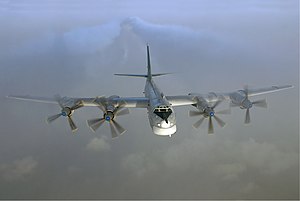
The Long-Range Aviation is armed with the Tu-95 MS and Tu-160 strategic bombers, as well as the Tu-22M3 long-range bombers:
- 64 Tu-95MS aircraft
- 16 Tu-160 aircraft
- about 150 Tu-22M3 aircraft
Composition
- Headquarters, military unit 44402 (Moscow)
- 63rd Mitavsky separate communications center for automated controls, military unit 83069 (Smolensk region, Smolensk, aero. Smolensk-North).
- 22nd Guards Heavy Bomber Aviation Donbass Red Banner Division (Saratov Region, Engels):
- 121th Guards Heavy Bomber Sevastopol Red Banner Aviation Regiment of military unit 85927 (former military unit 06987) (Saratov Region, Engels)
technique: 7 units. Tu-160M (02 “Vasily Reshetnikov”, 04 “Ivan Yarygin”, 10 “Nikolay Kuznetsov”, 11 “Vasily Senko”, 17 “Valery Chkalov” 18 “Andrey Tupolev”, 9 “Valentin Bliznyuk”), 9 units. Tu-160 (03 “Pavel Taran”, 05 “Alexander Golovanov”, 06 “Ilya Muromets”, 07 “Alexander Molodchiy”, 08 “Vitaliy Kopylov”, 12 “Alexander Novikov”, 14 “Igor Sikorsky”, 15 “Vladimir Sudets ", 16" Alexei Plohov ") - 184th Guards Heavy Bomber Poltava-Berlin Red Banner Aviation Regiment (Saratov Region, Engels)
technique: 18 units. Tu-95MS (10 Saratov, 11 Vorkuta, 12 Moscow, 14 Voronezh, 15, Kaluga 16 Veliky Novgorod, 17, 18, 19 Krasnoyarsk, 20 Dubna, 21 Samara, 22 Kozelsk, 23, 24, 25, 27 Izborsk, 28 Sevastopol, 29 Smolensk) - 52nd Guards Heavy Bomber Aviation Regiment (TBAP), military unit 33310 (Kaluga Region, Shaykovka, aerial. Shaykovka). technique: 23 units. Tu-22M3
(01, 06, 12, 15, 16, 17, 21, 22, 24 “Mikhail Shidlovsky”, 25 “Yuri Deneko”, 26, 28, 35, 36, 38, 41, 42, 43, 44, 45, 46 , 48, 49 “Alexander Bereznyak”)- Aviation Commandant's Office of the 52nd Guards TBAP, military unit 33310-A (Novgorod Region, Soltsy, aer. Soltsy)
- 40th mixed aviation regiment (SAP), military unit 36097 (Murmansk region, Olenegorsk-8, p. Vysokiy, aerial Olenya)
technique: 4 units. An-12 (10, 11, 19, 26), 3 units. Mi-26 (80, 81, 82),, 6 units. Mi-8MT (07, 17, 70, 77, ...)- Aviation Commandant of the 40th SAP, military unit 36097-A (Komi Republic, Vorkuta, aero. Soviet).
- 121th Guards Heavy Bomber Sevastopol Red Banner Aviation Regiment of military unit 85927 (former military unit 06987) (Saratov Region, Engels)
- The 326th Heavy Bomber Aviation Tarnopol Order of the Kutuzov Division (Amur Region, Seryshevo-2, village of Ukrainka):
- 79th Heavy Bomber Order of the Red Star Aviation Regiment (TBAP), military unit 62266 (Amur Region, p. Seryshevo-2, s. Ukrainka, aer. Ukrainka)
technique: 14 units. Tu-95MS (01 Irkutsk, 02 Mozdok, 03, 04, 06, 07, 10, 20, 21, 22, 26, 28, 41, 43) - 182-й гвардейский тяжелый бомбардировочный Севастопольско-Берлинский Краснознаменный авиационный полк (ГТБАП), в/ч 75715 (Амурская обл., п. Серышево-2, с. Украинка, аэр. Украинка). техника: 16 ед. Ту-95МС (45, 47, 49 ,50, 51, 52, 53, 54, 55, 56, 57, 58, 59 «Благовещенск», 60, 61, 62)
- авиационная комендатура 182-го ГТБАП, в/ч 75715-А (Чукотский АО, г. Анадырь, аэр. Угольный).
- 200-й гвардейский тяжелый бомбардировочный Брестский Краснознаменный ордена Суворова авиационный полк, в/ч 35020 (бывш. в/ч 62266-Б) (Иркутская обл., Усольский р-н, п. Средний, аэр. Белая). Техника: 15 ед. Ту-22М3 (01, 02, 21, 22, 25, 26, 27, 30, 31, 33, 34, 37, 46, 58, 67)
- авиационная комендатура 200-го ГТБАП, в/ч 35020-А (Республика Саха — Якутия, Булунский улус, п. Тикси, аэр. Тикси): 1 ед. Ми-8AMTSh-VA (17)
- авиационная комендатура (о-в Котельный, Новосибирские о-ва, аэр. Темп).
- 444-й тяжелый бомбардировочный авиационный полк (Иркутская обл., Усольский р-н, п. Средний, аэр. Белая). Полк переведен из Воздвиженки.
Техника перенесена из Советская Гавань. техника: 14 ед. Ту-22М3 (03, 24, 37, 42, 43, 47, 48, 50, 51, 53, 54, 55, 56, 58) - 181-я отдельная смешанная авиационная эскадрилья (Иркутская обл., Усольский р-н, п. Средний, аэр. Белая)
техника: 2 ед. Ан-12, 3 ед. Ан-30 (30, 31, 33), 2 ед. Ан-26 (58, 59)
- 79th Heavy Bomber Order of the Red Star Aviation Regiment (TBAP), military unit 62266 (Amur Region, p. Seryshevo-2, s. Ukrainka, aer. Ukrainka)
- 43-й гвардейский Орловский центр боевого применения и переучивания летного состава дальней авиации, в/ч 41521 (г. Рязань, аэр. Дягилево):
- 49-й инструкторский тяжелый бомбардировочный Краснознаменный авиационный полк в/ч 52654 (г. Рязань, аэр. Дягилево)
техника: 6 ед. Ту-95МС(20 «Рязань», 22 «Челябинск», 23 ...) , 6 ед. Ту-22М3 (33, 34, 35, ...), 1 ед. Ил-78 (34), 1 ед. Ту-134AK, 2 ед. Ми-8МТ - 27-й смешанный авиационный полк, в/ч 77977 (г. Тамбов, аэр. Тамбов): 2 ед. Ан-12, 8 ед. Ан-26, 10 ед. Ту-134УБЛ (УБШ).
- 49-й инструкторский тяжелый бомбардировочный Краснознаменный авиационный полк в/ч 52654 (г. Рязань, аэр. Дягилево)
- 203-й отдельный гвардейский авиационный Орловский полк самолётов-заправщиков (г. Рязань, аэр. Дягилево)
техника: 12 ед. Ил-78М (30, 31, 32, 35, 36, 50, 51, 52, 80, 82, 83, 1 ед. Без борта), 6 ед. Ил-78 (33, 79, 81 , 86, 2 ед. Без борта) - Музей Дальней авиации , в/ч 41521 (г. Рязань, аэр. Дягилево).
Basing
Командование (штаб) дальней авиации — город Москва. Соединения и части базируются на всей территории России.
Notes
- ↑ Голованов А. Е. Дальняя бомбардировочная… Воспоминания Главного маршала авиации 1941—1945. — М. : Центрполиграф , 2007. — (Без купюр). — ISBN 978-5-9524-3033-4 .
- ↑ Директива Генерального Штаба № орг/1/120030 от 10.01.1949 г.
- ↑ Николаев А. ДАЛЬНЯЯ АВИАЦИЯ: САМОЛЕТЫ И ЛЮДИ
- ↑ А.Николаев. ДАЛЬНЯЯ АВИАЦИЯ: САМОЛЕТЫ И ЛЮДИ
- ↑ Глава военного ведомства проконтролирует ход работ по производству и модернизации самолётов дальней авиации в Казани / mil.ru , 30.01.2019
- ↑ Массированные авиационные удары крылатыми ракетами и авиабомбами по объектам ИГИЛ нанесли самолеты Дальней авиации ВКС России : Министерство обороны Российской Федерации
Literature
- Голованов А. Е. [http://militera.lib.ru/memo/russian/golovanov_ae/index.html Дальняя бомбардировочная… Воспоминания Главного маршала авиации 1941—1945]. — М. : Центрполиграф , 2007. — (Без купюр). — ISBN 978-5-9524-3033-4 .
See also
- День дальней авиации ВКС России
- 8-я воздушная армия (США)