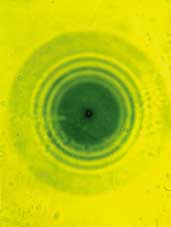
Radiooreol [1] ( English Radiohalo ), pleochroic halo [2] [3] ( English pleochroic halos ) is a microscopic spherical shell with a changed color, found inside minerals , such as biotite , contained in granites and other igneous rocks . These shells are places of radioactive damage caused by the inclusion of the smallest radioactive crystals in the main crystalline structure. Such inclusions are usually zircon , apatite, and titanite , within the crystal structure of which uranium or thorium can be located [4] . The most common is the explanation that the color change is caused by alpha particles emitted by radioactive nuclei [5] . The radius of the concentric shells is proportional to the energy of the alpha particle. The phenomenon of radiooreoles has been known to geologists since the beginning of the 20th century, but a wider interest was caused by statements by creationist Robert Gentry that radiooreoles in biotite testify to the young age of the Earth [6] . These claims have been refuted by the scientific community as an example of creationist pseudoscience [7] .
The formation of radio-reales
Uranium-238 is the beginning of the radioactive series of radium , which ends in lead-206 . The following isotopes emit alpha particles ( beta particles cannot form separate rings due to the continuous redistribution of energy and greater penetrating power):
| Isotope | Half-life | Energy in MeV |
|---|---|---|
| U-238 | 4.47x10 9 years | 4,196 |
| U-234 | 2,455x10 5 years | 4,776 |
| Th-230 | 75,400 years | 4.6876 |
| Ra-226 | 1599 years | 4,784 |
| Rn-222 | 3,823 days | 5,4897 |
| Po-218 | 3.04 minutes | 5,181 |
| Po-214 | 163.7 microseconds | 7,686 |
| Po-210 | 138.4 days | 5,304 |
| Pb-206 | stable | 0 |
The final characteristics of the radiooreoles depend on the initial isotope , and the size of the rings depends on the alpha decay energy. Theoretically, radiooreoles formed from uranium-238 have 8 rings, including five distinguishable under a light microscope, while radiooreoles formed from polonium have 3 rings. In radio-rheoles from uranium-238, the rings of uranium-234 and radon-226 coincide with the ring from thorium-230 into one ring, the rings of radon-222 and polonium-210 also coincide in one ring [8] . These rings are indistinguishable from each other under a light microscope , but the rings of radon-222 and polonium-210 can be distinguished from each other by other means [9] .
Giant radio rheoli caused controversy when Robert Gentry suggested that they were formed by the decay of unknown transuranic elements [10] .
Polemic
Robert Gentry studied radiooreols, which he assumed to have arisen from polonium-218, rather than uranium-238, and came to the conclusion that hard rocks should have formed with inclusions from this isotope of polonium. But, since the half-life of this isotope is about 3 minutes, these rocks, according to Gentry, could not be formed from molten rocks that require thousands of years to cool (standard theory). This was perceived by creationists as confirmation that the Earth was created instantly [6] .
Gentry’s critics, including Thomas Bayol [11] and John Brauli [12] , note that polonium-218 is a decay product of radon, which is a gas and can penetrate from one part of the rock (in which it was formed from uranium) to another and form radiooreoles without uranium. Apparently, a large number of radon atoms are adsorbed in one place. This was not proved experimentally, but is confirmed by the fact that the “polonium halos” found by Gentry are located along microcracks in the rocks, and in these rocks there are also normal uranium radio reoles [7] .
Gentry's work was supported and continued by the creationist project Radioactivity and the Age of the Earth (RATE ), which ran from 1997 to 2005. However, creationist claims about the young age of the Earth, based on data on radio-aureoles, have been repeatedly refuted by scientists in scientific publications [7] [13] .
Notes
- ↑ English-Russian geological dictionary. Ed. P. P. Timofeeva and M. N. Alekseev. - M.: “Russian language”, 1988. p.324
- ↑ There are also options for a pleochroic shell , a pleochroic “courtyard” . Unscientific publications also use tracing paper from English - radio halo
- ↑ English-Russian geological dictionary. Ed. P.P. Timofeev and M.N. Alekseev.— “M.: Russian language”, 1988. p.210
- ↑ Faure G. Principles of Isotope Geology. Wiley, 1986. pp. 354–355
- ↑ Henderson GH, Bateson S. “A Quantitative Study of Pleochroic Haloes, I” // Proceedings of the Royal Society of London, Series A, Containing Papers of a Mathematical and Physical Character, 1934, 145 (855): 563-581
- ↑ 1 2 Gentry RV Creation's Tiny Mystery // Earth Science Associates, 1992. (Published in 2004)
- ↑ 1 2 3 Wakefield JR The geology of 'Gentry's Tiny Mystery' // Journal of Geological Education, 1988, 36: 161-175
- ↑ Pal DC Concentric rings of radioactive halo in chlorite, Turamdih uranium deposit, Singhbhum Shear Zone, Eastern India: a possible result of 238U chain decay (unavailable link from 05/05/2013 [2271 days]) // Current Science, 2004, 87 (5): 662–667, 10
- ↑ Gentry RV Radiohalos in a Radiochronological and Cosmological Perspective // Science, 1974, 184 (4132): 62-66
- ↑ Gentry RV Giant Radioactive Halos: Indicators of Unknown Alpha-Radioactivity? // Science, 1970, 169 (3946): 670—673
- ↑ Baillieul TA “Polonium Haloes” Refuted. A Review of "Radioactive Halos in a Radio-Chronological and Cosmological Perspective" by Robert V. Gentry
- ↑ Brawley J. Evolution's Tiny Violences: The Po-Halo Mystery. An Amateur Scientist Examines Pegmatitic Biotite Mica
- ↑ Collins L. Polonium Halos and Myrmekite in Pegmatite and Granite / Hunt CW, Collins LG, Skobelin EA Expanding Geospheres, Energy And Mass Transfers From Earth's Interior.— Calgary: Polar Publishing Company, pp. 128-140