
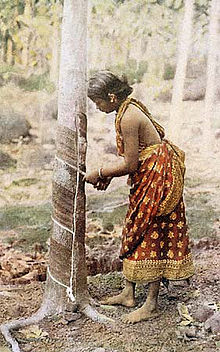
Socket - periodically applying special cuts to a tree trunk during its growing season in order to produce plant life products, such as coniferous resins ; tropical rubber latex ; sugary juices of birch and maple ; gum and others
Content
Types of hooking
- ordinary
- chemical
- using bleach
- using sulfuric acid
- using sulfuric acid paste
- using polymer pastes
- using sulphite-bardy concentrates
Timing and frequency of tapping
The hooking can be:
- short term - up to 5 years,
- long term - more than 5 years,
- long - it is supposed reuse with updating overgrown karr .
Trimming Receiving
To obtain the resin, the pine is mainly pinched, much less often other conifers (spruce, larch, fir). Hogging for the production of turpentine produce a few years before felling of the stand . A wound is inflicted on the tree - carr , a special tool - a hack
Pre-industrial sludge production
Getting sap from growing trees is an ancient form of forest management. Tripping of coniferous trees has been going on since the 4th century AD.
At the beginning of the XVII century, wood tar becomes an important product of international trade.
Development of underclothing production in the USSR
The geography of tapping
Used in Sri Lanka for the extraction of palm juice for the subsequent production of alcoholic beverages.
Literature
- Reference book "Forest Tripping". Edited by B. V. Tulikov. M., Goslesbumizdat, 1962
- Treinis A. M. Podochka forests. M., Goslesbumizdat. 1961.
- A.S. Yarunov, V.V. Petrik. From the history of the development of forest tapping // “Forest Journal”. 2003. № 5. ISSN 0536-1036.
- Yargin S.V. On the use of stimulants smolovydeleniya on the tip of the forest // Young scientist. 2017. №2. https://moluch.ru/archive/136/37981/