Urgut district (fog) ( Uzbek. Urgut tumani / Urgut fogi ) is one of the administrative units within the Samarkand region (viloyat) of the Republic of Uzbekistan . The administrative center is the city of Urgut .
| Fog (area) | |
| Urgut district | |
|---|---|
| Urgut tumani | |
| A country | Uzbekistan |
| Included in | Samarkand province (region) |
| Adm. Centre | Urgut |
| Hokim | Okbutaev Himmat Kuchkarovich [1] |
| History and Geography | |
| Square | 1.2 thousand km² |
| Height | and |
| Timezone | UTC + 5: 00 |
| The largest city | Urgut |
| Population | |
| Population | 420 065 people ( 2012 ) |
| Nationalities | Uzbeks , Tajiks, Iranians , Arabs , Tatars , Russians , etc. |
| Denominations | Muslims , Christians |
| Official language | Uzbek |
| Digital identifiers | |
| Auto Code numbers | thirty |
| Official site | |


Content
Location and Geography
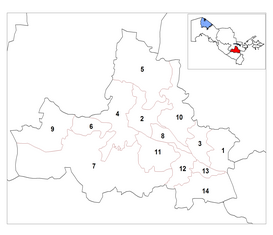
Urgut district is located in the southeastern part of the Samarkand region. It borders on the north side with the Bulungur and Samarkand regions, in the north-west the Tailak region , in the south the Kitab district of Kashkadarya region , and the Republic of Tajikistan on the east. The main part of the region is occupied by mountains. The western part of the Zeravshan Range passes through the territory of the district. The area of the district is 1.2 thousand km² [2] .
History
During the time of the Bukhara emirate, the Urgut bekstvo was semi-independent of Bukhara. From the 18th century to 1868 , the local Uzbek Ming dynasty , akin to Kokand mingas, ruled Urgut.
After the conquest of the territories of the Bukhara emirate by the Russian Empire in 1868, an administrative unit was formed as part of the Central Asian possessions of the Russian Empire - Zerafshan District . The structure of this district includes the cities: Samarkand , Urgut , Kattakurgan , Chilek and Paishanba . Thus, for the first time, the territory of today's Urgut region has entered a clearly defined administrative unit. On January 1, 1887, the Zeravshan district was abolished, and its territory was included in the newly formed Samarkand region . This region was divided into four counties: Jizzakh , Katta-Kurgan , Samarkand and Khojent . The territory of today's Urgut region was part of the Samarkand district of the region [2] .
On April 30, 1918, the territory of the Samarkand region became part of the Turkestan ASSR , and on October 27, 1924, as a result of the national-territorial demarcation of Central Asia in the USSR, the Samarkand region became part of the newly formed Uzbek SSR . After the Samarkand region entered the Uzbek SSR on September 29, 1926, the Urgut region was formed, which existed as part of the Samarkand region until the collapse of the USSR and Uzbekistan gained independence. After Uzbekistan gained independence, the region continues to be part of the Samarkand region [2] .
Nature
Climate
The climate of the district is subtropical inland , with hot and dry summers and cold winters. The average annual temperature is +16.5 ° C; the average January temperature is -1.5 ° C; the average July temperature is +24.5 ° C. The absolute minimum temperature was –25 ° C, the absolute temperature maximum +49 ° C. On average, 459-500 mm of precipitation falls in the territory of the region per year (48% of precipitation falls in spring). The growing season lasts 215–217 days [2] [3] .
Soil
The soil cover of the Adyrs is formed by gypsum serozems , meadow gray-earth soils and salt marshes [2] [3] .
Relief
The relief of the Urgut region is diverse, represented mainly by hills and mountains. Lowlands are common in the northern part of the region; Adyrs are widespread everywhere. Mountains occupy the southern and eastern parts of the territory where the western part of the Zeravshan Range is located . The heights in the region accordingly increase in the direction from north to south and from west to east. The southern part of the district is on average 1000 meters above sea level. The rest of the district is located at an altitude of 500 to 900 meters above sea level. The highest point of the district is the Takhtakaracha Pass with a height of 1675 meters. Through the pass and the territory of the district passes a large Uzbekistan tract. The hills are formed by sandstones and loesses . The foothills of many mountains consist of slate . The territory of the district is included in the seven-point seismic zone [2] [3] .
Hydrography
From the Zeravshan Range, the watercourses Amankutansay , Bulbulzarsay , Gizhduvansay , Gussay , Urgutsay , Kamongaronsay , Karatepasay and others flow . Their waters are used for irrigated agriculture, practiced on the gentle slopes at the foot of the mountains [2] [3] .
The area also has water channels, the largest of them: Dargom , Yangiarik , Yangi Urgut . Groundwater lies in the district. In the northern part they are located at a depth of 1-2 m from the surface, in the southern - at a depth of 8 to 20 m [2] [3] .
Flora and Fauna
On the territory of the district, combers , camel thorns , wormwood and other plants are widespread, which are of great feed value for astrakhan sheep bred here. In mountainous areas, wild goose , apple tree , juniper , walnut , pistachio , almond , rose hip , barberry are found in wild form [2] [3] .
Wolves , wild boars , foxes , hares , various species of lizards, snakes and birds are widespread in the region [2] .
Guide
The head of administration ( khokim ) of the Urgut region is currently Okbutaev Himmat Kuchkorovich. The building of the district administration is located in the city of Urgut on Alisher Navoi Street, 104 [1] .
Administrative-territorial structure
The administrative center of the district is the city of Urgut with a population of about 60 thousand people, which at the same time is the only settlement with the status of a city in the region. As of January 1, 2012, the district includes seven urban-type villages ( Gus , Dzhartepa , Spain , Kamangaron , Kenagas , Pochvon , Uramas ), 10 rural gatherings of citizens, of which 102 mahalla gatherings of citizens and 40 mahallas , 115 rural settlements paragraphs [1] [2] .
Population
As of January 1, 2012, 420 065 people lived in the district, including 182 135 people in cities, 237 930 people in rural areas. 211 112 (91,962 in cities) are male and 208,953 (90,173 in cities) are female [1] . The population density as of 2002 was 300 people per 1 km². In the national composition of the population, the majority are Uzbeks . A significant number of Tajiks live. Also in the area live Iranians , Arabs , Tatars , Russians , Ukrainians and others [2] [4] .
Farm
Agriculture
The land fund of the district as a whole is 112.0 thousand ha. Of these, 9 thousand hectares are used for growing tobacco. In the Urgut region, mainly developed agricultural sectors : cattle breeding , agriculture ( tobacco growing , gardening , viticulture ). In the mid-2000s, there were 23 shirkat ( cooperative ) farms specialized in animal husbandry, grain growing and vegetable growing. The total number of farms exceeded 380. The area under crops of grain crops was 14.8 thousand hectares, potatoes - 1.8 thousand hectares, tobacco - 9 thousand hectares, melons and fruits - 1.4 thousand hectares, orchards and vineyards - 1.4 thousand ha [2] [5] .
In private and public ownership there were a total of 23 thousand heads of cattle , 36 thousand heads of small cattle ( sheep and goats ), 40 thousand heads of poultry , 2.0 thousand heads of horses in herds [2] .
In the forestry of the region there are 40 thousand hectares of land. Saxaul forests and hazel trees are mainly grown in forestry. The farm supplies the population with about 8 thousand seedlings of walnut and grape per year. In forestry, the procurement of such medicinal plants as oregano , dogrose , and rhubarb is underway [2] .
Industry
On the territory of the Urgut region there are deposits of basalt , limestone and shale . The development of these deposits is conducted in an open way . There are factories for the processing of tobacco, marble and cotton. There are enterprises for the production of bricks, concrete slabs, drinks, confectionery, dairy products. Over 800 different companies and enterprises function. In particular, there is a joint Uzbek-Belgian company UrgGazKarpet, Uzbek-Turkish companies and enterprises UrgANTET YASHAM, Urgut SaMNegin, Urgut Qoplon carpet manufacturing, Uzbek-Turkish marble processing Urgut LADO Marmar, Samplastik for the production of building materials, UzVAT for the processing of tobacco [2] [5] .
Transport
The total length of roads in the territory of the Urgut region is 382 km, of which 245 km are roads of national importance. The railway is absent [2] [5] .
Bus service is supported on the routes Samarkand - Shakhrisabz , Samarkand - Kitab and others [2] .
Social Sphere
Education
In the 2003/2004 academic year, 127 comprehensive schools functioned in the Urgut district. In schools, 102.3 thousand children were educated. As of 2004, there were three vocational colleges [2] .
Culture and Enlightenment
In the Urgut region, the Palace of Culture , 5 cultural houses , and numerous clubs are operating. A central library and 70 libraries are open throughout the district (as of the mid-2000s). Their book fund amounted to approximately 270 thousand works [2] [5] .
In addition to newspapers, magazines, radio stations and television channels distributed throughout Uzbekistan and the Samarkand region, the newspaper Urgut Sadosi ( Ekho Urgut ) and the Chinor television and radio channel are published in the territory of the Urgut region [2] .
Medicine
As of the mid-2000s, there were 8 hospitals (for 830 beds), 27 feldsher-obstetric centers , 36 rural medical centers , 9 rural medical outpatient clinics . In total, about 490 doctors and paramedical workers worked in medical institutions [2] [5] .
Sport
In the Urgut region there are stadiums , gyms , sports grounds and other sports facilities. As of the mid-2000s, 21 sports facilities operated [2] .
Famous Natives
- Rajab Adashev is a famous Soviet and Uzbek film and theater actor. Honored Artist of the Republic of Uzbekistan. Born on July 15, 1944 in the territory of the Urgut region.
- Ablakul Uzakov - Hero of the Soviet Union , commander of the 1st squadron of the 62nd Guards Cavalry Regiment of the 16th Guards Chernigov Cavalry Division. He was born on April 10, 1922 in the village of Karatep, which is located in the Urgut region.
- Nasim Khasanov - Full Knight of the Order of Glory , sergeant of guard, reconnaissance officer of the 41st separate guards reconnaissance company of the 39th guards motorized rifle division . He was born on August 9, 1924 in the village of Uzbek.
Notes
- ↑ 1 2 3 4 Urgut of the Mist (Uzbek) . Khokimiyat of Samarkand region. Date of treatment December 27, 2015.
- ↑ 1 2 3 4 5 6 7 8 9 10 11 12 13 14 15 16 17 18 19 20 21 22 23 Urgut tumani - article from the National Encyclopedia of Uzbekistan (O'zbekiston milliy ensiklopediyasi) (Uzbek)
- ↑ 1 2 3 4 5 6 беки Uzbekistan Tabi Geography, 2006 , p. 165.
- ↑ Ethnic Atlas of Uzbekistan. - Tashkent: “IOOFS - Uzbekistan”, 2002. - S. 436. - 452 p. - ISBN 5-862800-10-7 .
- ↑ 1 2 3 4 5 O`zbekiston iqtisodiy va ijtimoiy geografiyasi, 2008 , p. 178.
Literature
- Urgut fogi - National Encyclopedia of Uzbekistan . - Tashkent, 2000-2005. ( Uzbek )
- Ethnic Atlas of Uzbekistan. - Tashkent: “IOOFS - Uzbekistan”, 2002. - S. 436. - 452 p. - ISBN 5-862800-10-7 .
- O`zbekiston iqtisodiy va ijtimoiy geografiyasi. - Bukhara: O`qituvchi, 2008 .-- 178 p. ( Uzbek )
- Uzbekistan tabi geography. - Kokand: Publishing House of KSPI named after Mukimi, 2006. - 165 p. ( Uzbek )