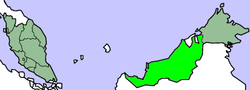
Sarawak is a state in the northern part of Kalimantan Island, which existed from the middle of the 19th century to the middle of the 20th century, and was ruled by the English dynasty.
| Historical State | |||||
| Sarawak | |||||
|---|---|---|---|---|---|
| |||||
| Motto : "Dum Spiro Spero ( Malay. Berharap Selagi Bernafas ) " | |||||
| Anthem : Gone Forth Beyond The Sea | |||||
 | |||||
←   → →1846 - 1946 | |||||
| Capital | Kuching | ||||
| Languages) | English , Ibanian , Malay , Chinese | ||||
| Currency unit | Sarawak dollar | ||||
| Square | 124 450 | ||||
| Form of government | monarchy | ||||
| Dynasty | White Rajas | ||||
| rajah | |||||
| • 1841–1868 | James brooke | ||||
| • 1868–1917 | Charles Anthony Brooke | ||||
| • 1917–1946 | Charles Weiner Brooke | ||||

Content
History
Establishment of an independent state
In the 1830s, the western region of the Sultanate of Brunei was ruled by the governor of Makot, whose abuses caused an uprising of the local Dayak tribes. Sultan sent an heir to the throne of Hashim to Saravak, who was never able to suppress the uprising. As a result, the Malay nobility of Brunei retained power only over the administrative center of Sarawak - Kuching - and its small district.
At this time, James Brooke appeared, who, after receiving an inheritance, equipped the yacht and set off for the Malay Archipelago in search of adventure. Arriving in Kuching in 1839, he became friends with Hashim. By helping Hashim suppress the Dayak uprising, Brooke received in 1841 the title of rajah and the post of governor of Sarawak.
The British government, on the basis of the general policy of not acquiring new territories (the possession of which increased management costs), and also not wanting to complicate relations with the Netherlands, reacted negatively to Bruk’s proposals on turning Saravak into a colony or protectorate. However, since the British were interested in suppressing piracy that threatened Singapore’s trade, Britain began to assist Brook in establishing power. Brooke, in turn, skillfully used the British military vessels to fight not only against pirates, but also against recalcitrant Dayak tribes, as well as Malay feudal lords.
In 1845, taking advantage of the advent of Admiral Cochran’s squadron, Brooke achieved the removal of his enemies from the power at the Brunei court and the restoration of the positions of Hashim and his brother Bedruddin. In the spring of 1846 a coup took place in the capital of Brunei - pro-English princes led by Hashim and Bedruddin were killed; the party of the Malay nobility, hostile to Brooke, came to power, connected with the pirates of the coast. Then, in August 1846, Brooke, with the support of Cockran's squadron, captured Brunei, and forced Sultan Omar Ali to sign an agreement under which he received sovereign rights to Sarawak, and the island of Labuan became British possession.
James Brooke Board
In 1847, Brooke appeared in triumph in the UK, where he was promoted to knighthood, received a doctorate from the University of Oxford, and was appointed governor of Labuan and the British consul general in Brunei.
Returning to Sarawak, Brooke continued the conquest of the Dayak tribes, using the same pretext - the fight against piracy. In 1849, the British fleet and the Brook saravak flotilla staged a bloodbath at Cape Batang Maru, sinking more than 90 prau in a night attack and killing about 400 people. After the battle, the Dayaks who acted on Brooke’s side beheaded at least 120 prisoners. The Batang Maru massacre became one of the main accusations of the liberal opposition in the British Parliament in the early 1850s, criticizing the actions of the British naval forces. Under pressure from the opposition in 1854, a parliamentary commission was set up to consider charges against Brooke, which justified him.
In 1850, Chinese began to clash with the Dutch authorities, who had established control over the western coast of the island, who had long lived in West Kalimantan. Many Chinese fled to Sarawak, where Brooke welcomed them. However, his policy of tight control over the settlers displeased the Chinese secret societies, and the events of the Second Opium War caused the growth of Chinese nationalism, and in February 1857, the Chinese gold miners from the inner part of Saravak moved to Kuching. Caught by the British by surprise, the Chinese killed several Europeans and their families, and plundered the city. The artillery of the approaching British steamship forced the attackers to retreat, while the Malayan and Dayak detachments of Brooke, who managed to escape, completed the rout of the Chinese, who fled into Dutch territory in panic. Brooke took control of the Chinese population of his property, which increased again in the following years. In 1863, the British government recognized Sarawak as an independent state under the rule of Brooke.
Board of Charles Johnson Brooke
After the death of James Brooke in 1868, his nephew Charles Anthony Brooke became the new ruler. He continued to expand the territory of Sarawak at the expense of Brunei, and clearly intended to turn the entire sultanate into his possession. When the British Northern Borneo Company began operating in Sabah in the 1880s, Charles Brooke was spurred by him, and he occupied a number of new areas of Brunei, causing the sultanate to become a tiny principality, and Sarawak began to border on Sabah. In 1888, Great Britain established a protectorate over all of North Kalimantan, including Sarawak, and in 1906 appointed a resident in Brunei, preventing its final absorption by Sarawak.
Despite the fact that the most powerful centers of anti-British resistance in Sarawak were suppressed under James Bruck, outbreaks of discontent with colonial rule sporadically arose in the inner regions right up to the First World War . The most significant of these was the Dayak uprising of 1893 under the leadership of Banting and Ngumbang. The expedition of 1894, led by Raja Charles Brooke, failed. In 1902, he outfitted another expedition against Banting, but the outbreak of cholera and the resistance of the rebels doomed her to complete failure. In the following years, the Brook troops and police made endless raids on rebellious territories, burning villages, destroying crops, etc., but it was not until 1908 that Banting recognized the power of Brooks and ceased resistance. In 1908-1909, and in 1915, new unrest among the Dayaks took place in Sarawak.
Board of Charles Weiner Brooke
After the death in 1917 of Charles Johnson Brooke, his son Charles Weiner Brooke became his new raja Sarawak. During his reign, a serious blow was struck on the country's economy: the economic crisis of the early 1930s led to a drop in the prices of rubber and pepper, which led to a two-fold drop in government revenues. The devastated Dayaks raised an uprising in the basin of the Kanovit and Entabay rivers in 1931, which was suppressed only in December 1932.
The Second World War brought an increase in demand for oil, rubber, wood and food. Raja Brook in 1940 made Britain two “gifts” worth 1.5 million Malay dollars as Saravak’s contribution to the military efforts of the metropolis.
In September 1941, the centenary of the Brook dynasty in Sarawak was solemnly celebrated in Kuching. A "constitution" was issued, which in vague terms hinted at the possibility of obtaining in the future the "indigenous population" of self-government.
After Japan entered the Second World War during the Borneosky operation, Japanese troops landed at Kuching on December 24, 1941. After a brief exchange of fire, the Punjab battalion defending there retreated to the airfield, and stayed there for the next day, sending the wounded and families of Europeans to the Dutch East Indies . At night, it was decided to take there and combat units. December 31 the remnants of British troops and refugees arrived in Singkavang . Charles Weiner Brooke departed for Sydney , where he remained until the end of the war.
Initially, there was no resistance to the Japanese from the local population in Sarawak; he was called by the occupiers themselves, who began to drive the locals to forced labor, to select rice and food. There were strong pro-British sentiments among the Chinese of Sarawak, and when, from 1943, British intelligence officers began to appear in Sarawak, they met a benevolent reception there. In 1945, Saravak was liberated by Australian troops during stubborn battles, as the Japanese troops stationed there continued to resist even after the surrender of Japan. Australians were able to enter Kuching only on September 11, 1945.
On April 15, 1946, Charles Weiner Brooke returned to Sarawak, and on July 1, 1946, in exchange for a pension, he agreed to transfer Sarawak to the British Empire. This decision, taken without taking into account the views of the local population, led to a powerful protest movement .
Literature
- "History of the East" (in 6 tons). T.IV “The East in the New Time (the end of the XVIII - the beginning of the XX centuries)”, book 1 - Moscow: the publishing company “Oriental Literature” of the Russian Academy of Sciences, 2004. ISBN 5-02-018387-3
- "History of the East" (in 6 tons). T.IV “The East in the New Time (the end of the XVIII - the beginning of the XX centuries)”, book 2 - Moscow: the publishing company “Oriental Literature” of the Russian Academy of Sciences, 2005. ISBN 5-02-018387-3
- "History of the East" (in 6 tons). T.V "The East in Modern Times (1914-1945)", - Moscow: Oriental Literature Publishing Company, Russian Academy of Sciences, 2006. ISBN 5-02-018500-0
- Mozheiko I. V. “The West Wind - Clear Weather”, - Moscow: AST Publishing House, 2001. ISBN 5-17-005862-4