" Jacob Sverdlov "; until July 13, 1926, the Novik was the destroyer of the Russian fleet . Designed and built with funds from the Special Committee for the Strengthening of the Navy for Voluntary Donations . The first pre-production ship. Serial destroyers - "Noviki" - were built on revised projects. In Russian shipyards, in 1911-1916, in six standard versions, 53 ships were laid down in total. By the beginning of World War I, he was the best ship in its class, and served as a world model in the creation of destroyers of the military and post-war generation. The first Russian-built destroyer with steam turbine engines and high-pressure boilers heated only with liquid fuel.
| "Jacob Sverdlov" until July 13, 1926 "Novik" | |
|---|---|
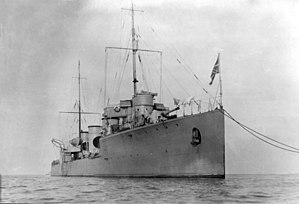 | |
| Service | |
 Russia Russia RSFSR RSFSR USSR (1924-1935) USSR (1924-1935) the USSR the USSR | |
| Class and type of vessel | destroyer |
| Port of registry | on the day of death - Leningrad |
| Manufacturer | Putilovsky plant |
| Construction started | August 1 ( July 3 ) 1910 |
| Launched | July 4 ( June 21 ), 1911 |
| Commissioned | September 11 ( August 29 ), 1913 |
| Withdrawn from the fleet | August 28, 1941 |
| Status | sank off the island of Mokhni in the Gulf of Finland of the Baltic Sea . Coordinates: 59 ° 42's. W, 25 ° 45'c. d. |
| Main characteristics | |
| Displacement | Normal - 1280 t , the largest - 1360 tons; In 1940: standard - 1483 t, normal - 1717 t the largest - 1951 t |
| Length | 102.43 m |
| Width | 9.53 m |
| Draft | 3.53 m |
| Engines | 3 steam turbines "A. E. G. Curtis-Vulcan ", 6 PC" Volcano " |
| Power | 42 000 liters with. (29.44 Mw) |
| Mover | 3 screws |
| Speed | Maximum - 37.3 knots Full - 36 knots, Economic - 21 knots. In 1940: The largest is 32 knots, Full - 30.5 knots, Economic - 16 knots |
| Sailing range | 740 miles (32 knots), 1800 miles (16 knots) (in 1940) |
| Crew | 117 (after modernization 168) people |
| Armament | |
| Artillery | 4 × 10²/60 mm; CAS "Geisler" |
| Flak | 4 × 7.62 mm machine gun "Maxim" system (after modernization replaced by 4 × 12.7 mm DK ), in 1915 one 76.2 / 30 mm was added At the beginning of the 1940s: 2 × 76.2 / 30 mm (inaccurate information), 1 × 45/46 mm 21-K , 4 × 12.7 mm DShK [1] |
| Anti-submarine weapons | 10 GB (after upgrading 28 - 8 BB-1 and 20 BM-1) |
| Mine torpedo armament | 4 twin-tube 457-mm torpedo tubes (after upgrading 3 three-pipe), 50 sea anchor mines |

Content
Design
The experience of the Russo-Japanese War showed the increased role of mine-torpedo weapons, which was widely used in the course of hostilities. The destroyers were widely used by both warring parties and established themselves as universal ships that carried out not only torpedo attacks and reconnaissance and patrol service, but also mine operations, and even supported the coastal flank of the ground forces. During the war, 18 mine cruisers , which were an enlarged version of the standard 350-ton destroyers that formed the basis of the mine forces, were ordered with funds raised by the Special Committee to Strengthen the Navy for Voluntary Donations. Although mine cruisers were more advanced ships with an increased displacement of up to 600-700 tons, improved seaworthiness and enhanced armament, they still could not fully perform the tasks of escorting large ships in any state of the sea. As a result, after all financial calculations with the factories, the “Special Committee” turned out to have unrealized more than 2 million rubles, which it was decided to spend on the construction of a ship in which the experience of the war would be fully taken into account [2] .
At the initiative of the "Special Committee" in December 1905, the Maritime Technical Committee (MTK) held a meeting on this subject. The former commander of the 2nd Pacific Squadron Z. P. Rozhestvensky chaired. At the meeting, the issue of developing mine forces was decided. Some participants proposed the construction of mine cruisers of increased displacement, and the other - small destroyers of coastal defense. Most (14 vs. 9) favored the construction of mine cruisers. The main characteristics were offered at the following level: speed of 28-30 knots, weapons of six to eight long-barreled guns (2 × 120-mm, 6 × 47-mm or 4 × 75-mm), four machine guns, three 450-mm mine vehicles, oil-fired steam boilers with a range of at least 3,000 miles at 12 knots. Rozhdestvensky’s proposal to limit the displacement to 750 tons was not accepted. The question of the type of engine installation remained open, although mechanical engineers present at the meeting spoke in favor of steam turbines. Particular attention was paid to ensuring unsinkability, the strength of the hull and the absence of vibrations at full speed. As a result, a final decision was not made, but it can be considered a starting point for the development of a new type of turbine destroyers [2] [3] .
In the summer of 1907, the "Special Committee", which did not receive any official instructions from the Maritime Department to resolve this problem, formed a technical commission to develop tasks for the design of a high-speed turbine destroyer. The Russian Navy General Headquarters developed the operational-tactical task (OTZ) for the development of a project for a promising 36-node steam-turbine mine cruiser , defining it for the first time in the world as a multi-purpose mine-torpedo-artillery ship intended for reconnaissance, setting minefields in the open sea and cruising raiding operations ... [4] . MGSH focused on the speed, cruising range and seaworthiness of the future ship. He had to perform combat missions in the open sea with a wind of 8-9 points and a wave of 7-8 points, have a speed of 35 knots and a range of about 1800 miles (86 hours of continuous travel at 21 knots). Displacement was limited to 1000 tons. Armament - two 120 mm guns and two twin 450 mm torpedo tubes (2 spare torpedoes on the upper deck) [2] .
Technical specifications for the design were developed by the Maritime Technical Committee (MTK) under the guidance of prominent shipbuilding scientists A. N. Krylov , I. G. Bubnov and G. F. Schlesinger [5] . The conditions were as follows: displacement of 1000 tons, speed at full load of 33 knots, armament of two 120-mm guns, 4 machine guns and three 450-mm mine vehicles, the main power plant - Parsons turbines. On February 11, 1908, the Special Committee sent these conditions to a number of shipyards with a request to inform the cost and construction time of such a ship within two days. The answers received showed that the task was difficult to solve, and, most importantly, the factories did not express a desire to deal with this problem without a guarantee of receiving an order for construction [2] [3] .
In connection with the problems encountered, it was decided to announce an international competition for the design of the “destroyer 36-knot speed” with the right to provide the winning plant with such an order. Invitations were sent in mid-1908, and from October ship projects began to come from them. In January 1909, the commission summed up the results. The projects of four Russian plants were considered (foreign ones were rejected at the preliminary stage as not satisfying the conditions of the competition): Admiralteysky, Creighton, Nevsky and Putilovsky. As a result, the project of the Putilovsky plant, developed under the guidance of engineers D. D. Dubitsky (for the mechanical part) and B. O. Vasilevsky (for the shipbuilding part) [2] [3] [5], was recognized as the winner.
The decision to transfer the order for the construction to the Putilov Plants Society was approved at the general meeting of the “Special Committee” on July 4, 1909, and on July 29, representatives of the plant and committee signed an agreement. The ship should have been presented for testing within 28 months from the date of signing the contract and delivered to the treasury no later than August 1, 1912. For the construction of the "Special Committee" pledged to pay 2 million 190 thousand rubles. The test conditions and fines for exceeding the recess, underspeed and insufficient stability were specified in detail [2] [3] .
Working design was carried out in 1909-1910 by the Putilov factory together with the German company Vulkan, which undertook to design, manufacture and install on the ship a powerful and compact three-shaft boiler turbine plant, which to a large extent determines the feasibility of design tactical and technical requirements [4] . Design was carried out by groups under the direction of the aforementioned D.D. Dubitsky (in the mechanical part) and B.O. Vasilevsky (in the shipbuilding part). The construction was supervised by Lieutenant Colonel of the Marine Engineers Corps (KKI) N.V. Lesnikov and the headquarters captain of the KKI V.P. Kostenko , and on the mechanical part by the headquarters captain of the Corps of Fleet Engineers (KIMF) G.K. Kravchenko . Senior builder K. A. Tennyson [2] [3] .
Construction and testing
In 1910, when on the eve of laying the ship the issue of including it in the list of the Baltic Fleet, the hero of the Russian-Japanese war, the naval forces of the Baltic Sea, Vice-Admiral N.O. Essen , was personally addressed to the Emperor with a request to assign the newest Russian " mine cruiser "name" Novik ", in memory of the cruiser of the 2nd rank (" light destroyer cruiser "), which he commanded in 1902-1904 [6] .
The ship was laid down on July 19, 1910 at the Putilovsky factory in St. Petersburg in the presence of the Minister of the Sea I.K. Grigorovich , on April 4, 1911, he was listed in the Baltic Fleet and launched on June 21, 1911 [7] .
On May 1, 1912, Novik entered the campaign. On May 17, a speed of 35.8 knots was developed at a measured mile off the island of Wulf , that is, a shortfall to the contract speed was 0.2 knots. Despite neither the replacement of screws, nor the careful adjustment of the oil heating system, it was not possible to develop the contract speed on the runs on June 18 and July 1 (average speed of 35.85 knots). After the secondary replacement of the screws on July 30, the destroyer developed 35.275 nodes. As a result, the commission found it impossible to fulfill the contractual conditions in this state of the main power plant. Therefore, the company "Vulcan", which is its manufacturer, in order not to lose face and gain additional experience in the design, manufacture and testing of the engine installation of a ship that has no analogues in any of the fleets of the world, proposed at its own expense to carry out a series of works to increase the heating surface of boilers , replacing nutritious donkeys and fans. The proposal was accepted and the work is scheduled for the summer of 1913 [8] [9] .
August 28 - 30 in the area of about. Björke carried out tests of torpedo weapons both in the parking lot and at speeds of 18 - 34 knots. As a result, the commission decided to establish calls and special signs, since at high speed the whistling of the wind and the noise of the fans drowned out the teams. On September 5–6, reinforcements under the guns were tested for strength — no permanent deformations were observed. From the autumn campaigns it was found that the ship has an excessive metacentric height (0.8 - 1.13 m) and gusty pitching. To solve the problem, the Putilov plant proposed the installation of Fram tanks, indicating that the side keels will reduce speed by about 1.5 knots [8] .
In the spring, the ship was prepared for the transition to Germany, removing weapons and unloading ammunition. May 17, 1913 "Novik" arrived in Stettin . For 3 months, the plant completed all the necessary work: replaced boilers, nutrient donks, fan machines. The length of the bow boiler increased by 213 mm, and the rest - by 294 mm; steam production increased by 15%. A casing was installed above the boiler compartment, as the height of the new boilers was 325 mm higher than the previous ones. Displacement increased to 1296 tons.
During sea trials on August 21, Novik easily reached an average speed for three preliminary runs of 36.92 knots (1360 tons, 42800 hp) and a maximum of 37.3 knots. On August 27, official tests of boilers and mechanisms were in full swing. The tests were considered successful: in three hours the average speed was 36.82 knots (41980 hp, displacement 141 tons more than normal), the highest - 37 knots. They agreed to consider the average speed at full speed equal to 36.2 knots. On August 29, the tests were declared completed, and the ship was fit for admission to the treasury [8] [9] .
Design
General architectural appearance
The main differences between the lead ship and subsequent serial destroyers were a four-pipe silhouette, two superstructures and a three-shaft power plant. The rest - two masts, a high forecastle, extending to a quarter of the length of the ship, a solid main deck and a deck of a forecastle - it was the model for subsequent destroyers [10] .
Housing and Add-in
The case is riveted. The greatest length is 102.43 m, the greatest width is 9.53 m, elongation L: B = 10.75. Particular attention in the design was given to ensuring longitudinal strength at a wavelength of 100 m and a height of 5 m. For this, a high-strength steel with a temporary fracture resistance of 55–70 kg / mm² and an elastic limit of 28 kg / mm² was used in the case set [10] [11 ] [11 ] ] .
The dialing system is mixed with a length of 560 mm. Due to the frames - from stern to the bow. The main feature of the hull design was the use of a longitudinal dialing system in the area of boiler rooms and engine rooms (41−139 sp.), Proposed by I. G. Bubnov . It consisted of an 8 mm vertical keel 1050 mm high with double steel squares along the upper and lower edges, 2 bottom and 1 side stringers on each side, one carling (350 × 1-1.5 mm) per side. This whole structure, together with a 4-mm deck of the second bottom and upper deck , longitudinal bulkheads (3.5 m from the diametrical plane ), 6–9 mm of the outer skin and 11.5 mm of the deck stringer, formed a fairly rigid structure that could withstand longitudinal bending moment in any operating conditions. The double bottom stretched throughout the main power plant (41−139 sp.). The double bottoms were divided by flora into compartments used to store fuel. Outside the machine and boiler rooms, the vertical keel, gradually decreasing, smoothly turned into a vertical forged stem and a figured cast stinger [10] [11] .
The transverse set consisted of frames (double squares 6 mm thick, interconnected by brackets - 4.5-5 mm sheets) and beams of the upper and living decks (5-6 mm squares). In the transverse pattern, a forecastle was also typed (4 mm casing and flooring).
Unsinkability was provided by 9 main waterproof bulkheads on 14, 41, 55, 75, 96, 117, 139, 159 shp. to the upper deck and 175 sp. to the deck of the forecastle. In addition, another 8 (at 20, 28, 37, 142, 146, 153, 165, 169 sp.) Reached the living deck at the ends of the vessel. Sheet thickness: lower belt - 5 mm, upper belt - 3 mm.
The outer skin consisted of 8 belts, including a keel belt and shirstrek. The thickness of the sheets decreased from 9 mm at the keel belt and 8.5 mm at the shirtrack to 6 mm. The connection of the belts with rivets in 3 rows [10] [11] .
The nasal superstructure consisted of a nasal bridge , a combat and a wheelhouse . The conning tower is made of sheets of chrome steel 12.7 mm thick (walls) and 6 mm (roof). In the area of the compass, low-magnetic steel was used. The navigation (navigational) cabin was located behind the battle cabin and was made of 3–3.5 mm steel sheets. The bow bridge was located on top of the conning tower and the wheelhouse, extending over the entire width of the ship and supported by pillers connected by diagonal struts.
The aft superstructure was located behind the fourth chimney and was noticeably larger than the rest of the ships of the series. It housed a radio room and a galley equipped with oil heating. The wings of the aft bridge reached the side. It should be noted the design of the radio room (according to the terminology of the beginning of the 20th century - radio telegraph or cutting of a wireless telegraph). The cabin was soundproofed. Walls and ceiling with an air gap of 45 mm from 3 rows of 12 mm boards with 10 mm layers of felt. On top of the inner boards is also a 10 mm felt. The floor also had a 45-mm air gap, then two 25-mm layers of boards with a 15-mm layer of cork . The entire inner surface - and the floor, and walls, and the ceiling - were covered with linoleum. To reduce vibration and heat from mechanisms, the floor of the radio room was raised above the machine casing. The telephone for communication with the dynamo was located outside the wheelhouse [10] [11] .
During the overhaul of the superstructure of the ship underwent redevelopment. The feed superstructure was expanded by the placement of the premises of the headquarters of the division, the post of the struggle for survivability. Radio room moved to the front of the front chimney. We expanded the nasal bridge and made it covered. In addition, instead of masts, odnodrevki installed tripod masts [12] .
Power plant
The destroyer Novik was the first Russian ship with a steam-turbine power plant operating only on liquid fuel. It should be noted that steam turbines were provided for in the project of battleships of the Sevastopol type and cruisers of the Svetlana type , but on the battleships the heating was pure coal, and on the cruisers it was mixed [13] .
The ship’s boiler-turbine installation itself consisted of three Curtis-AE G. Vulkan steam turbines and six Vulkan - type steam water tube boilers . The machine installation was completely manufactured at the Vulcan factory in Stettin , Germany. The layout of the power plant is linear - at first 6 boilers were located in three boiler rooms, and then steam turbines - 2 in the bow MO and 1 in the stern. The chimneys of the boilers had the following layout: from boilers No. 1 and No. 6 to their own chimneys (first and fourth, respectively), boilers No. 2 - 5 in pairs in the second and third. Steam turbines are direct-acting, that is, the turbine shaft is connected directly to the propeller (including several intermediate shafts ). Each unit consisted of their high pressure turbines (HPT), low pressure turbines (HPH) and reverse turbines (TZH). All components were located on one shaft and in one casing. According to the terms of reference, the power of the TLC should be at least 35% of the power of the forward turbines - TPD (high pressure fuel pump and high pressure pump). The total contracted capacity of 42,000 liters. with. (unofficially up to 42800 hp.) at 640 rpm , which allowed to develop speed when forcing to 37.3 knots . Full speed was 36 knots, economic - 21 knots. The turbines transmitted torque through shaft shafts to propulsors - 3 three-blade bronze propellers with a diameter of 2.4 m with a pitch of 2.3 - 2.2 m [13] [14] .
The ship used triangular-type steam tube boilers - two in each boiler room. Productivity of boilers is 50 t / h (boiler number 1 - 40 t / h) - a total of 290 t / h. The boilers had a heating surface of 850 m² (No. 1 - 720 m²) - a total of 4970 m². The boilers produced supersaturated steam at a pressure of 17 kg / cm² at a temperature of 203 ° C [15] . Boilers were supplied with water by means of reciprocating feed pumps - two per KO. To power KO with two boilers, double power pumps were installed. To heat the feed water, the Norman system heaters (one per KO) were used, working on waste (“crumpled”) steam and allowing heating the feed water to 60 - 80 ° C before it was fed to the boiler. Feed water tanks (two of 13 tons each) were located in front of the bow boiler room and behind the aft engine rooms [13] [14] .
The fuel supply was 351 tons of oil, which was stored in the double bottoms (42 - 139 sp.). Additional fuel could be taken into airborne tanks (75 - 117 sp.) - a total reserve of up to 418 tons. Cruising range of 740 miles at full speed (34 knots) and 1760 miles at economic speed (21 knots) [13] [14] [15 ] .
Inhabitance
Compared to the destroyers of previous generations, Novik had a completely different, more convenient distribution of living quarters. The difference was that the commander’s cabins, officers’s cabins and the campaign cabin were under the forecastle, in the immediate vicinity of the bow bridge, as well as the combat and navigation cabin. But subsequently, an increase in the crew led to a deterioration in his living conditions. In addition to the above premises, the officers included a buffet, a bathroom and officer latrine. Of furniture, each officer’s cabin was equipped with a bunk, a wardrobe, a folding washbasin, a desk, a chair and a hanger [16] .
The lower ranks were located in two aft and one bow stems. Beds were in the form of lockers, beds and hammocks. Team suitcases were stored in lockers, and bed nets on bridges. Conductors for 6 people were located in the aft and were equipped with lockers, located in two tiers, wardrobes for clothes and books, a dining table, chairs, etc.
The galley was located under the aft bridge. The stoves had oil heating. In addition, there was an officer plate, a command samovar, cabinets for provisions, a table and shelves. With the modernization and increase in the number of crews and equipment of additional premises for the headquarters, the galley was also expanded [16] .
When decorating residential premises, the sides were sheathed with cork plates with an air gap, the bulkheads were painted with white lacquer paint. The floors were covered with 5 mm linoleum, and in the latrines and bathrooms the floor was chipped marble on cement. Cases, tables (both dining and writing), steel lockers and washstands. Beech bent chairs, and the rest of the furniture made of ash [16] .
Armament
Artillery weapons
The armament of the destroyer was 4 × 102-mm (4-inch) rapid-fire guns manufactured by the Obukhov plant . The location of the guns is as follows: one is in the bow in front of the bridge (159 sp.), And 3 - in the stern (14, 41, 56 sp.). Ammunition was 160 unitary artillery shots per barrel - a total of 640. By the beginning of World War II, the ammunition was increased to 810 rounds [1] . The cartridges were stored in two artillery cellars. The feed was carried out by two elevators driven by electric motors or manually. Additional weapons were two - four 7.62-mm machine guns of the Maxim system . Two cabinets were on the bow bridge, two on the upper deck at the galley cabin. Ammunition - 810 rounds per barrel. Illumination of targets at night was carried out by a 60-cm combat searchlight of the Sperry company [11] [17] . Ammunition - a unitary cartridge weighing 30 kg with a shell weighing 17.5 kg and a sleeve with a charge weighing 7.5 kg. The ammunition of the guns included shells: high-explosive, high-explosive fragmentation, practical, shrapnel, diving, illumination-free. The initial velocity of a high-explosive projectile with a charge mass of 5.2 kg is 823 m / s.
To control artillery fire , a Geisler-type fire control system was installed on the ship. It consisted of two pointing devices of the angles of the sight and rear sight, located in the conning tower, and four sets of receiving equipment for each of the guns. In addition, the guns were equipped with bells and howls to signal the moment the shot and volley were fired. The distance to the target was determined using a 9-foot (base 2745 mm) stereoscopic rangefinder company "Barr and Strud", which was located on the bow bridge at the banquet [17] .
Anti-aircraft artillery was represented by a 76.2 mm anti-aircraft gun of the Lender system , which was installed in Utah in the winter of 1914-15. Ammunition of 300 rounds was placed in the mine pantry [17] .
During the reconstruction, the location of the artillery changed - increased the elevation angle of the guns to 30 ° and reinstalled the three guns behind the aft superstructure (by 15, 28 and 35 sp.). Lender's anti-aircraft gun remained in place - in utah. Also, in the bow of the aft bridge, a 37-mm Maxim automatic machine was installed. Later it was replaced by a 45-mm 21-K semi-automatic gun . In the 1930s, two 12.7 mm DCs were added to Maxim's machine guns. In 1940, another Lender anti-aircraft gun was installed (possibly) and the composition of anti-aircraft machine guns was completely replaced - now the destroyer was carrying 4 DShKs . The range finder “Barra and Struda” was left in the same place and added 1.5 m DM-1.5 on the aft bridge. The 60-cm Sperry combat floodlight was replaced by the domestic MPE-e 6.0 of the same diameter [1] [12] [18] .
Mine-torpedo and anti-submarine weapons
The ship’s torpedo armament consisted of four 450-mm four-tube torpedo tubes. All devices were located in the diametrical plane: No. 1, 2 and 3 in series between the 1st and 4th pipes, and No. 4 - between the 3rd and 4th guns. Torpedoes were stored in the apparatus, and spare torpedoes were not provided. For the loading of torpedoes and their submission to the apparatus there were portable mine beams with hand winches. The charging sections of Whitehead’s self-propelled mines (torpedoes) were stored separately in the mine cellar [11] [19] .
Despite the undoubted advantage associated with a more than twofold increase in torpedoes in a salvo in comparison with the ships of the previous types , the main drawback of the Novik and the next two series of destroyers for the Black Sea Fleet were just torpedo tubes. The two-pipe torpedo tubes of the Putilov factory had the following disadvantages: rigidly fastened tubes, the impossibility of tracking the target (the absence of a Jenny coupling in the gear transmission), the slow mechanical rotation of the apparatus, and the structural defect of the charger shutter [19] .
During the overhaul, the torpedo armament was completely replaced: the aft apparatus No. 4 was dismantled, and the remaining three were replaced by three-tube TA of the 1913 model, in which the main disadvantages of the two-tube TA were eliminated, allowing features such as volley firing on areas, speed regulation rotation of the apparatus (the presence of a Jenny coupling). The new version of the armament also did not provide for emergency torpedoes. The control of torpedo fire was carried out using Mikhailov M-1 sights, which stood on the wings of the bridge. Also, during the First World War, Ericsson's fire-fighting equipment was installed. Subsequently, during repairs, specialized shipboard control systems were not installed on the ship [18] [19] .
According to the TTT Novik could take up to 50 min barriers, for which the ship was first equipped with permanent rails and mine slopes. In addition, airborne mine slopes mounted on 121 bombs were tested on the destroyer. at an angle of 20 ° to the beam towards the stern. Slopes protruded overboard 1.5 m at an angle of 20 °. The design turned out to be unsuccessful - the ship’s speed when setting was limited to 24 knots instead of 30 or more when setting mines from the stern, and besides, mines were not excluded from the propellers. In the 1930s, the destroyer received two K-1 paravanes-guards as an anti-mine weapon [18] [19] .
To combat submarines, the destroyer could take up to 10 depth charges of types 4B-B or 4V-M. Subsequently, they were replaced by more advanced BB-1 and BM-1 (up to 8 and 20, respectively). Bombs were stored on the upper deck on racks and dropped overboard manually (early types) or using carts designed for 4 large or 5 small GBs [18] [19] .
Radio-technical weapons and communications equipment
The radio room on the destroyer was located under the aft bridge. Upon commissioning, the ship had one long-wavelength transmitter type MV (Marine Department), model 1911, with a power of 2 kW and a communication range of up to 200 miles, as well as two tube receivers with a range of 300-1900 m. The destroyer was also equipped with 30 radio telephones Tue [20] .
Intra-ship communication was carried out using intercom pipes, telephones and calls. Interphone pipes were made of copper-copper pipes with a diameter of 45 mm with brass sockets and whistles. The main communications passed from the navigating bridge and the conning tower to the guns, TA, in the Defense Ministry, to the steering machine, to the aft bridge, from the guns in the cellar, from the Defense Ministry to KO. The telephone network connected the conning tower with the fore and aft bridges, guns, searchlights, a radio room, the Moscow region and the tiller compartments. The cabin of the senior mechanic contacted the MO and KO. In addition, the conning tower was associated with the cabin of the division commander, the commander’s office, the wardroom and the office [20] .
Light-visual communication was carried out using a signal spotlight on the site of the foremast, Semenov system lights, Ratier system lights, STB stereo tubes, day and night binoculars, signal flags and signal rockets [11] [20] .
In the course of modernization, communication facilities were constantly improved. In 1931–1932, the Blockade-1 radio transmission and reception system was installed on Novik, and during the second major overhaul in 1937–1940, the improved Blockade-2 system was installed. There was a radio-telephone VHF station "Raid" [18] .
Naval Weapons
The navigational armament of the ship consisted of 3 5-inch (127-mm) magnetic compasses with direction-finding devices, a sextant , chronometers and a cushioning tool. The main magnetic compass on the high binnacle was located in the center of the navigation bridge. Travel compasses next to the controls on the bridge and in the conning tower. Two 75 mm boat compasses were also available. Depth was measured with a Thomson mechanical lot , as well as manual lots. Скорость измерялась вертушечным лагом Уокера. Посты управления находились на мостиках и в боевой рубке [11] [20] .
В 1931 году на «Новике» прошли испытания первого отечественного гирокомпаса «ГУ марка 1», репитеры которого вывели во все посты управления кораблём. Вертушечный лаг был заменён на электромеханический «ГО марка-III» [18] .
Service History
Служба в Российском Императорском Флоте
На начало Первой мировой войны был единственным современным эсминцем в БФ и числился в бригаде крейсеров. 18 июля 1914 года, ещё до начала боевых действий, в составе бригады в районе мыса Дагерорт прикрывал постановку центрального минного заграждения. 19–21 и 26 августа выходил в море на разведку и поиск кораблей противника, в ночь с 19 на 20 августа выпустил 4 торпеды по крейсеру « Аугсбург », не попавшие в цель.
С наступлением длинных тёмных ночей командующий Балтийским флотом Н. О. Эссен решил провести минные постановки у берегов противника. Для этих целей были выделены «Новик» и полудивизион особого назначения (ЭМ Пограничник , Стрелок , Генерал Кондратенко , Охотник ). Причём «Новик» должен был действовать самостоятельно, ставя мины в Данцигской бухте, к западу от банки Штольпе [21] .
С 4 по 16 октября несколько раз выходил на постановку, но операция каждый раз откладывалась. 18 октября в 7:30 вышел совместно с полудивизионом на постановку в район Мемеля . Но из-за шторма и сильной бортовой качки (до 36°) вынужден был снизить скорость, а затем лечь на обратный курс. 19 октября вместе с полудивизионом вернулся в Моонзунд. 23 октября и 10 ноября вновь участвовал в минных постановках. В результате на минах подорвались несколько кораблей. 2 декабря, возвратившись из очередной отменённой операции, в Ревеле при швартовке к минзагу « Нарова » ударился в борт заградителя и погнул форштевень. С 4 по 18 декабря ремонтировался в доке в Гельсингфорсе [21] . 21 декабря вернулся в Ревель на зимовку.
В ходе кампании 1915 года минные постановки продолжились (Ирбенский пролив, район Либавы ). Осуществлял деятельность по предотвращению прорыва немецкого флота в Рижский залив (постановка мин, дозорная служба). 4 августа 1915 года вступил в бой с двумя новейшими германскими эсминцами « V-99 » и « V-100 », прорвавшимися через заграждения, артиллерийским огнём нанес им серьёзные повреждения. «V-99», повреждённый огнём «Новика», подорвался на минах, выбросился на берег у Михайловского маяка и через 2 часа был подорван командой. За этот бой командир корабля Беренс и артиллерийский офицер лейтенант Федотов 8 сентября были удостоены ордена Святого Георгия 4-й степени. В течение июля–сентября 1915 года осуществлял прикрытие ЛК « Слава ». 15–21 сентября проходил ремонт в доке, где исправлял винты, повреждённые 4 августа при взрыве 305-мм снаряда за кормой. 25 сентября у Оденсхольма спас гидроплан лётчика Мусгяца, севший на воду из-за неисправности. 29–30 октября и 22–23 ноября совместно с линкорами Гангут и Петропавловск осуществлял прикрытие 1-й БР КР по постановке минного заграждения у о. Готланд. Участвовал в набеге на немецкие дозорные корабли в центральной Балтике [22] . 24–25 декабря отбуксировал к Ревельскому рейду эсминец « Забияка », подорвавшийся на мине у Дагерорта.
В июне 1916 года «Новик» принял участие в нападении русских кораблей на германские транспорты с железной рудой в Норчёпингской бухте , когда совместно с эсминцами «Гром» и «Победитель» впервые произвёл залповую стрельбу торпедами по площади и потопил транспорт «Герман» [23] .
26 июня 1916 года при переходе в Гельсингфорс у Наргена на скорости 17 узлов выскочил на камни по 1-е МО. Был снят ледоколом «Петр Великий» только с третьей попытки и отбуксирован в Гельсингфорс, где встал на ремонт в Сандвикский док до 13 августа. С 22 августа и до конца кампании находился в Моонзунде. 17 и 22 сентября выходил на поиск подлодок противника, но безрезультатно. В начале октября осуществил минную постановку у маяка Стейнорт, а также поиск немецких миноносцев в районе плавучего Сарыческого маяка. 2 ноября вместе с эсминцем Десна перешёл в Рогокюль [24] . 12 декабря перешёл в Гельсингфорс на ремонт.
В течение мая 1917 года стал флагманским кораблем минной дивизии Балтийского флота. Принимал участие в обороне Моонзундского архипелага . В ноябре 1917 года перешёл в Петроград для проведения капитального ремонта. 25 октября 1917 года вошёл в состав Красного флота. 9 сентября 1918 года выведен из боевого состава и сдан Петроградскому порту на долговременное хранение.
Служба в период между войнами
После окончания Первой мировой и Гражданской войн встал вопрос о восстановлении армии и флота. Ещё в марте 1921 года X съезд РКП(б) принял решение о возрождении и укреплении флота. 29 октября 1924 года СТО СССР утвердил доклад Высшей правительственной комиссии о выделении средств на достройку и капитально-восстановительные ремонты части эсминцев, в том числе и «Новика», переименованного в «Яков Свердлов».
Эсминец прошёл ремонт с 1 декабря 1926 года по 30 августа 1929 года на Северной судостроительной верфи . В ходе ремонта было принято решение о переделке «Новика» в штабной корабль дивизиона, что потребовало увеличения жилых и служебных помещений, изготовления новых надстроек. Четыре двухтрубных торпедных аппарата были заменены на три трёхтрубных. Модернизация вызвала существенное увеличение водоизмещения: стандартное — 1771 т, полное — 1951 т [25] .
В 1940 году эсминенц прошёл вторую модернизацию, в результате которой было увеличено его водоизмещение и усилена огневая мощь.
Перед Великой Отечественной войной «Яков Свердлов» входил в состав отряда учебных кораблей Высшего военно-морского училища имени М. В. Фрунзе , а с началом войны был включён в 3-й дивизион эсминцев эскадры Балтийского флота.
В первые два месяца войны осуществлял задачи эскортирования, прикрытия действий разнородных сил флота, поиска кораблей и подводных лодок противника, а также огневой поддержки сухопутных войск. Некоторое время в июле 1941 года был флагманским кораблем флота (ФКП — флагманский командный пункт).
Гибель эсминца и обнаружение его останков
В августе 1941 года под командованием капитана 2 ранга А. М. Спиридонова был включён в состав отряда главных сил, обеспечивших прорыв советских кораблей из Таллина в Кронштадт .
28 августа 1941 года в 5:00 вместе с эсминцами арьергарда был направлен в Минную гавань столицы советской Эстонии для эвакуации защитников города.
В 16:00 того же дня в составе эскадры, сформированной близ острова Нарген, начал движение от северной части острова. Вначале в голове строя шли пять тральщиков, далее ледокол, эсминец «Яков Свердлов», следом крейсер « Киров », подлодка и лидер эсминцев «Ленинград». Позже «Свердлов» получил приказ перейти на позицию 60° (чуть впереди) по левому борту «Кирова» [26] .
Описывая события, непосредственно предшествовавшие гибели эсминца, его капитан А. М. Спиридонов в своём рапорте указывал:
Подходя «к своему месту», я был огорошен событиями, чередующимися с молниеносной быстротой — с одного из тральщиков получен семафор: «У вас плавающая мина на носу. Уклонитесь». Сигнальщик левого борта докладывает: «Слева 60 градусов перископ подводной лодки». Обнаружив перископ в расстоянии 8 кабельтовых, я приказал старшему лейтенанту Орлову открыть огонь. Одновременно отдал приказание об изготовлении бомб и уже принял решение идти на лодку с целью таранить ее и бомбить, как вдруг сигнальщик правого борта доложил: «„Киров” застопорил ход». Оглянувшись, я обнаружил, что крейсер «Киров», двигаясь на самом малом ходу, спустил на беседку краснофлотца, который резал автогеном тралящую часть. В это же время командир отделения сигнальщиков доложил: «Слева след торпеды». Обнаружив в 2-3 кабельтовых след торпеды, я понял, что больше сделать ничего не могу, как только пожертвовать миноносцем. Кроме того, если я даже хотел уклониться от неё, то я ничего предпринять в данном положении не мог; это мне было известно, как бывшему начальнику кафедры торпедной стрельбы.
Дальнейшие события засвидетельствовали не только спасшиеся со «Свердлова», но и находившиеся на вахте моряки главного крейсера. Как пишет сигнальщик с «Кирова» Александр Панасенко, «„Яков Свердлов” поднял сигнал „торпеда слева” и дал звуковой сигнал сиреной», после чего увеличил ход и с разворотом влево принял торпеду на себя [26] . Таким образом, ценой своей гибели эсминец спас крейсер: если бы «Новик» не подставил борт под торпеду, «Киров» скорее всего не дошёл бы до Кронштадта [26] .
В 20:47 в результате взрыва, произошедшего, как показало погружение 2018 года к местонахождению останков «Якова Свердлова», в районе второй дымовой трубы [27] , эсминец переломился пополам. Затонул он не сразу, что позволило спастись части экипажа и, возможно, пассажиров. Согласно рапорта А. М. Спиридонова, «корма получила автономность, где командовал мой помощник; последним было сойти невозможно, так как я находился у среза воды, а часть краснофлотцев находилась наверху (некоторые даже прыгали с форштевня, когда нос встал вертикально и стал тонуть в таком положении)» [27] . Тем не менее, погибло более 300 человек: 100 из команды «Якова Свердлова» и 200 из взятых им на борт защитников Таллина [27] (по другим данным, 114 человек [7] [9] ).
С рассекречиванием рапорта капитана А. М. Спиридонова, прямо указывающего на перископ в расстоянии 8 кабельтовых и на след торпеды, прежняя версия о мине как источнике взрыва, отпала. Подтверждённый водолазами факт, что «Яков Свердлов» оказался разломан примерно посередине [27] , а не получил пробоину по одному борту, также свидетельствует в пользу торпеды, которая прошила корпус насквозь, обеспечив полный разлом его пополам.
Место гибели корабля — как оказалось, в 10 милях от острова Мохни ( et:Mohni ) — определил российский историк Михаил Иванов по немецким архивным материалам, где сохранились данные об ошибочном бомбометании в 1943 году по некоему объекту, который немцы приняли за советскую подводную лодку Щ-406 . Поскольку Щ-406 к тому моменту уже погибла у острова Большой Тютерс , историк предположил, что это мог быть один из кораблей, находившихся в районе атаки на советскую эскадру.
В начале лета 2018 года в указанный историком район Финского залива вышло исследовательское судно «Yoldia» с российскими и финскими водолазами на борту. 16 июня 2018 года в районе мыса Юминда на глубине 75 метров водолазы обнаружили две части корпуса эсминца: носовую, перевёрнутую вверх килем, и кормовую с орудиями и надстройкой, лежавшую на ровном киле. На корме сохранился герб СССР и чётко читаемое название корабля «Яков Свердлов». На кормовой палубе водолазы сфотографировали три 102-миллиметровых орудия главного калибра, а также характерную для этого эсминца надстройку с запасным штурвалом и машинным телеграфом [27] .
В том же году ветераны крейсера «Киров» направили президенту, премьеру и министру обороны предложение назначить комиссию и дать официальную оценку действиям командира и экипажа «Якова Свердлова», придав им официальный статус подвига, с установкой на Васильевском острове памятника героическому кораблю [26] .
Commanders
- Капитан 2 ранга Д. Н. Вердеревский (1911 год — 20 января 1914 года)
- Капитан 2 ранга П. П. Палецкий ( 20 января 1914 — 27 апреля 1915 года)
- Капитан 2 ранга М. А. Беренс 2-й ( 27 апреля 1915 — 28 ноября 1916 года)
- Капитан 2 ранга А. К. Пилкин ( 28 ноября 1916 года — 1917 год)
- Н. Ю. Рыбалтовский 1918-?
- А. М. Лавров ?
- И. П. Шабельский (26 мая 1927 — 13 января 1931 года)
- В. И. Иванов (1934 год)
- В. Ф. Трибуц (декабрь 1934 декабрь 1936 года)
- Капитан 2 ранга А. М. Спиридонов (1940 год — август 1941 года) [7] .
Notes
- ↑ 1 2 3 Верстюк А.Н., Гордеев С.Ю. Корабли минных дивизий. От «Новика» до «Гогланда». — М. : Военная книга, 2006. — С. 18.
- ↑ 1 2 3 4 5 6 7 Чернышев А. А. «Новики». Лучшие эсминцы Российского Императорского флота. — М. : Коллекция, Яуза, ЭКСМО, 2007. — С. 5 - 7.
- ↑ 1 2 3 4 5 Верстюк А.Н., Гордеев С.Ю. Корабли минных дивизий. От «Новика» до «Гогланда». — М. : Военная книга, 2006. — С. 4.
- ↑ 1 2 Журнал: «Моделист конструктор» № 6. 2000 г. Статья: С. Балакин. «Знаменитые „Новики“», С.38 — 40
- ↑ 1 2 Аммон Г. А . Морские памятные даты. — М.: Воениздат, 1987. — с. 184.
- ↑ Журнал: «Морской Сборник» № 12. 1990 г. Статья: Б. Шалагин. «Собиратель Балтфлота».
- ↑ 1 2 3 Чернышев А. А. «Новики». Лучшие эсминцы Российского Императорского флота. — М. : Коллекция, Яуза, ЭКСМО, 2007. — С. 207.
- ↑ 1 2 3 Чернышёв А. А. «Новики». Лучшие эсминцы Российского Императорского флота. — М. : Коллекция, Яуза, ЭКСМО, 2007. — С. 7 - 11.
- ↑ 1 2 3 Верстюк А.Н., Гордеев С.Ю. Корабли минных дивизий. От «Новика» до «Гогланда». — М. : Военная книга, 2006. — С. 7 - 8.
- ↑ 1 2 3 4 5 Чернышев А. А. «Новики». Лучшие эсминцы Российского Императорского флота. — М. : Коллекция, Яуза, ЭКСМО, 2007. — С. 47 - 52.
- ↑ 1 2 3 4 5 6 7 8 Верстюк А.Н., Гордеев С.Ю. Корабли минных дивизий. От «Новика» до «Гогланда». — М. : Военная книга, 2006. — С. 5 - 6.
- ↑ 1 2 Верстюк А.Н., Гордеев С.Ю. Корабли минных дивизий. От «Новика» до «Гогланда». — М. : Военная книга, 2006. — С. 8 - 17.
- ↑ 1 2 3 4 Чернышев А. А. «Новики». Лучшие эсминцы Российского Императорского флота. — М. : Коллекция, Яуза, ЭКСМО, 2007. — С. 61 - 69.
- ↑ 1 2 3 Верстюк А.Н., Гордеев С.Ю. Корабли минных дивизий. От «Новика» до «Гогланда». — М. : Военная книга, 2006. — С. 6 - 7.
- ↑ 1 2 Чернышев А. А. «Новики». Лучшие эсминцы Российского Императорского флота. — М. : Коллекция, Яуза, ЭКСМО, 2007. — С. 70 - 71.
- ↑ 1 2 3 Чернышев А. А. «Новики». Лучшие эсминцы Российского Императорского флота. — М. : Коллекция, Яуза, ЭКСМО, 2007. — С. 73 - 74.
- ↑ 1 2 3 Чернышев А. А. «Новики». Лучшие эсминцы Российского Императорского флота. — М. : Коллекция, Яуза, ЭКСМО, 2007. — С. 53—58.
- ↑ 1 2 3 4 5 6 Чернышев А. А. «Новики». Лучшие эсминцы Российского Императорского флота. — М. : Коллекция, Яуза, ЭКСМО, 2007. — С. 75—91.
- ↑ 1 2 3 4 5 Чернышев А. А. «Новики». Лучшие эсминцы Российского Императорского флота. — М. : Коллекция, Яуза, ЭКСМО, 2007. — С. 58 - 61.
- ↑ 1 2 3 4 Чернышев А. А. «Новики». Лучшие эсминцы Российского Императорского флота. — М. : Коллекция, Яуза, ЭКСМО, 2007. — С. 52 - 53.
- ↑ 1 2 Чернышев А. А. «Новики». Лучшие эсминцы Российского Императорского флота. — М. : Коллекция, Яуза, ЭКСМО, 2007. — С. 95 - 96.
- ↑ Чернышев А. А. «Новики». Лучшие эсминцы Российского Императорского флота. — М. : Коллекция, Яуза, ЭКСМО, 2007. — С. 96 - 100.
- ↑ Козлов Д. Ю. 2.4 Действия разнородных сил Балтийского флота на неприятельских сообщениях в кампании 1916 г // Нарушение морских коммуникаций по опыту действий Российского флота в Первой мировой войне (1914–1917). — М. : Русский фонд содействия образованию и науке, 2012. — С. 193—236. — 536 с.
- ↑ Чернышев А. А. «Новики». Лучшие эсминцы Российского Императорского флота. — М. : Коллекция, Яуза, ЭКСМО, 2007. — С. 101 -105.
- ↑ Чернышев А. А. «Новики». Лучшие эсминцы Российского Императорского флота. — М. : Коллекция, Яуза, ЭКСМО, 2007. — С. 147-148.
- ↑ 1 2 3 4 Почему капитан «Новика» не ушел в воду последним?
- ↑ 1 2 3 4 5 Найден легендарный эсминец «Новик»
Links
Literature
- Чернышов А. А. «Новики». Лучшие эсминцы Российского Императорского флота. — М. : Коллекция, Яуза, ЭКСМО, 2007. — 224 с. — (Арсенал-Коллекция). - 4000 copies. — ISBN 978-5-699-23164-5 .
- Верстюк А.Н., Гордеев С.Ю. Корабли минных дивизий. От «Новика» до «Гогланда». — М. : Военная книга, 2006. — 128 с. — ISBN 5-902863-10-4 .
- В. Ю. Усов. Эскадренный миноносец «Новик» // «Мидель-шпангоут» 2001 год, номер 1 : журнал. - SPb. : Гангут, 2001.
- Граф Г. К. На «Новике». Балтийский флот в войну и революцию. - SPb. : Гангут, 1997. — 488 с. — 5300 экз. — ISBN 5-85875-106-7 .
- Николай Виноградов. Подвиг эсминца // Поле памяти. М., Воениздат, 1989. стр.268-278
- Мильграм Н. Н. Один против двух: Бой эскадренного миноносца «Новик» с двумя германскими эсминцами 17-го августа 1915 г.. — М., Л.: Гос. воен.-мор. изд., 1941. — 15 с.
- Винтер В. А. Описание механизмов эскадренного миноносца «Новик». — Кронштадт: тип. В. Д. Комарова, 1914. — 272 с.
- Цветков И. Ф. Эскадренный миноносец "Новик". - Л.: Судостроение, 1981.