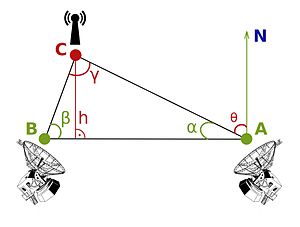
Radio direction finding - determining the direction ( bearing ) to a source of radio emission. Direction finding is carried out using direction finders.
The direction finder consists of an antenna system and a receiver-indicator device. Direction finding can be automated to varying degrees.
Content
Direction finding methods
Amplitude Method
For direction finding by the amplitude method, an antenna system is used that has a radiation pattern with one or more clear minima or maxima. For example, when detecting a source in the VHF range, it is typical to use wave-channel type antennas for maximum search. In the HF band, a loop antenna is often used, the radiation pattern of which has the shape of a figure of eight with two clear minima. To eliminate the ambiguity, it is necessary to apply special technical solutions (for example, connecting an additional whip antenna, which eliminates one minimum and turns the radiation pattern into a cardioid).
The disadvantage of this method is the low accuracy of measuring angular coordinates, low resolution and sensitivity to amplitude fluctuations of the received signal. Advantages are the simplicity of technical implementation and the small effect of noise on direction finding accuracy.
Phase Method
When detecting by the phase method, an antenna system is used that allows you to distinguish between signals coming from different directions by analyzing the phases of the signals received by several antennas. As a rule, direction finding by this method is automated.
Telzhansky method
The conclusion about the direction (in some cases - about the distance) to the source of radio emission is made on the basis of the nature of the change in the Doppler frequency shift of the signal received by a moving direction finder or a moving direction finder antenna. The Doppler method is used, for example, in the direction finding of emergency beacons of the Cospas-Sarsat system .
Various combinations of these methods are also possible.
Applications
By locating the source from two or more points distant from each other, it is possible to determine the location of the radiation source by triangulation. Conversely, with the direction finding of two or more spaced beacons whose location is known, the position of the direction finder can be determined. In both cases, to obtain satisfactory accuracy, it is required that the directions determined be sufficiently different from each other. In the first case, this is achieved by choosing the points from which the direction finding is carried out, in the second, by choosing the appropriate radio beacons.
Radio Navigation
Many radionavigation systems use direction finding as a positioning method. For example, the radio compass , in fact, is a specialized direction finder that receives signals from driven radio beacons or broadcast medium-wave broadcasting stations.
Disaster Finder
There are a large number of different emergency beacons containing beacons, the location of which in the event of an accident can be established by direction finding. Modern beacons, as a rule, transmit an individual code that allows you to identify the buoy, as well as the coordinates of the disaster site, as determined by the built-in navigation receiver,
Also, radio direction finding techniques are used when searching for avalanche radio beacons . The most common types of avalanche beacons use a frequency of 457 kHz, at which the directivity of the antennas is determined primarily by near-field effects. [1]
Sports direction finding
Sports direction finding or “fox hunting” is the general name for a group of sports in radio sports. The athlete is encouraged to find, using the direction finder, the specified number of radio transmitters installed in arbitrary places, which are called "foxes". As a rule, competitions are held on rough terrain, most often in the forest.
Radio intelligence
Search for interference sources
See also
- Radio compass
- Radio communication
- Radar
- Electronic warfare
Notes
- ↑ * J. Hereford and B. Edgerly. 457kHz Electromagnetism and the Future of Avalanche Transceivers (Eng.) // International Snow Science Workshop (ISSW 2000): journal. - 2000.
Links
- Radio Direction Finding Applications Literature (RDF Products)
- Radio Direction Finding Equipment & Systems (Morcom)
- http://www.ewgenesis.com
- Paly A. Electronic warfare. M Military Publishing House 1981
- "LoJack Corp. int. " (English) (RDF Products)
- “TRACKER Radio Direction Finding System” (rus.) (RDF System)
"How does the direction finding system"(rus.)