The transport equation is a partial differential equation describing a change in a scalar quantity in space and time.
The transport equation has the form:
- {\ displaystyle {\ frac {\ partial \ psi} {\ partial t}} + \ nabla \ cdot \ mathbf {F} = 0,}
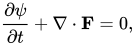
Where {\ displaystyle \ nabla \ cdot}  - divergence operator, and {\ displaystyle \ mathbf {F}}
  Is a scalar quantity flux density vector {\ displaystyle \ psi}
  . It is equal to the product of the quantity {\ displaystyle \ psi} per flow velocity vector: {\ displaystyle {\ mathbf {F}} = \ psi {\ mathbf {u}}}
  . It is often assumed that the velocity field is solenoidal, i.e. {\ displaystyle \ nabla \ cdot {\ mathbf {u}} = 0}
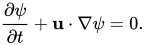
  . In this case, the equation takes the form:
- {\ displaystyle {\ frac {\ partial \ psi} {\ partial t}} + {\ mathbf {u}} \ cdot \ nabla \ psi = 0.}
In a one-dimensional formulation, it has the form:
- {\ displaystyle {\ frac {\ partial \ psi} {\ partial t}} + {u} {\ frac {\ partial \ psi} {\ partial x}} = 0.}
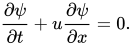
And at a constant value {\ displaystyle u}  has an analytical solution:
- {\ displaystyle \ psi (x, t) = \ psi _ {0} (x-ut),}

Where {\ displaystyle \ psi _ {0}}  Is an arbitrary smooth (differentiable) function.