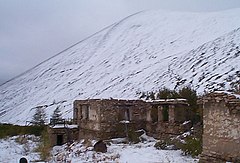
Butugichag [1] - a forced labor camp, was part of Tenlag , a division of Dalstroy .
The camp existed in 1937 - 1956 in the territory of the present Magadan region . The camp is known for its uranium and tin mines [2] . Extraction was carried out manually, without protective equipment [3] . This is evidenced by Russian historians Zhores and Roy Medvedev [ where? ] , as well as Anatoly Zhigulin [4] .
The Butugychag consisted of several separate camp sites (OLP): PO Box 14, Diesel, Central, Kotsugan, Sopka, Bakhanka [5] .
In the early 1950s, convicted writers Yakov Yakir , Nathan Lurie and poet Anatoly Vladimirovich Zhigulin met at the Kotsugan OLP [6] . The poetess Victoria Goldovskaya was serving her sentence here [7] .
In August 2017, a research expedition of the Gulag History Museum ( Moscow ) took place at the camp’s location, during which photo and video recordings of camp facilities were made to create panoramas and maps of the area, and exhibits were collected for the museum exposition [8] .
Content
- 1 Legends
- 2 Location
- 3 notes
- 4 References
Legends
- Translated from the Even language, Butugychag sounds like a "bad place." Many sources claim another translation - "death valley", but this is not true, since the word "valley" is missing in the Even language. This name was given to this area by a nomadic tribe that bred deer in the area. Moving along the Detrin River, they came across a huge field filled with human skulls and bones. Soon after, their deer became ill with a mysterious disease, the first symptom of which was the loss of fur on their legs, followed by the inability to walk [9] . Mechanically, this name passed to the Beria camp of the 14th department of the Gulag.
- There is a legend that medical experiments were conducted on prisoners of the camp [10] . This legend is mentioned in the drama film of the Latvian director Edvins Schnuore “ Soviet History ” (2008). Witnesses claim that the camp took the lives of about 380 thousand people in 10 years of its existence. Uranium was produced here manually without any means of protection. The average miner's life expectancy was only a few months here. To this day, radiation in this area is above normal. The Tenkinsky district administration has established warning signs as a precaution for violators.
Location
The remnants of the camp can still be found about 35 miles north of Ust-Omchug near the Tenkinian highway. There are two abandoned settlements in the area, located close to each other 6 miles away: Butugychag, where there was a camp itself, which contained prisoners, and Nizhny Butugychag, which housed soldiers of the local electrical substation. In 1955, when the camp was closed, Nizhny Butugychag was abandoned and its population was transferred to Ust-Omchug. Construction of 5 miles of poultry farms has remained incomplete.
All roads in the area have deteriorated, making it inaccessible. You can only get on an all-terrain vehicle or on air transport.
Notes
- ↑ News Prime. The worst area in the history of the USSR and Russia !!! (March 10, 2011). Date of treatment March 1, 2017.
- ↑ Radioactive Poultry Farm Archived December 16, 2013 at Wayback Machine , Newspaper
- ↑ Butugyagag camp in Kolyma - uranium ore processing plant , RIA-Novosti image library
- ↑ Anatoly Zhigulin. Black stones (1988). - Chapter "The cemetery in Butugychag
- ↑ Remains of a uranium camp in Magadan. .
- ↑ Anatoly Zhigulin . Black stones. - M .: Banner, 1988. - No. 8. - S. 83–84.
- ↑ Shevelov M. Zi by me from the primary school // Melitopol Journal of Local Lore, 2013, No. 2, p. 81-83
- ↑ The museum organizes expeditions to former camp sites.
- ↑ "Far East. A modern guide. ”- p. 107.
- ↑ Gulag, Death Valley - the accusation of the USSR in experiments on people. PHOTO . ARGUMENT. Date of treatment February 28, 2017.
Links
- Chorne Kamіnnya Butugichagu (Ukrainian)
- Koreskpondent of “Visoki Valu”: Report from the Gulag Gourd (Ukrainian)
- Tenkinsky ITL Dalstroy (Tenlag, Tenkinsky ITL USVITLA)
- Butugyagag camp in Kolyma - uranium ore processing plant , RIA-Novosti image library