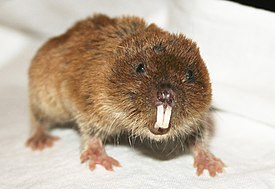
The common mole rat ( Latin Ellobius talpinus ) is a small animal of the hamster family , a species of the genus mole rat of the vole subfamily.
| Common mole vole |
 |
| Scientific classification |
|---|
| No rank : | Bilateral symmetrical |
| Squadron : | Euarchontoglires |
|
| International scientific name |
|---|
Ellobius talpinus ( Pallas , 1770 ) |
| Security status |
|---|
Least ConcernedIUCN 3.1 Least Concern : 7656 |
|
Content
The length of the body of an ordinary mole vole is 10-12 cm. The color of the coat is from light beige to almost black, usually gray-brown; the head and the area near the eyes are dark, the back of the head is black or brown-gray. The belly is dark with a beige tint. The eyes are small, the auricles are absent. The lip closure line is located behind the incisors. Wide feet without wool, with bristles. The coat is soft.
It differs from the Afghan mole vole in terms of cranial features, from the prometheus vole in the short tail, and from other excavators in small sizes.
The common mole vole lives in the southern regions of the European part of Russia, Kazakhstan, the southern regions of the Trans-Urals, Central Asia, as well as in Tuva. The animal is widespread in the steppes, forest-steppes, deserts and semi-deserts. In the steppe zones it lives in areas with soft earth and abundant, diverse grass cover. In the feather grass and wormwood-grass steppes is rare. In forest-steppe zones it is found on virgin lands, along the edges of aspen and birch meadows. In the semi-deserts and deserts, it lives among the sands, on rocky gentle slopes and along river valleys, sometimes in solonetzes. It is especially numerous in foothill zones.
It mainly consumes the underground parts of plants - roots , bulbs and tubers , also feeds on worms , insects . The animal has the ability to make food reserves, which it places in special minks near its home. Stocks are small - it can be several roots or tubers.
The activity of the common mole vole is manifested in the evening, day and morning. Very rarely appears on the surface. It builds rather long burrows with a complex structure. The basis of the hole is one main passage, the length of which reaches up to one hundred meters, and the depth of the arrangement is from ten to forty centimeters. Lateral passages of an impressive length of 20 to 50 m branch from it. Some of them end in dead ends, another part reaches the surface and is designed to throw out dug land. Crescent-shaped dug heaps of earth can be seen around the entire aisle. The main dwelling (the so-called "housing chamber") is located at a depth of 70-50 cm. Lateral passages depart from it, in part of which the animal develops its reserves. In general, for the whole year, females bring from three to four litters, and a brood usually has from two to four litters. Propagate from March to October.
The common mole rat harms melons, garden plants and alfalfa crops. At the same time, it also benefits by loosening the soil, enriching it with organic substances, and its holes facilitate the penetration of moisture and air into the soil.
- Flint V.E. and others. Mammals of the USSR. - M., publishing house "Thought", 1970.
- Atlas-determinant of terrestrial mammals (animals) of Russia and their traces. - Ecosystem, 2010.