The Battle of Gidasp (July 326 BC ) is the battle of Alexander the Great with the army of the Indian king Pora on the Gidasp River (a tributary of the Indus ).
| Battle of the Hydasp | |||
|---|---|---|---|
| Main Conflict: The Wars of Alexander the Great | |||
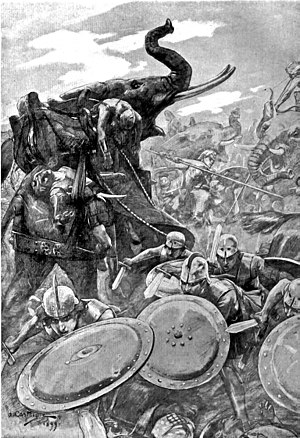 Macedonian phalanx against the elephants of King Por | |||
| date of | July 326 BC e. | ||
| A place | Gidasp River, Pakistan | ||
| Total | victory of the Macedonians | ||
| Opponents | |||
| |||
| Commanders | |||
| |||
| Forces of the parties | |||
| |||
| Losses | |||
| |||
The Macedonian forces defeated the Indian army, after which King Por, who was captured, became an ally and vassal of Alexander the Great. The battle was the last of the major battles in the biography of Alexander. Soon after him, he stopped his victorious 10-year campaign to the East and returned to Persia, where he took up the internal affairs of the created empire.
Content
- 1 Background
- 2 Opponents
- 3 battle
- 3.1 Crossing
- 3.2 Battle progress
- 4 The outcome of the battle
- 5 notes
- 6 Sources and links
Background
Alexander the Great in May 334 BC e. began his legendary trip to Asia. After the decisive battle of Gaugamela in 331 BC. e. The Persian Empire of the Achaemenids , which existed for more than 200 years, has actually disintegrated. Alexander had to fight not with the Persian king, but with the former Persian satraps, who became specific rulers in their lands. When the entire territory of the Persian state was included in the empire of Alexander the Great, Alexander began to expand his possessions at the expense of new countries, following the obsession to become the ruler of the entire civilized world. 8 years after the invasion of Asia, Alexander entered the fabulous India for the Greeks.
Hearing about the exploits of Alexander, the small Indian kings surrendered their cities to the formidable Macedonian army. They were driven not only by fear, but also by a certain interest - due to the Macedonian army, they expanded their possessions and strengthened against rivals. After crossing the Indus River, Alexander, advancing east, in July 326 BC. e. He approached the Gidasp River (now the Jhelum River in Pakistan), a large tributary of the Indus from the eastern side. For Gidasp, Alexander was waiting for King Por.
Arrian called May as the month of the battle [1] , but in another place he made a reservation that the battle took place after June [1] , which is consistent with the date named by Diodorus [2] . Curtius says this about this meeting:
“ Alexander, believing that the glory of his name could persuade Pore to surrender, sent Cleochar to announce to Pore that he should pay tribute and meet the king at the border of his state. Por replied that only one of these requirements would be fulfilled: he would meet the king entering his country, but he would do so with weapons in his hands. [3] "
Opponent Strengths
King Por, or Pururava in Sanskrit , was distinguished from his former opponents by Alexander's determination and personal courage. All ancient authors note his royal appearance - a growth of 2 meters and a powerful physique, so that on the elephant Por looked like a rider on a horse. The army of Pore did not reach the size of the Persian army, but was strong enough. Arrian has more than 30 thousand infantry, 4 thousand horse, 300 chariots and 200 elephants. [4] Curtius repeats these numbers, but reduces the number of elephants to 85. [5]
According to Diodorus, King Por had 50 thousand infantry, 3 thousand horse, thousand chariots and 130 elephants [6] . On the other hand, Plutarch reports only about 20 thousand infantry and 2 thousand horsemen at Pora [7] . Judging by the description of the battle and the losses, Por probably had up to 30 thousand infantry, 3 thousand horse, 300 chariots and 130-200 elephants. The most formidable force in the Indian army was the fighting elephants , tanks of the ancient era. At the Battle of Gaugamela, the Macedonians captured 15 elephants from the Persians, but did not yet have a real battle with formidable animals. The lightly armed Indians infantry served mainly to protect elephants from attack from the side and from the rear. The main weapons of the infantry were large bows, capable of throwing heavy arrows, spears and clubs. According to Curtius, four horses harnessed to the chariots, the quadriga crew consisted of 6 people: two archers, two shield carriers for close combat and a charioteer. Unlike the Persian sickle-chariots on the Indian chariots, sickles, knives and blades were not attached. The Indian cavalry, apparently, was inferior to the Persian in armament.
In addition to his considerable strength, Por was counting on the imminent arrival of an ally, the Indian king Abisar , whose army was only slightly inferior to Por's army.
Sources do not report the size of the army of Alexander the Great, however, based on Arrian’s detailed listing of the Macedonian units [4] and their allies, Alexander’s strength can be estimated at about 8-10 thousand horse and 25-30 thousand infantry, of which 5 thousand were allied Indians from the king Taxila.
Battle
The battle between Alexander and Pore is remarkable for the complexity of the maneuvers that only Arrien, a man versed in military affairs, could clearly describe.
Crossing
The armies of Pore and Alexander were separated by the Gidasp river, 4 stages wide (approx. 700 m), according to Kurtsia, who was full-flowing at this time of year and with a strong current. The camps of the kings were opposite each other. Along the Por River, sent out guard detachments to learn in advance about the crossing of the Macedonians and dump them into the water. Alexander, for his part, tried to mislead the enemy. He sent his troops along the river, imitating the crossing in one place or another, until the Indians stopped paying attention to the maneuvers of the Macedonians. Alexander also launched a rumor about plans to wait for the drop in water level in order to force the Hydasp ford.
When the vigilance of Pore was dulled, Alexander decided to proceed with the crossing. The army was divided into 3 parts. Units of about 10 thousand soldiers under the command of the Crater , including 5 thousand allied Indians, were left in the camp opposite Pora’s camp with the order to begin the crossing only when Por would be forced to withdraw his troops, especially elephants.
The second part of the army of about 10 thousand, too, was ordered to begin crossing about 10-12 km from the base camp at the time when Por entered into battle with Alexander. Alexander himself with the 3rd part of the army was about to discreetly cross under the cover of a wooded mountain and island in a place that was 150 stages from the camp (approx. 25 km). Such a separation of forces, according to Alexander, did not allow Por to concentrate his forces to attack the vulnerable at the time of the Macedonians crossing.
Alexander led selected troops: Getai squads of about 2 thousand, mounted barbarians, shield corps, two phalanx regiments and light infantry with archers. In total, under his command, according to Arrian, there were 5 thousand horsemen and up to 6 thousand infantry. Secret preparations for the crossing made at night masked heavy rain. By morning, the rain subsided, and the crossing began unexpectedly for the Indians. The infantry crossed the river on oar boats, the cavalry sailed on hay stuffed leather furs. By mistake, having landed on the island, the Macedonians were forced to ford to the other side of the Gidasp. The crossing was successfully completed before the advance detachment under the command of Por's son arrived at the site.
Battle Progress
The son of Pore arrived at the landing site of Alexander with 2 thousand horse and 120 chariots (Plutarch calls twice as few [8] ). Alexander threw his cavalry at them, far superior in number. Chariots stuck in the mud due to night rain, they could not be stepped on, and it was also impossible to retreat. They were all captured, having interrupted the crews. About 4 hundred horse Indians died, and the son of Pore fell.
Then Por moved his army towards Alexander, leaving several elephants and a small part of the troops in the camp to prevent the crossing of the Crater. Out of the blue, Por built the army as follows: in front of the elephants in line with equal gaps between them. Behind the elephants, the Indus infantry Por arranged his cavalry on the flanks, and set chariots in front of the cavalry.
Alexander decided to attack the army of Pore, without waiting for the crossing of the rest of his army. He directed the cavalry strike on the left flank of the Indians, against their riders. The warlord of Alexander Ken attacked the right flank of Pore. To step on the elephants in the forehead of the Macedonians did not dare. First, a thousand horse archers bombarded the Indians with a hail of arrows, then Alexander surrounded the left flank of the Indians with his squadrons. The chariots were quickly incapacitated by the Macedonian cavalry. Pora's cavalry threw themselves under the protection of elephants, but made sorties at an opportunity. The leaders of the elephants led the animals to the horsemen of Alexander, but they could dodge the clumsy animals, so that the burden of fighting them fell on the Macedonian infantry. The Indus Infantry tried to stay behind the elephants, attacking in between. The battle turned into a landfill, where the advantage and victory goes to those who better manage the units. At Pora, the army soon turned into a huge crowd; Indians, horse and foot, sought salvation for the elephants, but suffered from them even more than from the enemy. Arrian writes:
“The Macedonians, if it was spacious around and they could attack the elephants, taking advantage of a convenient opportunity, usually ran away when the animals rushed at them, and when they turned, they pursued them and threw spears. Indians moving between elephants, especially from them suffered. [9] "
Soon the surviving elephants turned back. Alexander cavalry surrounded the entire Indus army, which, squeezed in a bottleneck, no longer represented military force. His detachments approached Alexander, crossing the Gidasp without interference, and began to exterminate the Indians, replacing Alexander's soldiers, who were tired after 8 hours of battle.
Battle Outcome
The Indian king Por fought to the last. There are several versions of surrendering him. Some authors claim that he was captured unconscious. According to the story of Arrian, the wounded man in the shoulder of Pore was persuaded to get off the elephant, sending an old friend to persuade:
“ Alexander was the first to turn to him, offering to say what he wants for himself. Por replied: "So that you treat me, Alexander, royally." Alexander liked this answer: 'I will do it, Por, for my own sake. And you ask for yourselves that which is sweet to you. ' Por replied that everything was in his request. Alexander liked these words even more; he handed Por power over his Indians and added to his former possessions still others that were more primordial. [4] "
According to Arrian, the Indus infantry perished up to 20 thousand; riders about 3 thousand; all the chariots are chopped up; elephants either perished or captured; two sons of Por and all his military leaders died [4] . Diodorus causes the following losses: 12 thousand Indians died, including sons and the best military leaders of Pore, another 9 thousand were captured; 80 elephants were also captured [10] .
The Macedonians along Diodorus also suffered heavy losses: 280 mounted and more than 700 foot soldiers [10] . The opinion of Arrian is consistent with Diodorus in the number of dead riders - 230, of which 20 hetairas, but Arrian names only 80 dead on foot [4] .
After the battle, Alexander gave a month of rest for his army, founded the city of Nicaea on the battlefield, and then moved further east. Some princes obeyed him voluntarily, he took the cities of others with an attack. Alexander gave the conquered lands under the rule of Pore. However, on the way to the Ganges, the Macedonians, hearing about the huge armies and thousands of elephants fighting behind the Ganges, refused to follow their king. Thus the battle on the Gidasp River, the first battle of the Macedonians with elephants, stopped the advance of the great conqueror to the east. Now Alexander conquered the tribes on his way back to Persia.
The Battle of Gidasp was the last major battle in the biography of Alexander the Great.
Notes
- ↑ 1 2 Arrian. 5
- ↑ Diodorus , The Historical Library, 17
- ↑ Quintus Curtius Rufus . History of Alexander the Great. 8
- ↑ 1 2 3 4 5 Arrian
- ↑ Curtius, “The Story of Alexander the Great,” 8
- ↑ Diodorus. Historical library
- ↑ Plutarch. Comparative biographies. Alexander the Great
- ↑ Plutarch. Comparative biographies. Alexander the Great. 60
- ↑ Arrian. 5.17
- ↑ 1 2 Diodorus. Historical library. 17.89
Sources and links
- Diodorus (17.87-89), Arrian (5.9-19), Curtius (8.13-14), Justin (12.8), Plutarch (Alexander, 60)
- Arrian, Alexander's Campaign . - M.: MIF, 1993
- Quintus Curtius Rufus, History of Alexander the Great. - M.: Publishing House of Moscow State University, 1993
- Diodorus Siculus , Book XVII, from the Perseus project site