" Somebody blew up America " ( eng. Somebody Blew Up America ) is a poem written by a verlibre by American beat author and political activist Amiri Baraki , created in 2001 [1] [2] [3] . The work was written within two weeks after the terrorist attacks of September 11, 2001 , but this topic is only superficially focused on the "global destruction of America" (according to critics) and the "suffering of African Americans from" home terrorism "in their own country" (according to the author himself) [4] [5] .
| Who blew America | |
|---|---|
| Somebody blew up america | |
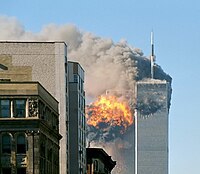 World Trade Center Towers at the time of the terrorist attack | |
| Genre | Poem |
| Author | Amiri Baraka |
| Original language | English |
| Date of writing | 2001 |
| Electronic version | |
The work was first presented to the general public in 2002 during open poetry readings in New Jersey [6] . The work received a positive assessment, but only a short time later caused a surge of indignation; in particular, the Barack suffered the most attacks from the Anti-Defamation League , which accused the author of anti-Semitism [7] . Nevertheless, the poet continued to stubbornly assert that his work does not contain even a bit of hatred of the Jews - this, in his opinion, becomes completely clear if you read the poem without prejudice; Barack denied accusations of anti-Semitism, arguing that "Who blew up America" is directed against capitalism , the patriarchal system, white hegemony and Zionism [8] .
Due to Amiri Baraki’s reluctance to admit that he was wrong and to make adjustments to the text of the work, the honorary position of “New Jersey Laureate Poet” was eliminated , which since 2002 he occupied [6] [9] . From the very beginning of the debate over the work, literary critics did not consider the work as poetry as such, the emphasis in the discussion was always placed on Amiri's political proclamations ; even now, not a single major analysis of "Who blew up America" affects its artistic features, shifting focus to its ideological component [10] .
Creation Circumstances

The poem Who Blasted America was written a few weeks after September 11th. By the end of the month, the work was completely completed. In early October, Baraka sent a text to his close friends and received mostly positive feedback [6] . Immediately the work was published on the Baraki website and reprinted on many pages on the Internet. In a short time, the work became the most famous and widely discussed poem of the poet [11] .
The work was presented to the general public only a year later, on September 19, 2002, during the event entitled "Dodge Poetry Festival", held in Waterloo Village in New Jersey [6] . It is noteworthy that at the event the poem was received very positively, and its author was even asked to speak again at several universities after the festival. The wave of indignation rose only some time later, when the work was criticized by the famous TV presenter Bill O'Reilly , which spurred a surge of indignation throughout the United States [10] . Critics say that Barak is actually not just a “provocateur”, but a serious reason for stigmatizing him for hatred of Jews was much earlier than the publication “Who blew up America”; So, in 1980, the pages of The Village Voice weekly published his essay Confessions of a Former Anti-Semite [12] .
Contents
(all thinking people
against terrorism
both home and
international ...
but not worth one
cover another) [13]
| External video files | |
|---|---|
| Amiri Baraka reads a work | |
| Amiri Baraka "Somebody Blew Up America" on Youtube.com | |
In the lines “opening” the work, the poet provides his own definition of his theme; in parentheses, the author justifies the poem and shows its thematic orientation. The introduction to the work actually demonstrates that topics 11/9, “Who blew up America”, are only superficial. Baraka shifts the focus from the responsibility for terrorist acts to the issue of global destruction of America - understood as a historical project and a radical experiment to create a utopian nation based on the promises of freedom and justice for all and for everyone. In this context, the poem can be read as a series of speculations on the identity of those who, in the global sense, “blew up America” [5] .
Who subjected the genocide of the Indians
<...>
Who enriched in Algeria , Libya , Haiti ,
Iran , Iraq , Saudi Arabia , Kuwait and Lebanon ,
Syria , Egypt , Palestine , Jordan
<...>
they say (who says? yes the one to whom everything is ordered
To whom paid
Who knows how to lie a lot and often
Who nowhere and never takes off the mask
The work recites an area of well-known issues that require, in the opinion of the author, a solution, beginning with the superiority of the white race and oppression of the "colored" people all over the world and ending with more local issues. The main theme of the work is the merciless instinct of the powerful and the blindness of the average man in the street [14] .
With its themes, the work touches on many political and social aspects; thus, for example, “white” criminals are exposed - murderers who have messed up the past of the United States of America. From the past, the emphasis is gradually shifting to the present, focusing on the country's foreign policy. In addition to the political, the content of the work begins to affect the social aspect; Baraka asks: "Who owns the buildings / Who owns the money / Who considers us all fools." The author also raises an ideological issue, criticizing the omnipotence of the media and propaganda [5] .
The constant questioning is reinforced with each new word “who,” repeated about two hundred times in the text. Contrary to the claims of critics calling the work anti-Semitic, Edward Curtis, compiler of Encyclopedia of Muslim-American History, believes the poem can be seen as a study of the long history of racism in the United States.
Among other things, the poem repeats the well-known refuted theory of the conspiracy that the Israeli government was involved in the attacks, and that the allegedly working in the buildings of the "4000 Israelis" were warned in advance and did not show up for work on the day of the attack [15] . In addition to this, the poem contains gross insults to contemporary Barack black politicians and public figures who support, in his opinion, the white establishment - a member of the Supreme Court of the Clarence Thomas , Secretary of State Condoleezza Rice and Colin Powell , a well-known politician and human rights activist, Ward Connerly : “Who did the work for the fucking Tom Clarence / Who slipped out of Colin’s mouth / Who knew that Condoleezza was a vile Rat / Who paid Conolly to be a black idol” [16] .
Baraka explained his position as follows: “I am still a Marxist , and I think this gives a certain form to my art in the sense that I try to get to the bottom of the true essence of everything that is happening around - everything that I describe - events , circumstances and phenomena that I try to highlight. I want to know why everything happens exactly as it happens, and things are just that and no other ” [17] . The poem reaches its climax at the very end, breaking off with repeating words merging into an inarticulate howl ( as can be seen on the video ): “Who and Who and WHO (+) who who ^ / Kutoooooooo and Kotooooooooooooooooooo!” [5] .
Perception of work
Maurice Lee , author of The Aesthetics of LeRoi Jones / Amiri Baraka: The Rebel Poet, a study of Amiri Baraki’s work, notes that after the debate about the poem began, almost all members of the media , radio , newspapers , television channels and talk shows discussed the work not as poetry as such, but rather as news, facts, documentary [10] . The consideration of "Who blew up America" exclusively in terms of political proclamation will also be characteristic of all later authors who devoted more or less large-scale analysis to the work - Ruppert, Campbell, Curtis, Rubin and Verkhel, Hurley, Gomel, Leighton and Maurice himself [17] [18] [14] [5] [19] [10] [8] . Famous conservative political commentator and talk show host Laura Ingraham spoke about the poem as follows: “it is not much more than an ignorant, anti-Semitic, racist, anti-American pompous tirade written by a child jam-packed with conspiracy theories” [20] . A number of Baraka's theses , which were most fiercely criticized and / or widely discussed, can be divided into three large thematic groups:
- Israel’s involvement in terrorist attacks (Ruppert, Campbell, Curtis, Rubin and Verhel, Maurice, Sandquist, Hurley, Gomel [18] [14] [5] [10] [21] [19] [8] )
- “Home” terrorism in the United States (Maurice, Rubin and Verhel, Campbell, Hurley, Leighton [10] [5] [14] [19] [17] )
- US foreign policy (Rubin and Verhel, Curtis, Hurley, Shermak [5] [16] [19] [22] )
Who knew WTC would bomb
Who ordered 4,000 Israeli servants in the twin towers
stay at home this day
Why didn’t Sharon go to New York
The famous TV presenter Bill O'Reilly called Barack "dumbass" and accused of racism and anti-Semitism [6] . On September 27, representatives from the Anti-Defamation League ( ADL ) sent a letter to Jersey Governor Jim McGreevey ; the final lines read: “It may well be that as a poet, Mr. Baraka can say whatever he pleases, no matter how dirty, irresponsible or fraudulent it will be. However, we do not believe that the names of New Jersey residents or their representatives should be harassed by such poison ” [23] . ADL accused Barak of anti-Semitism for propaganda of one of the " conspiracy theories " according to which Israel was involved in terrorist attacks - the basis of such a statement was the lines of the work presented on the left. In sharp form, the poet was criticized by the American human rights activist Abraham Foxman (who had previously made a statement about the need to debunk the myth of Jewish involvement in the incident [24] ), stating that the poet’s statements were simply absurd [7] .
In addition to human rights defenders, however, the public reaction to Baraka’s work was also extremely negative [3] . A broad campaign was launched against the author, quickly spreading from national publications to student newspapers. The famous political activist Ward Connerly called the poet "one of the main haters of America" [19] . During a television interview on October 2, the poet, citing a large number of online articles on the subject, continued to insist on Israel’s involvement in the attacks. A day later, Baraka said that he would not make any concessions and would not make adjustments to the work.
Governor McGreevey demanded that Baraka resign from the honorary post of New Jersey poet laureate however, when he refused, it turned out that the law did not contain any rule allowing the authorities to dismiss him, and the only way out was to abolish the post itself [9] [6] .
Subsequently, the author repeatedly emphasizes that he sincerely believes that the Israeli government was aware of the impending attack, but the poem “does not even contain a hint of anti-Semitism, as anyone who reads“ Who blew up America ”from beginning to end without a hidden bias will have to admit relations ” [25] . To this day, the poet has not made a single amendment to the original text of the poem and continues to read it with pride during public speaking [26] .
Reply to criticism
Who killed Malcolm X and the Kennedy brothers?
Who killed Martin Luther King , who needed it?
<...>
Who killed Huey Newton , Fred Hampton ,
Medgar Evers , Mikey Smith Walter Rodney
Wasn't he trying to poison Fidel
Do not give Vietnamese freedom
Third-party critics noted that one of the dominant themes of the work is the involvement of not the Israeli, but the American government in the terrorist attack [27] . Writer and journalist Michael Ruppert expressed the opinion that “Who blew up America” appears in the form of an internationalist work directed against fascism and all its derivative forms [18] . Personally, Baraka argued that the main theme of the work was the suffering of African Americans from "home terrorism" in their own country [4] .
Despite the immediate reaction of the poet to what happened, the work does not actually contain an expression of emotion regarding the actual terrorist attacks. The text of the work does not pay tribute and does not even pay the slightest attention to those who survived this tragedy, and does not express a bit of patriotism either. What Barak offered to readers is an aesthetically complex work written by a verlibre , the content of which is extremely political [5] . A critic of one of the literary magazines reacted as follows to the poem:
“Who blew up America” is not a woeful lament for about three thousand people who lost their lives that day, and not a joyful tribute to the wounded American spirit, nor is it a call for immediate revenge. Instead, the poem offers an eye-catching diatrib against the horrors of imperialism and the horrors of its closest companion - racism , the main weapon of injustice.
- Piotr Gwiazda, Contemporary Literature [5]
In response to numerous criticisms, Barak asked a rhetorical question: “If this is my house and something stinks there, should I be silent only because I live there?” [28] Regarding “anti-Semitism”, the poet said that the poem is by no means such is not, it is directed against capitalism , patriarchal order, white hegemony and Zionism [8] . The executive director of the New Jersey branch of the American Civil Liberties Union said: “Who are the representatives of our government to decide what we want to hear or not?” [5] . The political organization New African's People Organization also defended Baraki:
In the United States, the government has been training people like Manuel Noriega in Panama , Saddam Hussein in Iraq , Osama bin Laden and the Taliban in Afghanistan , for killings and terrorist acts against civilians ... American bombs killed millions of civilians in Hiroshima and Nagasaki , Libya , Vietnam and Sudan ... They, like us, fell "the victims of Americanism" ... And now "the chickens are returning home to the chicken coop," as Malcolm X warned us [22] .
| External video files | |
|---|---|
| Fragment of a performance by work | |
| TFANG except on Youtube.com | |
The poet tried to appeal the liquidation of the post of laureate poet, who brought him an income of $ 10,000 per year, in court, appealing to the district court; Baraka claimed that McGreevey’s decision violated the first amendment to the US Constitution , but the judge found the governor’s actions "consistent with the law, not dictated by political considerations." The decision was upheld [29] .
Some modern scholars have called "Who blew up America" the strongest example of " war resistance poetry ", which appeared in the United States after the events of September 11 [30] . Based on a work by Baraka, the American Contemporary Theater Theater for a New Generation staged a performance .
Editions
The poem was published as part of a small collection, " Who Blasted America and Other Poems " ( eng. Somebody Blew Up America & Other Poems ) in 2003 ; The publication included seven long sad poems, similarly written by the verlibre. The book was accompanied by an introductory article by critic, poet and professor at the University of South Carolina Kveim Daves and an afterword by Amiri Baraki himself with an answer to the numerous criticisms of the title work of the collection. In connection with the mixed assessment in the USA, the book was published outside of them [31] .
- Baraka, Amiri. Somebody Blew Up America & Other Poems. - House of Nehesi Publishers, 2003 .-- 82 p. - ISBN 978-0913441619 .
Daves commented: “Today in the US, poetry can still arouse passion and lead to political action”; Professor of New York University Camau Brathwait noted: ““ Who blew up America and other poems ”is a typical example of the modern radical and revolutionary cultural reconstruction of African-Americans” [32] . The poem was translated into Russian by Ilya Kormiltsev and published as part of the collection “The Anthology of Hipster Poetry ” ( 2004 , Ultra.Kultura ).
Notes
- ↑ Kurt Hemmer. Encyclopedia of beat literature. - Infobase Publishing, 2001 .-- P. 9-11. - 401 p. - ISBN 9780816042975 .
- ↑ Koolish, Lynda. African American writers: portraits and visions. - Univ. Press of Mississippi, 2001. - P. 10. - 122 p. - ISBN 9781578062584 .
- ↑ 1 2 Amiri Baraka . The Poetry Foundation . poetryfoundation.org. Date of treatment September 14, 2011. Archived February 1, 2012.
- ↑ 1 2 Baraka, Amiri. I will not "appologise", I will not "resign"! (eng.) . Amiri Baraka. Poet, Playwrite, Activist . amiribaraka.com. Date of treatment September 14, 2011. Archived December 13, 2002.
- ↑ 1 2 3 4 5 6 7 8 9 10 11 Rubin, Derek; Verheul, J. Somebody Blew Up America // American multiculturalism after nine eleven. - Amsterdam University Press, 2010 .-- 224 p. - ISBN 9789089641441 .
- ↑ 1 2 3 4 5 6 Hampson, Rick; Moore, Martha T. How 9/11 changed us: Person by person (inaccessible link - history ) . Tucson Citizen tucsoncitizen.com (09/02/11). Date of appeal September 14, 2011.
- ↑ 1 2 Amiri Baraka Accuses ADL of Slander; League Says Charges are "Absurd" . Anti-Defamation League . adl.com (07/09/2003). Date of treatment September 14, 2011. Archived February 1, 2012.
- ↑ 1 2 3 4 Gomel, Elana. The pilgrim soul: being Russian in Israel. - Cambria Press, 2009. - P. 45. - 208 p. - ISBN 9781604975987 .
- ↑ 1 2 New Jersey - State Poet Laureate . The Library of Congress . loc.gov. Date of treatment October 13, 2011. Archived February 1, 2012.
- ↑ 1 2 3 4 5 6 Maurice, Lee. Chapter Six. Somebody Blew Up America // The Aesthetics of LeRoi Jones / Amiri Baraka: The Rebel Poet. - Universitat de València, 2004 .-- ISBN 9788437055411 .
- ↑ Poetry Matters! (eng.) . USA Surrealist Movement . surrealistmovement-usa.org. Date of treatment September 16, 2011. Archived February 1, 2012.
- ↑ Hansen, Suzy. Amiri Baraka stands by his words . Salon.com . salon.com (10.17.2002). Date of treatment September 16, 2011. Archived February 1, 2012.
- ↑ The Russian translation hereinafter is given according to Ilya Kormiltsev , an edition of the Anthology of the beatnik poetry / G. Andreyev. - 1st ed. - Ultra. Culture, 2004. - S. 708-714. - 784 p. - (Poetry). - 3000 copies. - ISBN 5-98042-072-X .
- ↑ 1 2 3 4 Campbell, James. The Rhetoric of Rage // Syncopations: Beats, New Yorkers, and writers in the dark. - University of California Press, 2008 .-- 226 p. - ISBN 9780520252370 .
- ↑ The 4,000 Jews Rumor . International Information Programms . usinfo.state.gov. Date of appeal May 15, 2015.
- ↑ 1 2 Curtis, Edward IV. Encyclopedia of Muslim-American History. - Infobase Publishing, 2010. - P. 81. - 628 p. - ISBN 9780816075751 .
- ↑ 1 2 3 Layton, Rebecca. Someboby Blew Up America // Arab-American and Muslim Writers. - Infobase Publishing, 2010 .-- 130 p. - ISBN 9781604133776 .
- ↑ 1 2 3 Ruppert, Michael. Crossing the Rubicon: the decline of the American empire at the end of the age of oil. - New Society Publishers, 2004 .-- P. 257. - 674 p. - ISBN 9780865715400 .
- ↑ 1 2 3 4 5 Carey Hurley, Adrienne. Revolutionary Suicide and Other Desperate Measures: Narratives of Youth and Violence from Japan and the United States. - Duke University Press, 2011 .-- P. 112. - 280 p. - ISBN 9780822349617 .
- ↑ Ingraham, Laura. Shut up & sing: how elites from Hollywood, politics, and the UN are subverting America. - Regnery Publishing, 2003 .-- P. 244. - ISBN 9780895261014 .
- ↑ Sundquist, Eric. Strangers in the Land: Blacks, Jews, Post-Holocaust America. - Harvard University Press, 2008. - P. 411. - ISBN 9780674030695 .
- ↑ 1 2 Shermak, Steven M. Media representations of September 11. - Greenwood Publishing Group, 2003. - P. 37. - 258 p. - ISBN 9780275980443 .
- ↑ Davidson, William; Goldstein, Shai. ADL Writes to the Governor of New Jersey About Amiri Baraka . Anti-Defamation League . adl.com (11/27/2001). Date of treatment September 14, 2011. Archived February 1, 2012.
- ↑ Foxman, Abraham H. Blaming Jews For 9/11 Must Stop . Anti-Defamation League . adl.com (11/27/2001). Date of treatment September 14, 2011. Archived February 1, 2012.
- ↑ Baraka, Amiri. From a Statement by Amiri Baraka, New Jersey Poet Laureate, 1002 . Peace Work Magazine . peaceworkmagazine.org. Date of treatment September 14, 2011. Archived February 1, 2012.
- ↑ Erickson, Ceilidh. In Newark Amiri Baraka recites infamous poem again, this time to applause . capitalnewyork.com (09/11/2010). Date of treatment September 14, 2011. Archived February 1, 2012.
- ↑ Nimmo, Kurt. Poetry as Treason? (eng.) . Counter Punch counterpunch.org (10/03/2002). Date of treatment September 14, 2011. Archived February 1, 2012.
- ↑ Pearce, Jeremy. When Poetry Seems to Matter The New York Times . nytimes.com (02/09/2003). Date of treatment September 15, 2011. Archived February 1, 2012.
- ↑ New Jersey: anti-Semitic poet will not be returned the title of laureate . America News . americaru.com (03/23/2007). Date of appeal September 16, 2011.
- ↑ Metres, Philip. Behind the lines: war resistance poetry on the American homefront since 1941.- University of Iowa Press, 2007.- P. 220. - 282 p. - ISBN 9780877459989 .
- ↑ Hibbard, Tom. The Hermeneutics of Rupture: Baraka's Somebody Blew Up America . The Jacket Magazine . jacketmagazine.com. Date of treatment September 16, 2011. Archived February 1, 2012.
- ↑ Editorial Reviews . Amazon amazon.com. Date of treatment September 16, 2011. Archived February 1, 2012.