Sminthopsis bindi (lat.) Is a species from the genus of narrow-legged marsupial mice of the family predatory marsupials . Endemic to Australia .
| Sminthopsis bindi |
| Scientific classification |
|---|
| No rank : | Bilateral symmetrical |
| Squad: | Predatory marsupials |
| Family: | Predatory marsupials |
| Gender: | Narrow-legged marsupials |
|
| International scientific name |
|---|
Sminthopsis bindi ( Van Dyck , Woinarski & Press , 1994 ) |
| Area |
|---|
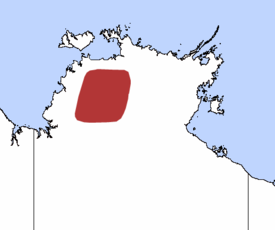
|
| Security status |
|---|
Least ConcernedIUCN 3.1 Least Concern : 40551 |
|
It lives in the northern part of the Australian Northern Territory [1] . The natural habitat is hilly areas with dense vegetation [2] .
The length of the body with the head ranges from 52 to 84 mm, the tail - from 61 to 105 mm. The weight of an adult is from 12 to 14 g [2] . The hairline is short, thick and soft. The back is light gray. The belly is painted white. The muzzle is elongated, pointed. Dark eye circles. Sometimes there is a dark strip stretching from the head. The ears are large, rounded. The hind legs are narrow. The interdigital pads of the hind legs are granular [2] . Unlike other representatives of the genus, Sminthopsis bindi has no fat deposits in the tail [2] [3] .
Lead a terrestrial, solitary lifestyle. Activity falls at night. Spend the day in their holes. They feed mainly on insects ( moths , crickets , caterpillars ) [2] .
The ecology of the species has hardly been studied. According to reports, the female offspring appears in February, March and November [2] .
- ↑ Sminthopsis bindi (English) . The IUCN Red List of Threatened Species .
- ↑ 1 2 3 4 5 6 James R. Turner. Kakadu Dunnart // Mammals of Australia. - Sofia-Moscow: Pensoft, 2004 .-- P. 106. - ISBN 954-642-198-7 .
- ↑ Ronald M. Nowak. Walker's marsupials of the world. - JHU Press, 2005 .-- P. 102-105. - ISBN 0801882222 .