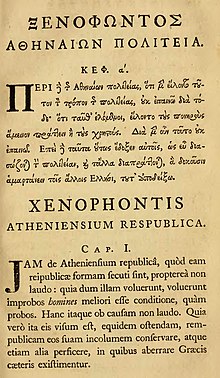
“Athenian polity” ( dr. Greek Ἀθηναίων πολιτεία ) is a small pamphlet about the Athenian government, attributed in antiquity to the corpus of small works of Xenophon , one of two texts that have survived from Antiquity with the same name (in addition to the Aristotelian “ Athenian polity ”).
Content
The general political orientation of the treatise
Some modern authors try to see in the pamphlet an apology for democracy [1] . A more widespread opinion, however, boils down to the fact that in every line of this composition there is an evil sarcasm regarding the Athenian demos and its political influence. [2] According to this point of view, the “Athenian polity” of Pseudo-Xenophon is a well-thought-out and evil satire on the Athenian democratic system. Democracy is such an order, according to the author, in which good citizens live well, and not good and kind. This regime deserves all condemnation, but at the same time it is unusually effective: the author establishes a close connection between the sea power of Athens, their domination over allies and democracy. From this a pessimistic conclusion is drawn that democracy cannot be destroyed.
Who, not belonging to the people, prefers to live in a democratic, rather than an oligarchic state, is simply given some kind of criminal intention and sees that a fraudster can more likely go unnoticed in a democratic state than in an oligarchic one.
- Pseudo-Xenophon. Athenian polity , 2. 20, trans. S. I. Radzig
Dating
The author of the policy states that long-term land military expeditions against sea powers are unlikely, since it is very difficult to provide warriors with food (it is understood that those who dominate the sea have fewer problems with this). Since the long campaign to the north, undertaken by the Spartans led by Brasid , took place in 424 BC. e., a treatise was hardly written earlier than this date. In addition, the treatise emphasizes the military successes of democracy; When listing the functions of the Council of 500, the author first of all speaks again about the military sphere. From this it is concluded that the composition was written in wartime. If this is the Peloponnesian War , then the approximate time for writing the Athenian Politics is 431-424. BC e. Most modern scholars agree with this, although, on the one hand, the opinion was expressed that the work could be attributed to the 450th - 460th years. BC e. [3] , and, on the other hand, attempts were made to lower the chronology and attribute the time of compilation of the treatise to the IV century. BC e. [four]
If the generally accepted dating is correct (431-424 BC), then it turns out that we have before us the earliest extant sample of literary prose in the Attic dialect, as well as the very first version of literary criticism of Athenian democracy [5] .
Authorship. Old Oligarch
A number of arguments do not allow one to agree with the opinion of the ancients, who included this “Athenian policy” in the corpus of small writings of Xenophon (doubts about the authorship of Xenophon were already in antiquity, as the words of Diogenes Laertius , Prince II, 57 indicate). First of all, this “Athenian polity” in its character and style sharply diverges from all the writings of Xenophon, who was capable of humor, but at the same time did not show any satirical talent in any of his works, and it would be strange if he created the one and only pamphlet entirely written in this genre. In addition, the style of "Athenian polity" is deliberately sloppy, unprocessed, a rough language, it is very different from the language of Xenophon, which was called the "Attic bee." Finally, the most probable date of the birth of Xenophon (around 430 BC) serves as yet another argument against the attribution of our treatise to him - otherwise it turns out that he should have written it at about the age of five (see section “ Dating ").
The tradition of calling the anonymous author of this “Athenian Politics” “Old Oligarch” has become established in modern research literature. This symbol was chosen because of the political views of the author, whose sarcasm regarding democracy is obvious (despite the unconvincing attempt to present him as a sincere supporter of democracy).
Publications
- Die pseudoxenophontische ΑΘΗΝΑΙΩΝ ΠΟΛΙΤΕΙΑ. Einleitung, Ubersetzung, Erklarung von E. Kalinka, Leipzig — Berlin: Teubner, 1913.
- Xenophon. Atheniensium respublica [spuria] // Xenophontis opera omnia. Ed. EC Marchant. Oxford: Clarendon Press, 1920 (repr. 1969). Vol. five.
Translations
- Athenian state // Xenophon Works in five issues. Translation by A. A. Yanchevetsky. Kiev, 1880. Issue. V. Small articles. S. 64
- Pseudo-Xenophon. Athenian polity. Per. A. A. Zakharova // Collection of the Kharkov Historical and Philological Society in honor of prof. V.P. Buzeskula. Printing house "Printing business". Kharkov, vol. XX, 1914.
- [Xenophon]. Athenian polity. Per. S.I. Radzig // Aristotle. Athenian polity. M .: Sotsekgiz, 1937.S. 222–235.
- (same, reprint :) Aristotle. Athenian polity. The state system of the Athenians. M .: Publishing. Flint, 2007. ISBN 978-5-89349-838-7 pp. 201-214, note. 226-233.
- (same, reprint :) Athenian democracy in the testimonies of contemporaries. M., 1996.
- On the Athenian Government, translated by JS Watson // Xenophon's Minor Works Literally Translated from the Greek with Notes and Illustration by JS Watson. London: G. Bell and Sons, LTD, 1914 .
- Pseudo-Xenophon, translated by EG Marchant // Xenophon. Xenophon in Seven Volumes. EC Marchant. Harvard University Press, Cambridge, MA; William Heinemann, Ltd., London., 1984. Vol. 7.
- The Old Oligarch: Pseudo-Xenophon's Constitution of the Athenians. LACTOR 2. Second Edition. Introduction, Translation and Commentary by R. Osborne. London: The London Association of Classical Teachers, 2004. Pp. 29. ISBN 0-903625-31-8 . (See also review of this publication: Bryn Mawr Classical Review 2005.07.79 ).
- The Old Oligarch : The Constitution of the Athenians Attributed to Xenophon. Transl. by JL Marr, PJ Rhodes. Aris & Phillips Classical Texts. Oxford, 2008. Pp. 178. ISBN 9780856687815 . (See also the review of this publication: Bryn Mawr Classical Review 2009.04.05 ).
Literature
- Antique writers. / Ed. M.V. Belkina. - SPb. , 1999 .-- S. 341.
- Grabar-Passek M.E. Xenophon // History of Greek literature. - M. , 1955. - T. II. - S. 124.
- Dovatur A. I. Politics and Polities of Aristotle. - M. , L .: Nauka, 1965 .-- S. 297-298.
- Davis J.K. Democracy and Classical Greece. / Per. from English N. N. Trubnikova, ed. I.A. Okazova. - M .: Russian Political Encyclopedia, 2004. - ISBN 5-8243-0552-8 (About the Old Oligarch on pp. 72, 77, 98, 116, 122, 123).
- Fifth century BC. // Cambridge History of the Ancient World . - T. V. - M .: Ladomir, 2014 .-- S. 51, 100, 113, 123, etc.
- Sobolevsky S.I. Xenophon, his life and writings // Xenophon. Memoirs of Socrates. - (Monuments of philosophical thought). - M. , 1993 .-- S. 278.
- Tumance H. Birth of Athena. The Athenian path to democracy from Homer to Pericles. - SPb. , 2002.S. 459-462.
- L'Athenaion politeia rivisitata: il punto su Pseudo-Senofonte. Contributi di storia antica, 9. / Eds .: Bearzot C., Landucci F., Prandi L. - Milano: Vita e Pensiero, 2011 .-- Pp. 189.- ISBN 9788834321263 .
- Hornblower S. The Old Oligarch (Pseudo-Xenophon's Athenaion Politeia) and Thucydides. A fourth-century date for the Old Oligarch? // Polis and Politics. Studies in Ancient Greek History Presented to MH Hansen. / Eds .: P. Flensted-Jensen et al. - Copenhagen, 2000 .-- S. 263-284.
Notes
- ↑ Tumans H., “The Birth of Athena,” pp. 459-462. Refuses to see in “Athenian Politics” a parody or satire of R. Osborne (R. Osborne, see introduction to his translation, p. 9-10.
- ↑ Dovatur A. I. “Politics and the Politics of Aristotle”, pp. 297–298
- ↑ M. E. Grabbar-Passek in the History of Greek Literature, vol. II, p. 124
- ↑ See, for example: Hornblower S. The Old Oligarch ... , pp. 263–284.
- ↑ See the introduction to the translation of J. Marr and P. Rhodes (in the Aris & Phillips Classical Texts series), p. 6.