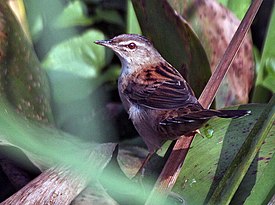
The wild cricket [2] ( lat. Helopsaltes certhiola ) is a species of cricket birds (Locustellidae) [1] . Opened and studied by the zoologist P.S. Pallas .
| Song cricket |
 |
| Scientific classification |
|---|
| No rank : | Bilateral symmetric |
| Infrastructure : | Passerida |
|
| International Scientific Name |
|---|
Helopsaltes certhiola ( Pallas , 1811 ) [1] |
| Synonyms |
|---|
- Locustella certhiola (Pallas, 1811) [1]
|
| Security status |
|---|
Least concernIUCN 3.1 Least Concern : 22714664 |
|
Content
Body length 12-16 cm. Plumage brownish or olive tones, chest and back, sometimes with mottled. Singing, unlike most other crickets, is diverse, consisting of various trills.
The song cricket is common in North Asia . It is found on the territory of Russia . Winters in South Asia . It lives in thickets of bushes along forest edges and in tall grasses, especially in damp places.
It feeds on insects and spiders.
Nests on the ground or very low on the bushes. In laying 4-6 white or pinkish with speckled eggs.
- ↑ 1 2 3 Grassbirds, Donacobius, Malagasy warblers, cisticolas, allies : [ eng ] / F. Gill & D. Donsker (Eds). // IOC World Bird List (v 8.2). - 2018. - DOI : 10.14344 / IOC.ML.8.2 . (Checked July 4, 2018) .
- ↑ Boehme RL , Flint V. Ye. The five-language dictionary of animal names. Birds. Latin, Russian, English, German, French / Under total. ed. Acad. V.E. Sokolova . - M .: Rus. lang., "RUSSO", 1994. - p. 337. - 2030 copies. - ISBN 5-200-00643-0 .