Angular acceleration - a pseudovector physical quantity equal to the first derivative of the angular velocity pseudovector with respect to time
| Angular acceleration | |
|---|---|
| Units | |
| SI | rad / s 2 |
| GHS | rad / s 2 |
| Notes | |
| pseudovector | |
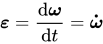

Angular acceleration characterizes the intensity of changes in the module and the direction of the angular velocity during the motion of a solid .
Content
How they come to the concept of angular acceleration: acceleration of a point of a rigid body in free motion
The concept of angular acceleration can be arrived at by considering the calculation of the acceleration of a point in a rigid body making free motion. Body point speed with free movement, according to Euler's formula , is equal to
Where - body point velocity adopted as a pole; - pseudovector of the angular velocity of the body; is a vector released from the pole to the point whose speed is being calculated. Differentiating this expression in time and using the Rivals formula [1] , we have
Where - pole acceleration ; - pseudovector of angular acceleration. Component acceleration point calculated through angular acceleration is called rotational acceleration of a point around the pole
The last term in the resulting formula, which depends on the angular velocity, is called the persistent acceleration of the acceleration of the point around the pole
The geometric meaning of the angular acceleration pseudovector
Pseudovector directed tangent to the hodograph of angular velocity. Indeed, we consider two values of the angular velocity vector at the time and at time . Let us estimate the change in the angular velocity for the considered period of time
We attribute this change to the period of time during which it occurred
The resulting vector is called the mean angular acceleration vector. It occupies the position of a secant, crossing the hodograph of the angular velocity vector at points and . We pass to the limit at
The vector of average angular acceleration will go into the vector of instantaneous angular acceleration and take the tangent position at the point to the hodograph of angular velocity.
Expression of the angular acceleration vector in terms of the final rotation parameters
When considering the rotation of the body through the parameters of the final rotation, the angular acceleration vector can be described by the formula
Where - an ort specifying the direction of the rotation axis; - the angle by which rotation is made around the axis .
Angular acceleration when the body rotates around a fixed axis
When the body rotates around a fixed axis passing through the fixed points of the body and derivatives of the unit vector of the rotation axis are zero
In this case, the angular acceleration vector is determined trivially through the second derivative of the rotation angle
or
Where - algebraic value of angular acceleration. In this case, the pseudovector of angular acceleration, like angular velocity, is directed along the axis of rotation of the body. If the first and second derivatives of the angle of rotation have the same sign
then the angular acceleration vector and the angular velocity vector coincide in direction (the body rotates rapidly). Otherwise, when , vectors of angular velocity and angular acceleration are directed in opposite directions (the body rotates slowly).
In the course of theoretical mechanics, a traditional approach is that in which the concept of angular velocity and angular acceleration is introduced when considering the rotation of a body about a fixed axis. Moreover, as a law of motion, the time dependence of the angle of rotation of the body
In this case, the law of motion of a point on a body can be expressed in a natural way, as the length of an arc of a circle passed by a point when the body rotates from a certain initial position
Where - the distance from the point to the axis of rotation (the radius of the circle along which the point moves). Differentiating the last time relation, we obtain the algebraic velocity of a point
Where - algebraic value of the angular velocity. The acceleration of a body point during rotation can be represented as the geometric sum of tangential and normal acceleration
moreover, tangential acceleration is obtained as a derivative of the algebraic velocity of a point
Where - algebraic value of angular acceleration. Normal acceleration of a body point can be calculated using the formulas
The expression of the pseudovector of angular acceleration through the body rotation tensor
If the rotation of a rigid body is given by a rank tensor ( linear operator ), expressed, for example, in terms of the final rotation parameters
Where - Kronecker symbol ; - Levi-Civita tensor , then, the pseudovector of angular acceleration can be calculated by the formula
Where is the inverse transformation tensor equal to
Notes
- ↑ V.I. Drong, V.V. Dubinin, M.M. Ilyin et al .; under the editorship of K.S. Kolesnikova, V.V. Dubinin. The course of theoretical mechanics: a textbook for universities. - 2017 .-- S. 101, 111. - 580 p. - ISBN 978-5-7038-4568-4 .
Literature
- Targ S. M. A Short Course in Theoretical Mechanics - 10th ed., Rev. and add. - M .: Higher. school., 1986 - 416 S.
- Pogorelov D. Yu. Introduction to the modeling of the dynamics of body systems: Textbook. - Bryansk: BSTU, 1997 .-- 197 p.