The orbital , in a multi-electron system, is a spin-independent mathematical function that describes the motion of an electron and is used to construct the full electronic wave function [1] of an atom or molecule.
In the description of atomic and molecular multielectron systems in the Schrödinger equation there is a term describing the interaction of electrons with each other, which makes an analytical solution impossible and extremely difficult to numerically. One of the first approaches to the search for an approximate wave function was the Hartree-Fock method, in which the pairwise interaction of electrons is replaced by the interaction of an electron with an averaged field created by other electrons. This allows us to go on to the description of the general wave function as a determinant constructed of single-electron wave functions called spin-orbitals (Slater determinant). The spin-orbital component independent of the spin is called the orbital . The Slater determinant is convenient in describing electronic systems, since it ensures that the resulting wave function is absolutely antisymmetric with respect to electron permutations (a condition imposed by the fact that electrons are fermions). Therefore, the description of the full electronic wave function in later methods is usually constructed using it and inherits the concept of orbital, although it loses its visual interpretation as a description of the behavior of an individual electron.
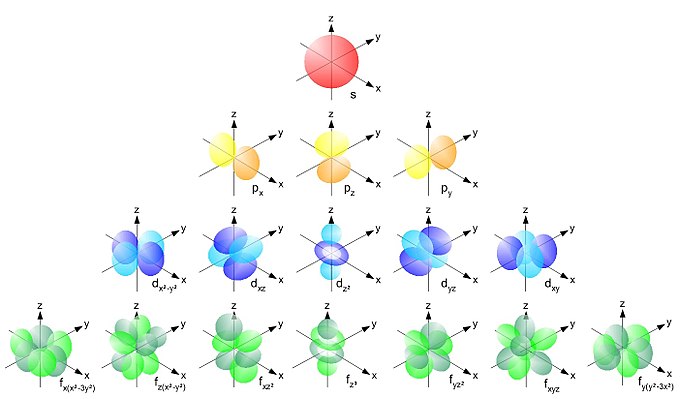
When depicting orbitals, an isosurface is usually displayed, enclosing a region of space for which the probability of an electron being in it is some large value (usually 95%). Sometimes, in a simplified presentation, a definition of the orbital is given as such a region of space [2] .
See also
- Atomic orbital
- Molecular orbital
Notes
- ↑ Dmitriev I.S., Electron through the eyes of a chemist, 1986 , p. 65.
- ↑ Ramsden, E.N., The Beginning of Modern Chemistry, 1989 , p. 44.
Literature
- Davydov A.S. Quantum mechanics. - 2nd ed., Rev. and reslave. - M .: Nauka , 1973.- 704 p.
- Dmitriev I.S. Electron through the eyes of a chemist. - 2nd ed., Rev. - L .: Chemistry , 1986.- 226 p.
- Ramsden E. N. The Beginning of Modern Chemistry. - L .: Chemistry , 1989 .-- 784 p.