The first Anglo-Mysore war was the war on the Indian subcontinent between the principality of Mysore and the British East India Company . The war was provoked by the Nizam of Hyderabad , Asaf Jah II , who sought to distract the company’s management from trying to gain control of the Northern Sirkars .
| First Anglo-Mysore War | ||||
|---|---|---|---|---|
| Main Conflict: Anglo-Mysore Wars | ||||
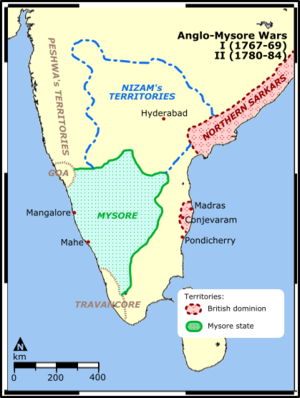 Combat map | ||||
| date | 1767-1769 | |||
| A place | Indian subcontinent | |||
| Total | Madras Agreement | |||
| Opponents | ||||
| ||||
| Commanders | ||||
| ||||


Background
The eighteenth century was a period of great turmoil in the Indian subcontinent. At the beginning of the century, most of the subcontinent fell under the control of the Mughal empire , but after the death of Emperor Aurangzeb in 1707, the empire began to disintegrate, and the struggle between governors and other local rulers over the territory intensified [1] . In the 1740s and 1750s, French and British colonial companies became more actively involved in these local conflicts, as well as in the wars for Karnatik . The British strengthened in Bombay , Madras and Calcutta , but at the same time they could not eliminate the influence of other colonial powers. In Madras, the influence of the Navab Karnatika was also strong , Muhammad Ali Khan Wallajah , the territory of which surrounded the city. Another major power in the east was Hyderabad , the former vice kingdom of the Mughal Empire, which was proclaimed an independent state in the 1720s. In Mysore, nominally ruled by representatives of the Vodeyar dynasty , but in 1761 the commander Hyder Ali began to lead the principality [2] .
Each of these powers was interested in weakening its neighbor, and therefore sought to attract the armed forces of the French and British colonial companies to their side. Colonial powers sought to influence local authorities in order to gain either direct control over their territory or part of the revenues from the budget of the territory, which was nominally controlled by the local ruler, but paid tribute for financial and military support. European military training was an order of magnitude better than local. This was especially important, since a small army of well-trained European soldiers could defeat a much larger Indian army, which consisted of poorly trained infantry and cavalry [3] .
Reasons for War
The British East India Company, desiring to create a land connection between its semi-enclaves in Madras and Bengal , sought to gain control of the Northern Circars (the Northern Circars - a series of coastal territories that belonged to the French until 1758; then the French were driven out by the British armed forces) . The British turned to the Nizam, offering to pay for the territory much more than he received from the Navab Karnatik. Nizam rejected the offer [4] . Lord Robert Clive turned to the Mughal Emperor Shah Alam II , who in August 1765 issued a decree granting the company rights to the disputed territory [5] .
At the same time, Nizam entered into an alliance with the Marathas . He and the peshwa Madhav-rao I were worried about the expansionist threat from Haider Ali. Since 1765, the Allies began to develop plans for the invasion of the Principality of Mysore. When in March 1766 the British began to occupy the Northern Sirkars, the lower classes objected and sent threatening letters to the company in Madras [6] . He wanted to start a war against the company, but because of financial problems he could not do it [7] . Instead, he began negotiations with the company in November 1766. According to his conditions, the company received four of the five Kirkars territories immediately (the fifth district of Guntur , which was led by the son of Nizam as a jaghir , was supposed to go to the company after the death of his son). In response, the British were to provide military support to the Nizam on his efforts. One historian described this Nizam agreement as a financial necessity [8] . In accordance with this agreement, the company provided two battalions of troops to the Nizam [7] .
The conflict with the participation of the authorities of Madras, Muhammad Ali Khan Vallajah and Haider Ali went into the open stage. The territory controlled by Muhammad Walladjah was surrounded by the British, and he was upset that Hyder was harboring his opponents, including his older brother Mahfuns Khan and Raj Sahib, the son of Chand Sahib (the previous candidate for the throne of Karnatik). Hyder was annoyed by the fact that the British created a fortified outpost in Velloura , and that the company several times rejected his proposal for an alliance. His proposal, which he made at the end of 1766, was rejected, as local companies considered that the signing of this agreement would be contrary to the agreement concluded with the Nizam of Hyderabad [9] .
The course of the war
The war began in January 1767 , when the Marathi, possibly awaiting an attack from the Nizam, invaded northern Mysore. They marched south to the Tungabhadra River before Hyder entered into negotiations to end the invasion. In exchange for paying the indemnity, the Marathi agreed to withdraw troops north of the Krishna River; and by March, when the lower classes began their invasion, they had already completely retreated from the territory of the principality. The historian Mark Wilkes believes that this Maratha invasion was carried out in order to improve its financial situation [10] . Nizam advanced to Bangalore , accompanied by two battalions of the East India Company under the command of Colonel Joseph Smith [11] .
In May, Smith discovered that Hyder and the lower classes were negotiating an alliance, and withdrew most of his troops from the border to Karnatik [11] . A deal between the two powers was concluded against the British. Hyder paid the Nizam, in return he recognized Tipu Sultan (the son of Hyder) as Navab Karnatik. Despite the peace agreement between the parties to the conflict, they still did not trust each other; Hyder Ali sent spies to the Nizam camp.
These diplomatic maneuvers led to an attack on the company’s troops at the Changama outpost, a joint effort by Mysore and Hyderabad, under the command of Hyder Ali [12] [13] . Despite the significantly superior troops (according to British estimates, the size of the Allied army was 70,000, and the British - 7,000 soldiers), the Allies could not take the British outpost and retreated with heavy losses. Then Haider managed to capture Pukhar after two days of siege, while Colonel Smith retreated from Changam to Tiruvannamalai to regroup [14] [12] . Hyder tried to besiege Turivannamalai, but the siege failed and he retreated on September 26, 1767. [15] With the onset of the rainy season, Hyder decided to continue the military campaign, rather than take advantage of the usual practice of suspending operations due to difficult weather conditions for the army [16] . After the capture of several outposts, he besieged the city of Ambur in November 1767, forcing the British to go on active fighting [17] . The British garrison commander refused the large bribe offered by Haider in exchange for surrender, and the arrival of reinforcements from the company in early December forced Haider to lift the siege [18] . He retreated north along with the forces of Nizam, but fell into despondency when the entire corps of European cavalry sided with the British [19] . The failure of this military campaign, coupled with successful British operations in North Kirkars, coupled with secret negotiations between the East India Company and the Nizam, led to a split between Mysore and Hyderabad. The latter recalled his troops back to Hyderabad and, in the end, concluded a new peace treaty with the British company in 1768 . Hyder was looking for ways to end the conflict, but the British refused to negotiate with him. [20]
In early 1768, the Bombay presidency organized an expedition to Mysore, in the province of Malabar. This was due to the fact that in the mid-1760s Hyder established a small fleet in the port of Mangalore . This fleet, consisting of ten ships, deserted in droves due to the fact that the captains were dissatisfied with Lutf Ali Beg, an officer of the Mysore cavalry, as the commander of the fleet [21] . When Lutf Ali Beg recalled a large portion of the garrison in Mangalore to attack British targets in Honnavar . The British took advantage of this and occupied Mangalore with minimal losses [22] . This defeat, combined with the loss of an ally in the person of Nizam Hyderabad, prompted Hyder to leave Karnatik and advance to Malabar. His son Tipu managed to recapture Mangalore and other ports captured by the British [23] [22] . He also began to levy additional taxes on the population, as a punishment for supporting the British troops [23] .
During Hyder’s absence in Karnatik, the British managed to capture a lot of territory and reach Dindigul [24] . In August 1768, the British also entered into an alliance with the Marathas [25] . The British embarked on a siege of Bangalore , where Hyder was on August 9 [26] . On August 22, Hyder attacked the Maratha camp in Oskot but the attack was repelled with heavy losses for Mysore [27] . Hyder came to the conclusion that he would not be able to defeat the allied forces, and he retreated to Gurrabkonda , where his cousin ruled [28] . He also tried to take diplomatic measures to lift the siege from Bangalore, offering to pay tribute and give land concessions in exchange for peace. The British provided another list of requirements, requiring Mysore to pay tribute to the nizam of Hyderabad and transfer more land to the British East India Company. Hyder refused to deal with Muhammad Ali Khan Vallajah. Through negotiations, the parties failed to find a common language [28] .
On October 3, 1768, Hyder, while his army was moving from Guramkond back to Bangalore, was surprised at the appearance of a small garrison of Nizam Hyderabad’s troops in Mulvagal, near Oskot. This small detachment was surrounded by a whole army of Haider [29] , but the British came to the aid of the allies. Colonel Brooks ordered two cannons to be pulled to the top of the hill, and shouted, "Smith! Smith! ”While firing a cannon [30] . Hyder Ali thought that Joseph Smith was taking part in the battle, and decided to retreat. This allowed Colonel Wood to join Brooks and other reinforcements from Mulvagal. Only after this did Hyder realize that he was deceived and the British troops under Brooks did not constitute a serious force [30] . Then he resumed his attacks, but in the end was forced to retreat, suffering heavy losses. He lost about 1,000 people, while the British lost only about 200 [31] . Colonel Smith was convinced that he would not be able to effectively besiege Bangalore, without first inflicting a major defeat on Haider in an open battle [32] . Company officials accused Smith of failing to defeat Hyder and called him back to Madras. Hyder took the opportunity to besiege Hosur . When Colonel Wood entered the fray, Hyder lifted a siege of the city and attacked Wood's convoy near Bagalur. Hyder successfully seized materials and weapons [33] . After this defeat, Wood was replaced by Colonel Lang [34] .
Hyder pulled additional forces into Mysore and went on the offensive. In November 1768, he divided his army into two parts, and led the campaign on Karnatik, regaining control of many territories. After gaining control of much of southern Karnatik, his army advanced to Madras. [34] This prompted the British to send a messenger to discuss the terms of the armistice with Hyder. However, Hyder Ali insisted that the Navab Karnatika should be expelled as a party to the negotiations, because of this the signing of the peace did not take place. Hyder Ali, leading the troops of 6,000 cavalry and a small number of infantry, made a three-day transition of 210 kilometers to Madras [35] .
This show of force made the British East India Company try to negotiate further, since Madras was left almost without protection [36] . Hyder was also looking for diplomatic leverage against the Marathas, he wanted to conclude a treaty with the British for joint action against them [37] . Peace Agreement Signed in Madras on March 29, 1769 , included obligations to provide military assistance to an ally in the event of a third party attack [38] .
Battles
- Battle of Chengham (September 3, 1767)
- The Battle of Tiruvannamalai (September 25, 1767)
- Siege of Ambur (November to December 1767)
- Battle of the Oscott (August 22, 1768)
- The Battle of Mulvagul (October 4, 1768)
- The Battle of Boglur (November 22-23, 1768)
Consequences
Hyder Ali, inspired by an allied agreement with the British, entered the war with the Marathas in 1770 , and then asked the British for military support when the Marathas entered the Mysore territories [39] . The British refused to help him, although they were also embroiled in a conflict with the Marathas in the 1770s. The Principality of Mysore fought with the Maraths until the end of 1779, the war ended to no avail, but at the conclusion of peace, both states agreed on an alliance and came together against the British. This led to the start of the second Anglo-Mysore war in 1780 [40] . This conflict devastated most of Karnatik, and also could not finally resolve the differences between the Principality of Mysore and the British. The conflict was resolved in 1799 , after the killing of Haider’s son, Tipu, and the restoration of the Vodeyars dynasty as British clients.
Notes
- ↑ Bowring, pp. 19-23
- ↑ Bowring, p. 33
- ↑ Duff, pp. 607-608
- ↑ Duff, p. 651
- ↑ Duff, p. 652
- ↑ Regani, p. 130
- ↑ 1 2 Regani, p. 131
- ↑ Regani, pp. 133-134
- ↑ Regani, p. 129
- ↑ Duff, p. 653
- ↑ 1 2 Wilks, p. 306
- ↑ 1 2 Bowring, p. 49
- ↑ Wilks, p. 312
- ↑ Wilks, p. 311
- ↑ Bowring, p. 50
- ↑ Wilks, p. 322
- ↑ Wilks, p. 323
- ↑ Wilks, p. 324
- ↑ Wilks, p. 326
- ↑ Wilks, pp. 328—329
- ↑ Sen, pp. 147-148
- ↑ 1 2 Wilks, p. 331
- ↑ 1 2 Bowring, p. 51
- ↑ Bowring, p. 52
- ↑ Wilks, p. 340
- ↑ Wilks, pp. 341—342
- ↑ Wilks, p. 342
- ↑ 1 2 Bowring, p. 53
- ↑ Wilks, p. 346
- ↑ 1 2 Wilks, p. 347
- ↑ Wilks, p. 348
- ↑ Bowring, p. 54
- ↑ Bowring, p. 55
- ↑ 1 2 Bowring, p. 56
- ↑ Bowring, p. 57
- ↑ Wilks, pp. 367—369
- ↑ Duff, p. 668
- ↑ Bowring, p. 58
- ↑ Bowring, pp. 59-82
- ↑ Bowring, pp. 80-84
Literature
- Bowring, Lewin. Haidar Alí and Tipú Sultán, and the Struggle with the Musalmán Powers of the South . - Oxford: Clarendon Press, 1899.
- Brittlebank, Kate. Tipu Sultan's Search for Legitimacy. - Delhi: Oxford University Press, 1999. - ISBN 9780195639773 .
- Chitnis, Krishnaji Nageshrao. The Nawabs of Savanur. - New Delhi: Atlantic Publishers and Distributors, 2000. - ISBN 9788171565214 .
- D'Souza, ALP History of the Catholic Community of South Kanara. - Mangalore: Desco Publishers, 1983.
- Duff, James Grant. History of the Mahrattas, Volume 1 . - London and Bombay: Times of India, 1878.
- Lethbridge, Sir Roger. The Golden Book of India: A Genealogical and Biographical Dictionary of the Ruling Princes, Chiefs, Nobles, and Other Personages, Titled or Decorated, of the Indian Empire . - London and New York: Macmillan, 1893.
- Narasimha, Roddam. The Dynamics of Technology: Creation and Diffusion of Skills and Knowledge. - New Delhi: Sage Publications, 2003 .-- ISBN 9780761996705 .
- Rao Punganuri, Ram Chandra. Memoirs of Hyder and Tippoo: Rulers of Seringapatam, Written in the Mahratta Language . - Madras: Simkins, 1849. Rao Punganuri was, according to Brown, in the employ of both Hyder and Tipu.
- Regani, Sarojini. Nizam-British Relations, 1724–1857 . - New Delhi: Concept Publishing, 1988 .-- ISBN 9788170221951 .
- Sen, Surendra Nath. Studies in Indian History: Historical Records at Goa. - New Delhi: Asian Educational Services, 1993. - ISBN 9788120607736 .
- Subramanian, KR The Maratha Rajas of Tanjore. - Mylapore, Madras: self-published, 1928.
- Tour, Maistre de la. The History of Hyder Shah, Alias Hyder Ali Khan Bahadur . - London: W. Thacker, 1855. Biography of Hyder and memoir by one of his French officers; coauthor Gholam Mohammed was Tipu Sultan's son.
- Wilks, Mark. Historical Sketches of the South of India, in an Attempt to Trace the history of Mysoor . - Second. - Madras: Higginbotham, 1869.
- Journal of the United Service Institution of India, Volume 32. - New Delhi: United Service Institution of India, 1903.