Hexamino is a six -cell polymino , that is, a flat figure consisting of six equal squares connected by sides. With hexamino figures, as with all polyminos, many tasks of entertaining mathematics are associated.
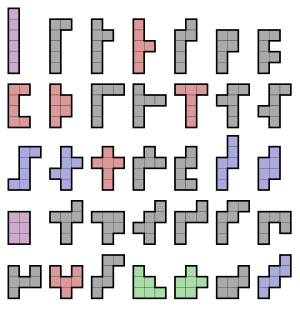
Apart from the various figures that coincide during turns and mirror reflections, there are 35 different (“free”) forms of hexamino (see figure) [1] [2] . There are 60 types of “one-sided” hexamino (if mirror reflections are considered various figures) and 216 types of “fixed” hexamino (turns are also considered different) [3] .
Content
Hexamino Classification by Symmetry
35 free hexamino figures according to their symmetry properties can be divided into 5 categories:
- 20 hexamino figures (shown in gray in the figure) are asymmetric;
- 6 hexamino (shown in red) have an axis of symmetry parallel to the lines of the square grid;
- 2 hexamino (shown in green) have a diagonal axis of symmetry;
- 5 hexamino (shown in blue) have a second-order central (rotational) symmetry;
- 2 hexamino (shown in purple) have two axes of symmetry parallel to the grid lines.
For one-sided hexamino (that is, if the mirror reflections of the figures are considered different), the first and fourth categories are doubled in number, which gives an additional 25 hexamino, that is, a total of 60. For fixed hexamino (that is, if the turns are also considered as different figures), then the first category will increase eight times in comparison with free hexamino, the next three categories will quadruple, and from the last category two times. It will give fixed hexamino.
Hexamine Shaping
Although a complete set of 35 hexamino has a total area of 210 squares, it is impossible to make any rectangle with such an area (3 × 70, 5 × 42, 6 × 35, 7 × 30, 10 × 21, 14 × 15) - in unlike 12 pentamino, from which you can add any of the rectangles 3 × 20, 4 × 15, 5 × 12 and 6 × 10. You can prove this by coloring the hexamino and rectangle in a checkerboard pattern. Then 11 hexamino pieces will have an even number of squares of both colors (2 white and 4 black or vice versa), and the remaining 24 hexamino - odd (3 white and 3 black). Thus, in any figure made up of a full set of hexamino, the number of squares of each color will be even. But any rectangle of 210 squares will have 105 black squares and 105 white squares, i.e. an odd number.
However, there are other symmetrical figures of 210 squares that can be composed of hexamino. For example, a 15 × 15 square with a 3 × 5 rectangular hole in the center has 106 white and 104 black squares (or vice versa) and can be made up of a complete set of 35 hexamino [4] .
Some symmetrical hexamino stacks
“Parallelogram” 15 × 14 with serrated sides
Rectangle 19 × 11 with single-celled protrusion
Rectangle 13 × 16 with two ledges
"Triangle" with gear hypotenuse
Rectangle 17 × 15 with a cross-shaped hole
In addition, from 60 one-sided hexamino having a total area of 360 unit squares, it is possible to make rectangles 5 × 72, 6 × 60, 8 × 45, 9 × 40, 10 × 36, 12 × 30, 15 × 24 and 18 × 20 [5] .
Cube Sweeps
11 of the 35 hexamino figures are the scans of the cube (see figure) [6] . It is impossible to add a rectangle of 66 unit squares from them [7] .
Notes
- ↑ Golomb, 1975 .
- ↑ Golomb, 1994 .
- ↑ Weisstein, Eric W. Hexomino on the Wolfram MathWorld website.
- ↑ Hexominos
- ↑ Gerard's Polyomino Solution Page
- ↑ I. Konstantinov Pentamino et al. Science and Life, No. 4, 2002
- ↑ Gardner, Mathematical Novels, 1974 .
Literature
- Golomb S.V. . Polyminino = Polyominoes / Per. from English V. Firsova. Foreword and ed. I. Yagloma . - M .: Mir , 1975 .-- 207 p.
- Solomon W. Golomb . Polyominoes. - 2nd ed. - Princeton, New Jersey: Princeton University Press , 1994 .-- ISBN 0-691-02444-8 .
- Gardner M. Mathematical short stories. - M .: Mir, 1974.
- D. Hugh Redelmeier. Counting polyominoes: yet another attack // Discrete Mathematics: Journal. - 1981. - Vol. 36. - P. 191–203. - DOI : 10.1016 / 0012-365X (81) 90237-5 .
- Daniel A. Rawsthorne. Tiling complexity of small n -ominoes ( n <10) // Discrete Mathematics: Journal. - 1988. - Vol. 70. - P. 71–75. - DOI : 10.1016 / 0012-365X (88) 90081-7 .
- Glenn C. Rhoads. Planar tilings by polyominoes, polyhexes, and polyiamonds // Journal of Computational and Applied Mathematics: Journal. - 2005. - Vol. 174. - P. 329–353. - DOI : 10.1016 / j.cam.2004.05.05.002 .