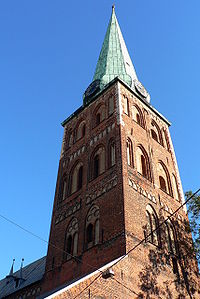

Catholicism in Latvia or the Catholic Church in Latvia is part of the worldwide Catholic Church. The number of Catholics in Latvia is about 415 thousand people [1] (about 17% of the total population). Catholicism is prevalent mainly among the Latvian ethnographic groups of Latgalese and Suites , as well as among Poles and part of Belarusians living in Latvia.
Content
History
The first acquaintance of the local population with Christianity dates back to the 11th century. At this time, the first Western missionaries appeared on the territory of the Curonian and Kurzeme Livs . Latgals first became acquainted with Eastern Christianity.
At the end of the 12th century, a Catholic missionary from the monastic order of the Augustinians, Saint Maynard , preached in the territory of today's Latvia, who built the first Catholic church in the village of Ikskile in 1185. In 1186, Maynard became the first bishop of Livonia . In 1201, the third bishop of Livonia, Albert of Riga, moved the department to Riga .
The baptism of the western Latvian peoples was completed by 1225. The peoples who lived in the east of modern Latvia were introduced to Christianity in the second half of the 13th century.
In 1234, the independent Courland Bishopric was formed , which in 1559 was annexed to Denmark and after 1585 to the Commonwealth . In 1243, the Bishopric of Ermland was formed. In 1255, Riga became the department of this bishopric and the Ermland bishopric became known as the Riga bishopric. In 1237, the theocratic Livonian Order was formed, and lasted until 1561, when its territory was transferred to the Commonwealth.
From the beginning of the 16th century, the ideas of the Reformation began to spread in the territory of modern Latvia, against which the Jesuits actively fought with the support of the Duke of Zadvina . In 1525, Pope Benedict XV abolished the Diocese of Riga . After the Polish-Swedish war, Livonia moved to Sweden , as a result of which Lutheranism in Livonia received wide state support. Latgale remained under the influence of the Polish-Lithuanian Commonwealth, therefore Catholicism has retained its significant position here.
After the first northern war of Russia with Sweden, Livonia was annexed to the Russian Empire . After the partition of Poland in 1772, Latgale was annexed to the Russian Empire, and in 1795, after the second partition of Poland, the Duchy of Courland left to Russia.
After the formation of independent Latvia in 1920, the territory of the Catholic dioceses was recreated within the borders of the new Latvian state. In 1920, a Catholic political party was formed in Latvia, which took an active part in the country's public life. On October 31, 1925, Pope Pius XI issued the log De more Romanorum Pontificum , with which he established the Apostolic Nunciature in Latvia. In 1937, Latvia entered into a concordat with the Holy See .
After Latvia joined the USSR, the activities of the Catholic Church were persecuted by the Soviet authorities. On June 1, 1947, in the Riga Seminary , according to the report of the Chairman of the Council for Religious Cults I.V. Polyansky , 29 students and 7 teachers [2] . In the post-war period, the activities of the Catholic Church in the Latvian SSR were subject to significant restrictions. Local bishops were instructed to inform their supervisors of their decisions, and many clergy were repressed. Catholic monasteries were closed. In 1949, Bishop Dulbinskis was arrested and convicted. After Stalin's death , some restrictions were lifted. In 1956, the Riga Seminary was opened. The Holy See entrusted the Apostolic Administrator of Riga, Bishop Julian Vaivods, with Catholics who lived in other republics of the USSR except the Lithuanian SSR . Riga seminary was given the status of an inter-republican seminary - students from all republics of the USSR studied there.
After the reconstruction of the Republic of Latvia in 1991, the activities of the Catholic Church in Latvia gained freedom. The Catholic Church was returned its property, confiscated by the Soviet government.
On September 12, 2002, a concordat was signed between Latvia and the Vatican.
Before the referendum on February 18, 2012 amending the Constitution of Latvia, the Catholic bishops of Latvia made an appeal to vote against giving the Russian language the status of the state language [3] .
Current status
Currently in Latvia there is 1 archdiocese, three dioceses, 252 Catholic parishes. The centralized body of the Catholic Church in Latvia today is the Conference of Catholic Bishops of Latvia .
- Riga Archdiocese ;
- Jelgava diocese ;
- Liepaja diocese ;
- Rezekne-Aglona diocese .
Notes
- ↑ Catholic Encyclopedia, vol. 2, p. 1514
- ↑ Akhmadullin V.A. The activities of government bodies of the USSR to prevent the creation of a legal system of Islamic education in the Transcaucasus (1944 - 1965) // Scientific and Information Journal Army and Society. - 2015. - No. 4 (47). - S. 38.
- ↑ Bishops of Latvia call on Latvians to vote for mother tongue in referendum
Literature
- Catholic Encyclopedia , ed. Franciscantsev, M., 2005, pp. 1510-1514, ISBN 5-89208-054-4
- Breve De more Romanorum Pontificum , AAS 19 (1927), p. 245