Schönke von Limpurg ( cf.-v.-It. Der Schenke von Limpurg ; full name is Konrad Stenke von Limpurg , s.-v.-him. Konrad Schenke von Limpurg ; before 1249 , Schwäbisch Hall - after 1286 , ibid ) - German medieval poet of the Late Minnesang period, knight .
| Schenke von Limpurg | |
|---|---|
| Der Schenke von Limpurg | |
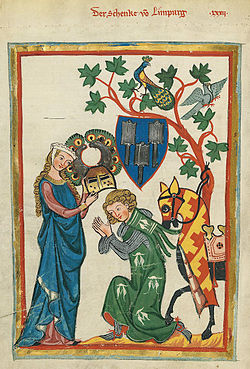 Codex of Manes , XIV century | |
| Date of Birth | until 1249 |
| Place of Birth | Schwäbisch Hall ( Germany ) |
| Date of death | after 1286 |
| Place of death | Schwäbisch Hall ( Germany ) |
| Citizenship |  Holy Roman Empire Holy Roman Empire |
| Occupation | poet |
| Direction | lyrics |
| Genre | minesang |
| Language of Works | Middle High German |
Content
Biography
Schönke von Limpurg was born in about 1249 at Limpurg Castle in Schwäbisch Hall . He was the youngest son of Walter von Limpurg (died 1249 ), an ally of King Henry VII , and then adviser to Conrad IV . From his wife Walter received extensive land ownership, where he built the castle Limpurg. The nickname "Schenke" comes from the post of court butler , who was the ancestor of the family.
The name of Conrad, together with his elder brother Walter II, was first mentioned in the documents of 1255 in connection with the conflict between Hohenstaufen and the Pope of Rome . In October 1266 he was in Augsburg , where the Duke of Swabia Conradin was preparing his expedition to Rome . In Italy, he was accompanied by Conrad Staufen in the squad of German knights. In 1267 in Pisa, he is mentioned as one of the members of his circle. Probably Schenke von Limpurg participated in the fatal battle for Konradin at Talyakozzo on August 23, 1268 , when the French knights routed the mercenary army of Konradin. Conradin - King of Jerusalem , Sicily and the Duke of Swabia was captured and executed. So the Hohenstaufen dynasty was interrupted. Schenke von Limpurg was lucky enough and returned home. He settled in the castle of Bilriet , inherited from the maternal inheritance, where he died about 1286 . Conrad's marriage certificate is not. He had no children.
Schönke von Limpurg is depicted in the Manesky Code as kneeling in front of a lady who hands him a gilded helmet, topped with horns with peacock feathers. The coat of arms consists of three silver clubs in an azure field. The symbols on green surcoats and eilets are stylized letters “A”, meaning the word “amor” - love.
Creativity
Literature
- Gerd Wunder, Max Schefold, Herta Beutter: Die Schenken von Limpurg und ihr Land , (= Forschungen aus Württembergisch Franken, Bd. 20), Sigmaringen 1982, Seite 23f. ISBN 3799576193
- Emil Kost: Der Schenk von Limpurg. Ein ritterlicher Minnesänger der Hohenstaufenzeit , in: Württembergisch Franken NF 20/21 (1940), Seite 215-239