Leonti Artemyevich Polubotok ( Ukrainian: Leonty Polubotok ;? - c. 1695 ) - General Yesaul and Bunkugny Zaporizhzhya Troops , Pereyaslavl Colonel and Chernigov Colonel .
| Leonty Artemievich Half-Work | |||||||
|---|---|---|---|---|---|---|---|
| ( Ukrainian Leontiy Polubotok ) | |||||||
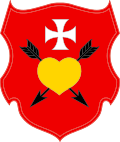 Variety of coat of arms of Przhiyatsel | |||||||
| |||||||
| |||||||
| Predecessor | Grigory Korovka-Volsky | ||||||
| |||||||
| Predecessor | Vasily Mnogoshinniy | ||||||
| Successor | Vasily Dunin-Borkovsky | ||||||
| |||||||
| Predecessor | Voitsa Serbin | ||||||
| Successor | Rodion Dumitrashko | ||||||
| Death | 1695? | ||||||
| Burial place | |||||||
| Father | Artemy Semi | ||||||
| Children | Pavel | ||||||


Biography
Belonged to the family of ancient Chernigov inhabitants; for example, in 1619 Yeremey Polubotok (most likely grandfather Leonty) was mentioned, to whom this year the Chernigov governor Saltykov gave a place for building a house in Chernigov, which was then devastated; in 1637, Yeremey Polubotok was already a Rayts and a "high-born" tradesman of Chernigov; his name was mentioned back in 1642 .
Leonty Polubotok in 1668 held the post of Chernihiv regimental clerk, and then he already received from the hetman Bryukhovetsky poop. In addition, Polubotok himself bought up land near the village of Polubotkov (in the Chernigov regiment), which must have been settled by his grandfather, and which, in all likelihood, was lost during Khmelnitsky’s struggle with the Poles. In 1669, Polubotok was considered only a “comrade of the Chernigov regiment” and lived in the village of Polubotok, where he actively bought up Cossack lands. In 1671, Polubotok, who was in great friendship with the Chernigov colonel Vasily Mnogogreshny, the brother of the hetman, received from the latter the post of Chernigov regimental centurion, who remained in 1672 , being appointed punished Chernigov colonel in 1671-1672.
With the election in 1672 of the hetman of Ivan Samoilovich , Polubotok received the post of General Bunchy and was granted the king a salary: "ten pairs of sables and ten rubles." Such a rapid increase, despite his friendship with the Sinful, exiled to Siberia, can be explained by the fact that Polubotok was a clever man who knew how to get along with all the parties in Little Russia at that time. Soon, Polubotok became related to Samoilovich: his son Pavel married the hetman niece of Euthymius Vasilievna Samoilovich (daughter of the Lebedinsky priest and sister of the Gadyatsky colonel Mikhail Vasilyevich Samoilovich). Half-work became a close person to the hetman, who was very kind to him. With the accession, in 1676 , to the throne of Moscow Tsar Fyodor Alekseevich , campaigns against Doroshenko began, and the advanced army sent against this hetman, locked up in Chigirin, defended 15,000 Russians, under the command of the captain Grigory Kosagov , and regiments: Gadyatsky , Mirgorodsky , Lubensky and one "company regiment" led by Polubotka. In 1679 he was with the army near Kiev, when the Turkish Sultan was expected to attack the city, and on February 10, 1681 he secured for himself all the manor received from the hetmans with a tsar’s diploma, from which it is clear that he already had at that time: the former mantle of Alexander Rassudovsky with all the lands in the key of Lyubetsky, the village of Gubichi, the village of Savinki, land in the Lyubetsky hundred, under the name Lishkovschizna, and several mills near Chernigov and on the Ubedi River.
In May 1685 , Polubotok was appointed Pereyaslavsky Colonel to the place of the displaced Vuytsa Serbin. Semi-work in 1683 was already a penal colonel of this regiment. By this time of his life, Polubotka refers his letter of 1685 to Vasily Kochubey on the death of the old-Duban colonel Semyon Samoilovich (son of the hetman ). At the post of Pereyaslavl colonel, Polubotok remained until the deposition of Samoilovich in 1687 , when he was arrested together with the hetman’s son, Grigory, and deprived of colonelism, however, for a short time: Rodion Dmitrashko-Raich appointed to his place seemed dangerous to the hetman Mazepa , and in 1689 , Polubotok again took the post of colonel in Pereyaslav. By this time, apparently, Polubotka and Mazepa had established even good relations, and on July 17, 1689, the hetman gave him the Sosnitsky village of Naumovka and confirmed the landfill data earlier; in addition, the hetman approved the decision of General Justice Vuyakhevich in the case of an attack on some of the Polubotka estates, made by Rodion Dmitrashk and his nephew Mark, who were sentenced to pay a fine of 1,000 "talyari". Having previously left both Chigirinsky campaigns and both Crimean in 1687 and 1689, Polubotok on September 22, 1690 again received the imperial letter to the estate. But then, in 1691 , the nephew of Hetman Samoilovich, Colonel Gadyatsky Mikhail Samoilovich, who lived in Moscow, was involved in the case of the black Solomon. From the investigation conducted in Moscow over Solomon, it turned out that Mikhail Samoilovich was involved in it, and he was exiled to Siberia . At that time, Leonty Polubotka's son, Pavel , lived in Moscow, and Mazepa was informed that he was in relations with Samoilovich, and that his father, Leonty , conducive to Samoilovich’s intentions to make trouble in Little Russia, he himself hoped to become a hetman. By order of Mazepa, Polubotok with his son Paul were taken into custody and put on trial by general elders and colonels. In the analysis of this case, it turned out that Pavel’s son Leonty, having heard from Samoilovich “unkind speeches” about the hetman, did not report Mazepa himself, but only handed them over to Mirgorod colonel Danil Apostol who was then in Moscow; and he had already informed Mazepa about this. This reason was enough to arouse Mazepa's suspicion of Semi-Work; they were taken away all the land, Leontius, in addition, was deprived of the post of colonel, and Ivan Mirovich was put in his place. The hetman wrote in detail about all this to Moscow in October 1692 .
During his colonelism in Pereyaslav, Polubotok , taking advantage of his proximity to the hetman Samoilovich, added many lands to his regiment, lying between the Sukhaya Orzhitsa River and its tributary, the Chumchak River and belonging to the Piryatinsky Hundred, of the Lubensky Regiment . Having transferred most of these lands to his personal property, Polubotok aroused a protest from Lubensky Colonel Leonty Svechka . The struggle that arose between the two colonels on this occasion ended with Mazepa’s wagon of March 20, 1690 , according to which the lands occupied by Polubotka were returned to the Lubensky regiment.
Having remained without a post, Polubotok wore only the title of "noble comrade of the Chernigov regiment" and lived in Chernigov, engaged in farming, which consisted mainly of buying up land and settling it with "free moving people." Thus, they founded and settled the settlements: Dovzhik, Tabaevka, Gubichi and others. Toward the end of his life, Mazepa’s half work had mercy on him and returned part of the areas taken from him, namely, the village: Savinki, Gabrilovka, Karukovka and Naumovka — in the Chernigov regiment.
Leonty Semybot died between July 1695 and September 1698. According to some reports (Count Miloradovich), Semibotok died in 1695 .
Leonty Semybotok was buried in the Chernigov Yelets Monastery . In 1978, during excavation work west of the Assumption Cathedral, a stone crypt was found in which the burial of Leonty Polubotka was discovered. This is proved by the inscription on the engraved silver cross (12.5 x 10 cm), which was attached to the top plate of the coffin24. Now the find is exhibited in one of the exhibition halls of the Collegium.
Literature
- Bantysh-Kamensky D. History of Lesser Russia ed. 4th, Kiev. 1903, p. 302, 343, and 345;
- Markevich "History of Little Russia", M. 1842-1843;
- Lazarevsky A.M. Pavel Polubotok, Essay on the history of Little Russia of the XVIII century - "Russian Archive" 1880, Prince. I, pp. 137-139;
- Lazarevsky A. M. "Description of the Old Little Russia", vol. I, Starodubsky regiment, Kiev. 1889, pp. 95–96;
- Kostomarov N. I. Pavel Polubotok - “Russian Old Man” 1876, No. 3, pp. 500-525;
- “From the Archive of Count Miloradovich” (reprint from the “Chernigov Provincial Gazette”), Chernihiv. 1889, pp. 1-14 and 16;
- “Acts Relating to the History of Southern and Western Russia”, vol. V, p. 184, vol. VII, p. 11, vol. IX, pp. 725–730 (P.'s correspondence with Vasily Mnogogreshny), 783, 810, 876, 907, 946, 948, 952;
- Soloviev S. M. History of Russia, vol. XIV, p. 179;
- Lazarevsky A. M. Review of the Rumyantsev inventory of Little Russia, Chernihiv. 1866, p. 16, 90, 132;
- “The General Investigation of the Locations of the Chernigov Regiment”, Chernihiv, 1892;
- Motyzhinsky Archive, Kiev. 1890, p. 6, 118, 123, 125, 130, 132, 134, 135;
- Notes of Gordon, vol. II, p. 188, 194;
- "Count Miloradovich, Little Russian nobility", Chernihiv. 1891, pp. 6-9;
- Prince Lobanov-Rostovsky Russian genealogy book, vol. II, St. Petersburg. 1895, pp. 118-120;
- "Complete collection of laws of the Russian Empire", St. Petersburg. 1830, vol. I, p. 841, 897;
- Papers of the Troinitzky clan reported by V.V. Rummel;
- "Calendar of the Chernigov diocese for 1891", p. 236;
- "Kiev Old" 1885, June, p. 433;
- Lazarevsky A.M. Ukrainian historical trifles, vol. I, Kiev. 1901, pp. 25–27;
- Chronicles of Grabyanka , Kiev. 1854, p. 314;
- Chronicle of the seer , Kiev, 1878, p. 172;
- Storozhenko N.V. Half-time or Candle? // Kiev Old Man of 1890, No. 12, pp. 434–447;
- "Acts Related to the Locations of Semi-Workings" - "Readings in the Society of History and Antiquities of Russia at Moscow University" 1862, Prince. 2, blend, pp. 91-133.