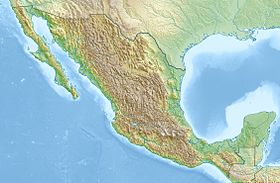
The cave of crystals ( isp. Cueva de los Cristales ) is connected to the Nike mine complex ( isp. Naica ), located at a depth of 300 meters under the city of Nike , Chihuahua , Mexico . The cave is unique in its presence of giant selenite crystals (a mineral, a structural type of gypsum ). The largest of the crystals found has a size of 11 m in length and 4 m in width, with a mass of 55 tons. This is one of the largest known crystals.
| Cave of crystals | |
|---|---|
| isp. Cueva de los cristales | |
 Researcher at the Cave of Crystals, Nike | |
| Specifications | |
| Depth | 300 m |
| Length | 27 m |
| Year of discovery | 2000 |
| Location | |
| A country |
|
| State | Chihuahua |



The cave is very hot, temperatures reach +58 ° C at a humidity of 90-100% [1] . These factors make it difficult for people to explore the cave, making it necessary to use special cooling equipment. Even with equipment, staying in a cave usually does not exceed 20 minutes, as water begins to condense in colder lungs [2] [3] .
Content
Crystal Formation
Nike is located on an ancient rift, and under the cave there is a magmatic cavity. Magma heated groundwater, and they were saturated with minerals, including a large amount of gypsum. The cave has been filled with hot minerals for hundreds of thousands of years, up to several million years.
During this time, the solution temperature remained stable in the range of + 54 ... + 58 ° C, providing the only possible conditions for the growth of selenite crystals (with the participation of the anhydrous form of calcium sulfate - anhydrite ). The lowest crystal growth rate is 1.4 ± 0.2 × 10 −5 nm / s at a temperature of +55 ° C [4] .
Opening History and Present
In 1910, the miners opened a cave beneath the Nike mines, later called the Cave of Swords ( Spanish: Cueva de las Espadas ). It is located at a depth of 120 m above the Cave of Crystals and is filled with beautiful light and transparent crystals of about a meter length. It is assumed that at this depth the temperature dropped much earlier, stopping the growth of crystals. [five]
The cave of crystals was discovered in 2000 by the Sanchez brothers-miners who were laying a new tunnel in the mine complex for Industrias Peñoles ( isp. Industrias Peñoles ). There are significant deposits of silver, zinc, and lead in the Nike mine complex. The cave of crystals is a horseshoe-shaped cavity in a limestone massif. Huge crystals cross the cave in different directions. From the caves constantly pumped water. If the equipment is stopped, they will be flooded again. The crystals are degrading in the air, so researchers from the Nike Project are seeking to document this geological object.
The new hall, called the "Ice Palace", was opened during drilling in 2009. It is located at a depth of 150 m and is not filled with water. Crystal formations are much smaller, with thin filamentous growths.
Future
In the future, biologists may be interested in crystals, since ancient microorganisms may be found in their microscopic cavities filled with liquid. In the transmission of Discovery Channel in February 2011, the possible existence of other caves was mentioned, but their study requires the destruction of crystals. It was indicated that in the end the cave would be returned to its original flooded state.
Notes
- ↑ Giant Crystal Cave Comes to Light (Unavailable (inaccessible link) . The appeal date is April 16, 2013. Archived February 9, 2010. // National Geographic News, April 9, 2007: “Temperatures hovered consistently around a steamy 136 degrees Fahrenheit (58 degrees Celsius)”
- Rare A rare glimpse of the cave of crystals // BBC, January 19, 2010: “special cooling suit - it’s not so hot!” Then you’re a breathing system. ”
- ↑ Cavern of Crystal Giants (inaccessible link) . The appeal date is April 16, 2013. Archived September 6, 2009. // National Geographic, November 2008: “There is a wide range of ice packs that can fit across the chest and back. Then another vest to insulate. Then, over everything, a bright orange caving suit. A helmet, a headlamp, a respirator mask blowing ice-cooled air. Gloves, boots. The heat is exhausting and dangerous; most trips inside last no more than 20 minutes. ”
- ↑ Ultraslow growth rates of giant gypsum crystals
- ↑ Stefan Lovgren, Giant Crystal Cave's Mystery Solved (not available link) . The appeal date is April 16, 2013. Archived on February 18, 2017. // National Geographic News, April 6, 2007: “In 1910, miners discovered another spectacular cavern beneath Naica. .. the depth of nearly 400 feet (120 meters). ”