Douglas's marsupial mouse [1] [2] ( lat. Sminthopsis douglasi ) is a species from the genus of narrow-legged marsupial mice of the predatory marsupial family. Endemic of Australia .
| Douglas's Bat |
| Scientific classification |
|---|
| No rank : | Bilateral symmetric |
| Squad: | Predatory marsupials |
| Family: | Predatory marsupials |
| Rod: | Narrow-legged marsupial mouse |
|
| International Scientific Name |
|---|
Sminthopsis douglasi ( Archer , 1979 ) |
| Area |
|---|
|
| Security status |
|---|
Close to VulnerabilityIUCN 3.1 Near Threatened : 20290 |
|
Content
The species was first described in 1979 by Australian palaeontologist Mike Archer based on a study of four museum specimens caught between 1911 and 1972 . Until the early 1980s, the species was considered extinct, but was re-opened in 1990 [3] . The specific name is given in honor of Atol Douglas, who in 1950–1960, together with his wife Marion, actively collected samples of bats for the in Perth , where he worked [4] .
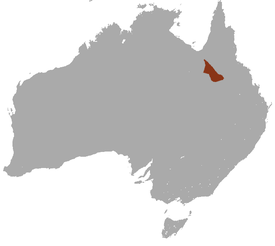
It lives in the northwestern part of the Australian state of Queensland in the Mitchell Grass hills [5] . The natural habitat is subtropical light forest with cracking clay soils, covered with dense grass vegetation [6] .
Douglas's marsupial mice are the largest representatives of the genus of narrow-legged marsupial mice . The length of the body with the head varies from 130 to 135 mm, the tail - from 120 to 130 mm. The weight of an adult individual is from 40 to 70 g [6] . The coat is short, thick and soft. The back is brown with splashes of gray. The belly is painted white. Muzzle elongated, pointed. There are facial stripes. Eyes are surrounded by dark hair. The cheeks and the base of the ears are red. The ears are average. The hind legs are narrow. Tail length slightly good length of the body with the head. Like a number of other members of the genus, Douglas's marsupial mouse has fat deposits in its tail [7] .
Douglas's marsupial mice lead a terrestrial, solitary lifestyle. Activity falls at night. In the dry season during the day they hide, as a rule, in cracks formed in the ground; during the rainy season they are protected under low-growing plants [8] . They feed mainly on insects and small invertebrates [6] [7] . Due to the fact that this food contains a large percentage of water, Douglas's marsupial mouse can go without water for a long time, and during hibernation it can hibernate [8] .
The bag is well developed. The number of nipples - 8. In captivity breeding occurs all year round. In nature, the female brings several offspring per year. In the offspring, usually six cubs (sometimes eight) [6] [5] . Cubs are born tiny and helpless: the average weight is only 15 milligrams and the body length is 4 mm. In this case, breathing is carried out through the skin [8] . Sexual maturity in males occurs in about 28-31 weeks, in females - in 17-27 weeks [6] . Life expectancy is two to three years [3] .
- Full illustrated encyclopedia. "Mammals" Kn. 2 = The New Encyclopedia of Mammals / ed. D. Macdonald . - M .: Omega, 2007. - p. 435. - 3000 copies. - ISBN 978-5-465-01346-8 .
- ↑ Sokolov V. Ye. The five-language dictionary of animal names. Mammals. Latin, Russian, English, German, French. / edited by Acad. V.E. Sokolova. - M .: Rus. lang., 1984. - p. 16. - 10,000 copies.
- 2 1 2 Dunnart (Sminthopsis douglasi) (English) . The State of Queensland, Department of Environment and Resource Management. Circulation date September 2, 2011. Archived September 3, 2011.
- ↑ Bo Beolens, Michael Watkins, and Mike Grayson. The eponym dictionary of mammals. - Baltimore: The Johns Hopkins University Press, 2009. - P. 115. - 574 p. - ISBN 978-0-8018-9304-9 .
- ↑ 1 2 Sminthopsis douglasi (English) . The IUCN Red List of Threatened Species .
- ↑ 1 2 3 4 5 James R. Turner. Julia Creek Dunnart // Mammals of Australia. - Sofia-Moscow: Pensoft, 2004. - P. 106. - ISBN 954-642-198-7 .
- ↑ 1 2 Ronald M. Nowak. Walker's marsupials of the world. - JHU Press, 2005. - p. 102-105. - ISBN 0801882222 .
- ↑ 1 2 3 Australian threatened species (English) . The Threatened Species Network. The appeal date is September 2, 2011. Archived on August 27, 2012.