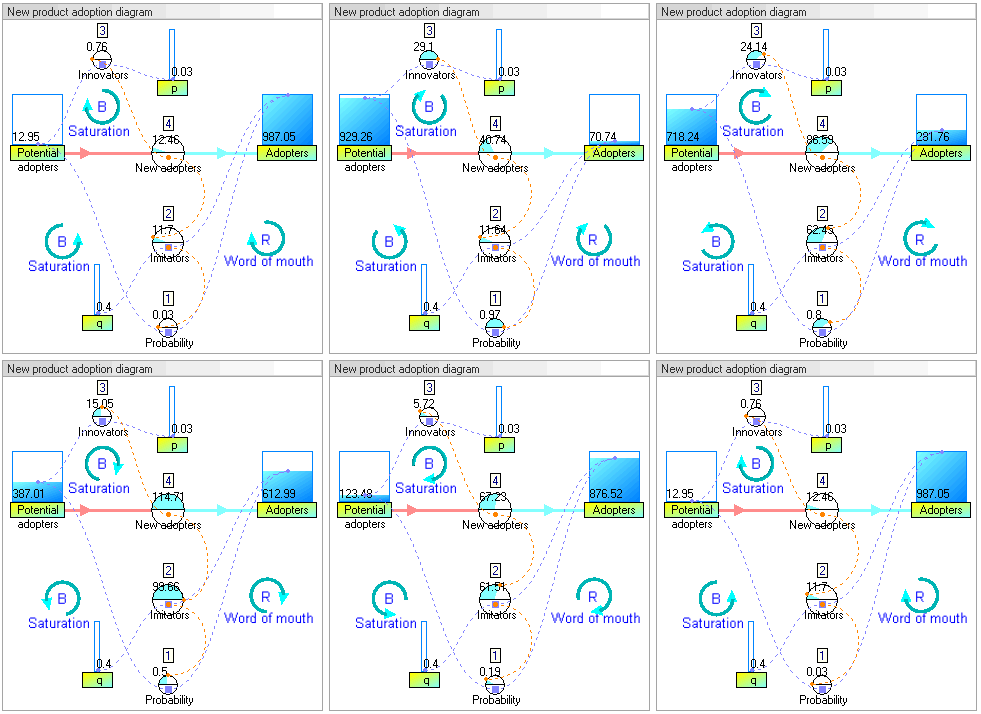
System dynamics - the direction in the study of complex systems , exploring their behavior in time and depending on the structure of the elements of the system and the interaction between them. Including: causal relationships, feedback loops , reaction delays, environmental influences and others. Particular attention is paid to computer modeling of such systems. .
Content
History
System Dynamics was created in the mid-1950s by Jay Forrester of MIT . His initial goal was to apply scientific and engineering experience to clarifying the fundamental reasons for the success and failure of corporations. The emergence of ideas that led to the creation of system dynamics was triggered by his collaboration with General Electric during the 1950s. At that time, GE managers were puzzled by fluctuations in the number of workers at one of the plants in Kentucky , whose period was three years. Business cycles have been recognized as insufficient explanations for these fluctuations. By manually calculating the structural model of the plant, which included an organizational model for making decisions about hiring and firing workers, Forrester was able to show that the instability of the number of workers was caused by the internal structure of the company and was not caused by any external factors, such as business cycles. . This work was the beginning of the system dynamics.
During the late 1950s and early 1960s, Forrester with a team of graduate students advanced system dynamics from manual computing to formal computer modeling. In the spring of 1958, Richard Bennett created the first modeling language using the method of system dynamics, which he called SIMPLE (Simulation of Industrial Management Problems of Lots of Equations, or the Simulation of Industrial Management Problems by a Set of Equations). In 1959, Phyllis Fox and Alexander Pooh wrote the first version of DYNAMO (DYNAmic MOdels), an improved version of SIMPLE, as a result of which the system dynamics language became the industry standard for the next thirty years. In 1961, Forrester published the first, which has become a classic, the book “Industrial Dynamics”.
Until the late 1960s, system dynamics was applied exclusively to corporate and management problems. However, in 1968, Forrester had a meeting with John Collins, the former mayor of Boston , as a result of which the book “Dynamics of the City” was written, revealing the application of the method to modeling the city as a dynamic system .
Soon after, another area of system dynamics emerged. In 1970, Forrester was invited to a meeting of the Club of Rome in Bern , Switzerland . The Rome Club is an organization whose activity is to predict the ways of human development and to identify possible crisis situations, such as the global crisis caused by the limited resources of the Earth in combination with an exponentially growing population. At this meeting, Forrester was asked about the possibility of applying system dynamics to the modeling of humanity. His answer, naturally, was positive. In the plane, on the way home, Forrester sketched the first scheme of the model of the global socio-economic system. He named this model WORLD1. Upon his return to the United States, Forrester refined this model for the visit of members of the Club of Rome to MIT. The latest model, described in World Dynamics, is known as WORLD2.
Model Elements
The system-dynamic model consists of a set of abstract elements representing certain properties of the simulated system. The following types of elements are distinguished [1] :
- Levels - characterize the accumulated values of the values within the system. These can be goods in a warehouse, goods in transit, bank cash, production areas, number of employees. Levels are applicable not only to physical quantities. For example, awareness is essential when making a decision. Levels of satisfaction, optimism and negative expectations affect economic behavior. Levels are the values of variables accumulated as a result of the difference between incoming and outgoing flows. The diagrams are represented by rectangles.
- Flows - the rate of change of levels. For example, the flow of materials, orders, cash, labor, equipment, information. Depicted by solid arrows.
- Decision functions (valves) are functions of dependence of flows on levels. The solution function can be in the form of a simple equation that determines the flow response to the state of one or two levels. For example, the performance of the transport system can be expressed by the number of goods in transit (level) and constant (delay in transit). A more complex example: the decision to hire workers may be related to the levels of available labor, the average rate of receipt of orders, the number of employees undergoing training, the number of new employees, outstanding outstanding orders, inventory levels, availability of equipment and materials. Depicted by two triangles in the form of a butterfly.
- Channels of information connecting valves with levels. Depicted by dashed arrows.
- Delay lines (lags) - serve to simulate the delay flows. Characterized by the parameters of the average delay and the type of unsteady reaction. The second parameter characterizes the response of the element to a change in the input signal. Different types of delay lines have different dynamic response.
- Auxiliary variables - are located in the channels of information between the levels and functions of solutions and define some function. Depicted by a circle.
Model Building Principles
A socio-economic system can be described by a variety of system-dynamic models. The choice of factors to be included in the model is determined by the questions that must be answered. However, in the general case it is impossible to limit the base of building a model to any narrow scientific discipline. Technical, legal, organizational, economic, psychological, labor, monetary and historical factors should be included in the model. All of them must find their place in determining the interaction of elements of the system. Any factor can have a decisive influence on the behavior of the system.
As a rule, the most important models responding to control requests include from 30 to 3000 variables. The lower limit is close to the minimum, which reflects the main types of system behavior that interest decision makers. The upper limit is limited by our perception capabilities of the system and all its interconnections.
Special attention should be paid to the following aspects of the system being studied:
- time dependencies
- gain,
- distortion of information.
When building a model, its variables should correspond to the variables of the system being modeled and be measured in the same units. For example, commodity flows should be measured in kind, not in monetary units. Cash flows are treated separately. Commodity and cash indicators associated prices . It is impossible to represent the goods in the form of appropriate monetary amounts, otherwise the value of prices and the fact that the movement of money is not synchronous with the movement of goods will not be taken into account. Orders for goods are not goods, goods shipped are not equivalent to payable bills, and the latter are not equivalent to cash.
Actual prices should be used in the model of the economic system, not quoted or indexed. Actual prices and their fluctuations cause important psychological consequences, for example, in determining the amount of wages.
The system-dynamic model does not have to be stable . Among the existing socio-economic systems, some are unstable in the mathematical sense. They do not tend to a state of equilibrium even in the absence of external disturbances. Social systems are highly non-linear and, most of the time, counteract the constraints associated with a shortage of labor, a reduction in monetary resources, overcoming inflation, a downturn in business, and a shortage of means of production. [one]
See also
- Dynamic system
- Agent Modeling
- Social dynamics
Notes
- ↑ 1 2 J. Forrester. Basics of enterprise cybernetics (industrial dynamics). M .: Progress, 1971.
Literature
- Forrester, Jay W. (1961). Industrial Dynamics. MIT Press. ISBN 0-262-06003-5 .
- Meadows, Donella H. , Dennis L. Meadows , Jørgen Randers, William W. Behrens III (1972). Limits to Growth . New York: Universe Books. ISBN 0-87663-165-0 .
- Sterman, John (2000). Business Dynamics. Irwin McGraw-Hill. ISBN 0-07-231135-5
- Goodman, Michael (1989). Study Notes in System Dynamics. Pegasus. ISBN 1-883823-40-4
- Forrester D. World Dynamics. - M .: AST, 2003
- Peter Senge Fifth discipline. The art and practice of a self-learning organization. - M .: Olimp-Business, 2003
- Forrester D. Industrial Dynamics. - M .: Progress, 1971
- Averin G.V. System Dynamics . - Donetsk: Donbass, 2014