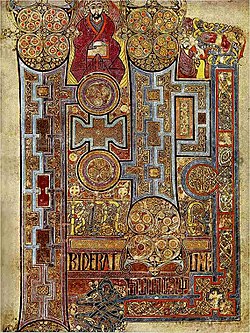
The Book of Kells (also known as the Book of Columbus, Ir. Leabhar Cheanannais , Book of Kells ) is a richly illustrated manuscript book created by Irish (Celtic) monks around the year 800. This is one of the most generously decorated with exquisite miniatures and ornaments of medieval manuscripts among all that have come down to us [1] . Thanks to the magnificent technique of execution and the beauty of the patterns, many researchers [2] [3] consider it as the most significant work of medieval Irish art. The book contains four Gospels in Latin , an introduction and interpretations, decorated with a huge number of color patterns and miniatures. The book is currently in the library of Trinity College Dublin , Ireland .
| ||
| The Book of Kells . OK. 800 | ||
| Leabhar cheanannais | ||
| Trinity College Dublin | ||
| ( inv. ) | ||
History
Creation

According to the main version of its origin, the book was created in the scriptorium of the monastery of St. Columbus on the island of Iona in the late VIII - early IX century [4] [5] . After the monastery was defeated by the Normans , the book was transported by fledging monks to Ireland [5] , to Kells Abbey (monastery), from where the book got its name.
The Book of Kells is the pinnacle of mastery in the creation of manuscript books from the end of the 6th to the beginning of the 9th centuries in the monasteries of Ireland , Scotland and northern England , as well as in the monasteries founded by immigrants from Ireland and England on the continent [5] . Of the manuscripts ( “illuminated Gospels” ) that have been preserved since then, one can note the “Life of St. Columba” ( Cathach of St. Columba ), Ambrosiana Orosius , a fragment of the Gospel from the Durham Cathedral Library (all from the beginning of the 7th century), a book from Darrow ( Book of Durrow - second half of the 7th century). From the books created at the beginning of the 8th century, the Gospel of Durham ( Durham Gospels ), the Gospel of Echternach ( Echternach Gospels ), the Gospel of Lindisfarne ( Lindisfarne Gospels ) and the Lichfield Gospels are preserved . The Gospel of St. Gall ( St. Gall Gospel Book ) and the Gospel of Macregal ( Macregal Gospels ) were created at the end of the VIII century. At the beginning of the 9th century, the Book of Armagh (dated 807–809), Turin Gospel Book Fragment , Leiden Priscian , St. Gall Priscian and Macdurnan Gospel . These manuscripts have common features that allow researchers to attribute them to the same tradition [6]
The book was kept in Kells Abbey for almost all the Middle Ages . This monastery was founded in the city of Kels ( County Meath , Ireland ) at the beginning of the ninth century, during the constant invasions of the Vikings , by monks from the monastery from the island of Iona off the coast of Scotland . After the island of Iona became too life-threatening due to Viking raids, most of the monks moved to Kells Abbey, which later became the center of the monastic society founded by St. Columba [5] .
Fierce debate was conducted on the date and place of the creation of the manuscript. Tradition attributed the creation of the book to St. Columbe [7] , but paleographic studies pushed the creation of this book to a slightly later date, around the year 800 [8] [9] .
There are at least five different theories about where the manuscript was created. According to one of them, the book was created in the scriptorium of the monastery of St. Columbus on the island of Iona and moved to Kells Abbey in its current, not fully completed form. According to the second version, the book was started on Aion, and subsequently work on it was continued at Kells Abbey [4] . According to the third, the book was entirely created in the scriptures of the Kells Abbey. According to the fourth version, the book was created in the north of England, possibly in Lindisfarne , then transported to Iona, and from there to Kells Abbey. And finally, a book could have been created in an unknown monastery in Scotland. Perhaps the exact location will never be established, but at present the most widely accepted is the second version - the book was started on about. Iona and continued at Kells Abbey [5] . In any case, the book was made by monks belonging to the society founded by Columbus .
Medieval Period
Whenever a book was created, in the XII century it was definitely located in Kells Abbey, and almost certainly it was there at the beginning of the XI century. In the annals of “Annals of Ulster, ” a record of 1006 says: “The great gospel of Columbus [10] , the main relic of the Western world, was stolen at night from the western sacristy of a large stone church in Kenannas because of its magnificent salary” [5] [11] (Kenannas is the medieval Irish name for Kells). The manuscript was found a few months later without its “under the turf” decorated with gold and jewelry [12] . If, as expected, we are talking specifically about the Book of Kells, then this is the first mention of its whereabouts in the sources. Perhaps it was after this abduction that the book lost a number of pages from its beginning and end. .
In the 12th century, the land charters of the Kells Monastery were copied onto some of the blank pages of the book, which gives the earliest accurate confirmation of the location of the book in Kells. (Copying charters to important books was a widespread medieval practice) .
The 12th-century writer Girald Cumbrian, in the book Topographia Hibernica, describes the great gospel that he saw in Kildar, the description of which corresponds to the Book of Kells: [13]
“This book contains the harmony of the four evangelists according to Jerome, almost every page in it is decorated differently, with different colors. In it you can see the face of the Lord, divinely painted, there are mystical symbols of the Evangelists, each with wings, with six, with four, with two; there is an eagle, there is a bull, there is a man, and there is a lion, and a great many other figures. Look at them with a superficial look, and you will think that these are erasures, not a pattern. The most beautiful art is near you, but you may not notice it. You will discover the labyrinths of lines, so delicate and elegant, full of interweaving and connections, with flowers so fresh and vibrant that you can say that this is the work of an angel, not a person. ” |
Since Girald says that he saw this book in Kildare, it is possible that he saw another, now lost, book equal in quality to the creation of the Book of Kells, or perhaps in this evidence he was mistaken with the location of this book [14] .
Kells Abbey was dissolved during church reforms in the 12th century. The monastery church was turned into a parish, in which the Book of Kells continued to be kept.
Modern Period
The Book of Kells remained in Kells until 1654, when Oliver Cromwell's cavalry was stationed in this church, and the city governor sent a book for its safety to Dublin . The book was donated to Trinity College in Dublin in 1661 by Henry Jones, the local bishop. [15] With the exception of brief exhibition periods, the Book of Kells is in the library of this college from the 17th century to the present.
In the sixteenth century, Gerald Plunkett on the margins of the book were affixed with Roman numerals of the numbers of the chapters of the gospels, in accordance with the division into chapters proposed in the XIII century by the Archbishop of Canterbury Stephen Lengton. In 1621, the pages of the book were numbered by Bishop James Asher [5] . In 1849, Queen Victoria and Prince Albert were asked to leave their signatures in the book [16] . They signed on the modern bookend book. This page was removed in 1953 during restoration [17] .
Over the past centuries, the book has been repeatedly bound and restored. During bookbinding in the 18th century, pages were cropped to bring them to the same format, with some fragments of images being lost. The book was bound in 1895, but this binding quickly deteriorated. Since the late 1920s, several pages were kept separately. In 1953, the book was bound by Roger Powell in four volumes [17] [18] .
In 2000, a volume containing the Gospel of Mark attended an exhibition of facial manuscripts in Canberra , Australia . It was the fourth foreign exhibition of the Book of Kells. Unfortunately, during the flight, Tom received “slight pigment destruction” due to vibration of aircraft engines during a long flight [19] .
Reproductions
In 1951, the Swiss publishing house Urs Graf-Ferlag Bern issued a facsimile edition. Most of the pages were reproduced in black and white. 48 pages, however, were reproduced in color, including all full-page illustrations.
In 1979, another Swiss publishing house, Facsimile Ferlag Laser, asked for permission to issue a full-color facsimile edition. Trinity College initially denied him for fear of damaging the book. In 1986, after developing a safe process for taking photocopies that excluded touching the pages, permission was obtained . The publication was published in 1990 in two volumes, in the first - a facsimile of the book, in the second - comments by scientists. A CD-ROM version is available with scanned images of facsimile publication pages and researchers' comments.
Description
The Book of Kells contains four Gospels written in black, red, magenta, and yellow ink, with a preface, conclusion, and selection of passages from the Gospels [20] . The book currently consists of 340 parchment sheets called folios. Most of the sheets are part of double sheets, the so-called bifolia, but some sheets are single.
It is estimated that about 30 folios were lost (there is a mention that in 1621 there were 344 folios in the book). The surviving folies are collected in 38 "notebooks". One notebook contains from 4 to 12 folias (from 2 to 6 bifolios). Most often, a notebook contains 10 folias. Some folios are separate sheets, in particular, many important decorated pages. On many pages, auxiliary lines and marks have been preserved [18] . The parchment is high quality, although the folios have an uneven thickness, from very thick to almost translucent. The format of the book is currently 330 by 250 millimeters. Initially, the pages were not the same size, but in the XVIII century they were cut off, leading to the same appearance. The text area is approximately 250 by 170 mm. On each page with text from 16 to 18 lines [18] . The manuscript is well preserved. The book remained incomplete, and some miniatures exist only in outline.
Contents
The book in its present form contains a preface, the full text of the Gospels of Matthew, Mark and Luke, and the text of the Gospel from John to John. 17:13. The remainder of the Gospel of John and an unknown piece of the preface are lost - perhaps this happened when the book was stolen at the beginning of the XI century. The surviving piece of the preface consists of two fragments of lists of Jewish names contained in the gospels, Breves causae and Argumenta (cross references to the gospels and legends about the life of the evangelists) for the four Gospels, and the canonical tables of Eusebius of Caesarea . It is likely that, like the Gospel of Lindisfarne , the book of Darrow and the book of Armagh, part of the lost preface contained a letter from Jerome to Pope Damas I , known as “ Novum opus ”, in which Jerome explains the purpose of his translation. It is also possible, although less likely, that the lost material included a letter from Eusebius to Karpian, in which he explains the use of canonical tables [21] (of all the above books, only the Gospel of Lindisfarne contains this letter).
There are two fragments of lists of Jewish names: one on the right side of the first sheet of the book, the second on sheet 26, which is currently inserted at the end of the introductory part of the Gospel of John. The first fragment of the list contains the end of the list of names from the Gospel of Matthew. Missing names from this list should have occupied an additional two sheets. The second fragment of the list, on page 26, contains about a quarter of the list of names from the Gospel of Luke. Names from this gospel should occupy about three sheets in addition. The structure of the notebook in which sheet 26 is located indicates that the additional three sheets could not be between sheets 26 and 27, so sheet 26 is definitely not in its original place. Lists of names for Mark and John, apparently, have been lost [21] .
The first fragment of the list is followed by the canonical tables of Eusebius of Caesarea. These tables, compiled even before the creation of the Vulgate bl. Jerome , represent a system of cross-references to parallel places of the Gospels. Eusebius divided each Gospel into fragments, the size of which depended on the presence of parallels in other Gospels, and then brought the numbers of parallel places into tables, allowing readers to find similar places in different Gospels. Canonical tables have traditionally been included in the introductory part of most medieval copies of the Vulgate test. The tables in the Book of Kells, however, are practically unsuitable for use because of the way the scribe portrayed them. In addition, the corresponding chapter numbers were never inserted into the fields of the book, so it is not possible to find the places to which these tables refer. The reasons why these chapter numbers were not inserted in the book are unknown. It is possible that they were planning to insert them when the book is completely completed, but this never happened [21] .
Breves causae and Argumenta belong to the pre-Vulgate manuscript tradition. Breves causae are summaries of the old Latin translation of the gospels. They are divided into a number of chapters. These chapter numbers, as in the case of canonical tables, are not affixed to the Gospels themselves. However, it is unlikely that these numbers could be used even if the book was completed, due to the fact that the chapter numbers correspond to the old Latin translation, which is difficult to harmonize with the Vulgate text. Argumenta is a collection of legends of the evangelists. Breves causae and Argumenta are arranged in a rather strange order: first Breves causae and Argumenta for Matthew, then Breves causae and Argumenta for Mark, then Argumenta for Luke and John, then Breves causae for Luke and John. The same order can be found in the Book of Darrow , although there Breves causae for Luke and John is at the end of the book, while everything else is at the beginning [21] . In other manuscripts of this group, such as the Gospel of Lindisfarne ( Lindisfarne Gospels ), the Book of Armagh and the Gospel of Echternach ( Echternach Gospels ), each Gospel is considered as a separate work and has an introductory section dedicated specifically to it [22] . Probably , scribes in Kells had before them either a Book from Darrow , or some common prototype of them as a model.
Text and Font
The Book of Kells contains the text of the four Gospels, based on the Vulgate. However, in the text there are also differences from the Vulgate, in which the old Latin translation (pre-Ieronym) is used. These variations are found in other "island" gospels, however, it does not seem that there was any one source for all the "island" texts. It is assumed that scribes often relied on their memory rather than on text in a prototype book. .
The manuscript is written in an island version of capital letters, sometimes lowercase letters (minuscules) are found, usually the letters "c" and "s". The text is mainly written in one long line throughout the page. Francoise Henry identified at least three scribes, calling them “Hand A”, “Hand B”, “Hand C” [23] . Hand A wrote pages 1 through 19v, from 276 to 289, and from 307 to the end of the manuscript. Hand A mostly used brown ink made from ink nuts that were used throughout the West [23] . Its pages are usually 18 or 19 lines of text. Hand B wrote sheets from 19r to 26 and from 124 to 128. He has a tendency to use minuscules (lowercase letters), red, magenta and black ink and a variable number of lines per page. Hand C has written most of the text. У него также заметна тенденция более часто, чем у «Руки А», использовать минускулы. Он использовал те же коричневые чернила из чернильных орешков, что и Рука А. На его страницах почти всегда 17 строк текста [24] .
Украшения
Текст сопровождается невероятно сложными по технике создания рисунками в полную страницу, а также в самом тексте часто встречаются небольшие художественные украшения. В книге используется широкая палитра цветов, наиболее часто встречаются пурпурный, сиреневый, красный, розовый, зелёный, жёлтый. (Для иллюстраций в Книге из Дарроу, напротив, используются только четыре краски). Удивительно, учитывая общую роскошь книги, но в ней не использовалось серебро и золото. Пигменты, использованные для приготовления чернил, импортировались практически со всей Европы, а наиболее редкий и дорогой — синяя ляпис-лазурь [25] — был привезён из Афганистана [26] .
Количество и качество рисунков намного превосходят все остальные сохранившиеся «островные» Евангелия. Сохранилось десять полностраничных иллюстраций, включая две с портретами евангелистов, три страницы с четырьмя символами евангелистов , страница с монограммой из имени Христа, миниатюра Девы с Младенцем, миниатюра Воцарившегося Христа, миниатюра с арестом Христа и с Искушением Христовым. Также в книге сохранились 13 полных страниц с декорированным текстом, включая страницы с первыми несколькими словами каждого Евангелия. На многих страницах книги только часть текста декорирована. Восемь из десяти страниц с каноническими таблицами щедро украшены узорами [27] . Очень вероятно , что в книге были и другие страницы с миниатюрами, ныне утраченные. В дополнение к этим главным страницам с миниатюрами, в книге имеется огромное количество маленьких орнаментов и украшений по всему тексту, например, для начальных букв.
Сохранившаяся часть манускрипта начинается с листа с фрагментом списка еврейских имён. Этот фрагмент занимает одну колонку правой страницы первого листа. Другая колонка этого листа занята миниатюрой с символами четырёх евангелистов, ныне почти стёртой. Миниатюра расположена так, что книгу нужно перевернуть на 90 градусов, чтобы увидеть её в правильном положении [28] . Символы четырёх евангелистов — это визуальная тема, встречающаяся на протяжении всей книги. Они почти всегда изображены вместе, чтобы показать единство послания четырёх Евангелий .
Единство четырёх Евангелий подчёркивается также в украшениях канонических таблиц Евсевия. Они сами по себе служили тому, чтобы подчеркнуть единство Евангелий, позволяя читателю находить схожие места из них. Канонические таблицы Евсевия обычно требовали для своего размещения двенадцати страниц. Творцы Келлской книги изначально и рассчитывали разместить их на 12 страницах (листы с 1v по 7r), но, по неизвестным причинам, ужали их до 10 страниц, оставив листы 6v и 7r пустыми. Это сжатие привело к тому, что таблицы невозможно использовать. Украшения первых восьми страниц канонических таблиц явно испытали на себе влияние ранних книг с Евангелиями, созданных в Средиземноморье. Украшать эти таблицы арками было весьма распространённой традицией (ср. с Лондонскими каноническими таблицами) [28] . Создатели Келлской книги также сделали это, но в своём островном духе. Арки изображены не как архитектурные элементы, а скорее как стилизованные геометрические шаблоны, выполненные с использованием кельтских мотивов. Символы четырёх евангелистов занимают пространство над и под арками. Последние две канонические таблицы изображены в сетке, что впервые встречается в Книге из Дарроу [29] .
Остаток книги после канонических таблиц разделён на секции. Начало каждой части отмечено миниатюрами и полными страницами с украшенным текстом. Каждому из Евангелий предшествует множество иллюстраций. Вступительная часть рассматривается в качестве отдельной, и ей предшествует щедро украшенный разворот. Помимо вступительной части и Евангелий, «второе начало» Евангелия от Матфея также украшено начальными иллюстрациями.
Вступительной части предшествует образ с Девой Марией и Младенцем Иисусом (лист 7v). Это старейшее из сохранившихся изображений Девы Марии в западных рукописях. Эта миниатюра стилистически похожа на изображение, вырезанное на крышке гроба св. Катберта . Иконография миниатюры может носить следы влияния Восточных или Коптских икон [30] .
Миниатюра Девы с Младенцем находится перед первой страницей с текстом Breves Causae для Евангелия от Матфея, который начинается со слов Nativitas Christi in Bethlem (рождение Христа в Вифлееме). Начальная страница ( folio 8r ) текста Breves Causae окружена тщательно украшенной рамкой. Двухстраничный разворот с миниатюрой и текстом оживляет вступительную часть материала. Начальная строка каждой части вступления увеличена и украшена (см. выше Breves causae Евангелия от Луки — лист 19), но остальные части вступления всё же выполнены не на таком высоком уровне, как начало Breves Causae Евангелия от Матфея [30] .
Книга была задумана так, чтобы каждое Евангелие начиналось с вводных иллюстраций, построенных по одному плану. Первоначально каждому Евангелию предшествовала полностраничная миниатюра с символами четырёх Евангелистов, за которой следовала пустая страница. Затем шёл портрет Евангелиста, после которого начинался уже собственно текст, первая страница которого всегда обильно декорирована [31] . В Евангелии от Матфея сохранились и портрет Евангелиста ( лист 28v ), и страница с символами четырёх Евангелистов (лист 27r, см. выше). В Евангелии от Марка отсутствует портрет Евангелиста, но осталась страница с символами Евангелистов ( лист 129v ). В Евангелии от Луки отсутствуют и портрет, и символы Евангелистов. В Евангелии от Иоанна, также как в Матфее, сохранились и портрет (лист 291v, см. справа), и страница с символами Евангелистов ( лист 290v ). Предполагают, что портреты Марка и Луки и страница с символами перед Лукой когда-то существовали, но ныне утеряны [32] .
Первые несколько слов Евангелия всегда обильно декорированы. Эти страницы напоминают орнаменты на ковре. Зачастую сам текст очень трудно различить среди всевозможных украшений. Начальная страница (лист 28r) Евангелия от Матфея может служить хорошим примером. Текст на странице состоит только из двух слов Liber generationis («Книга поколений»). «Lib» из слова Liber превращено в гигантскую монограмму, занимающую большую часть страницы. «er» из Liber представлено в виде пересекающегося орнамента внутри буквы «b» монограммы «lib». Generationis разорвано на три строки и находится внутри украшенной орнаментами рамки в правом нижнем квадранте страницы. Всё это окружено орнаментированным бордюром [33] . Бордюр и сами буквы украшены кельтскими узорами со спиралями и узлами, а также с зооморфными мотивами. Начальные слова Марка, Initium evangelii («Начало Евангелия»), Луки, Quoniam quidem multi («Как уже многие»), и Иоанна, In principio erat verbum , («В начале было Слово») отделаны в том же стиле. Во всех остальных «островных» Евангелиях эти страницы также сильно декорированы, но уровня Келлской книги всё же не достигают [1] .
Евангелие от Матфея начинается с родословия Иисуса Христа. Настоящий рассказ о жизни Христа начинается с Мат. 1:18. Это «второе начало» Матфея выделено во многих ранних книгах с Евангелиями настолько, что зачастую эти две части могут рассматриваться как отдельные работы. «Второе начало» начинается со слова «Христос». В средневековых манускриптах греческие буквы χ — «хи» и ρ — «ро» часто использовались для аббревиатуры имени Христа. В «островных» Евангелиях начальная «Хи Ро монограмма» обычно всегда увеличена и обильно украшена. В Келлской книге «второе начало» украшено так же изобильно, как начала Евангелий [33] . На листе 32v изображена миниатюра с Христом Воцарившимся. За этой миниатюрой следует «ковровая» страница лист 33r , единственная в Келлской книге, чьё содержимое — только орнамент. (Единственная «ковровая» страница — это довольно необычно . В Евангелии из Линдисфарна имеется 5 «ковровых» страниц, в Книге из Дарроу — 6.) После этого идёт пустая страница 33v, за которой следует, страница с монограммой Хи Ро, которая служит инципитом (началом) для рассказа о жизни Христа.
В Келлской книге монограмма Хи-Ро выросла до размеров целой страницы. Буква «Хи» доминирует на странице, занимая большую её часть. «Ро» расположена под буквой «Хи» справа. Обе буквы покрыты обильными узорами с кельтскими узлами . Фон также покрыт огромным числом узоров со спиралями и узлами. Внутри этой массы орнаментов спрятаны фигуры животных и насекомых. Три ангела появляются из-за одной из перекладин буквы «Хи». Эта миниатюра является самой большой и роскошной монограммой Хи Ро во всех «островных» Евангелиях, кульминацией традиции, начавшейся с Книги из Дарроу [33] .
Келлская книга содержит две полностраничные миниатюры, иллюстрирующие эпизоды со Страстями Христовыми. Текст Матфея иллюстрирован миниатюрой с арестом Христа ( лист 114r ). Иисус изображён стоящим под аркой, его держат за руки два человека [34] . В тексте Луки есть полностраничная миниатюра с Искушением Христа ( лист 202v ). Христос изображён по пояс на вершине Храма. Справа стоит толпа людей, возможно изображающая его учеников. Слева и ниже Христа находится чёрная фигура Сатаны . Выше изображены два ангела [35] .
Обратная сторона листа, содержащего Арест Христа , содержит полную страницу декорированного текста, который начинается с «Tunc dicit illis» . Следом за миниатюрой с Искушением также следует страница с декорированным текстом (лист 203r «Iesus autem plenus»). В дополнение к этому имеется ещё пять скрупулёзно отрисованных страниц с декорированным текстом. В Матфее находится ещё одна такая страница со словами ( лист 124r , «Tunc crucifixerant Xpi cum eo duos latrones»). В Евангелии от Марка есть две страницы с декорированным текстом ( лист 183r , «Erat autem hora tercia», и лист 187v, «[Et Dominus] quidem [Iesus] postquam»). Евангелие от Луки также содержит две страницы декорированного текста (лист 188v, «Fuit in diebus Herodis», и лист 285r , «Una autem sabbati valde»). Хотя эти тексты не имеют связанных с ними миниатюр, возможно, что эти миниатюры или существовали и были утеряны, или были, как минимум, запланированы, но так и не нарисованы. В Евангелии от Иоанна, помимо инципита , нет других страниц с декорированным текстом. Однако, в трёх других Евангелиях все полные страницы с декорированным текстом, за исключением листа 188v, встречаются внутри рассказов о Страстях Христовых. В Евангелии от Иоанна как раз эта часть текста отсутствует, так что, вероятно, в Иоанне некогда существовали эти страницы с декорированным текстом [36] .
Украшения в книге не ограничены основными страницами. В действительности все, за исключением двух, страницы содержат какие-либо иллюстрации/орнаменты. По всему тексту разбросаны декорированные инициалы и маленькие фигурки животных и людей, зачастую закрученные в узлы и сложные орнаменты. Многие важные тексты, такие как молитва «Отче наш» , имеют декорированные инициалы. На странице, содержащей заповеди о блаженствах из Нагорной проповеди в Матфее ( лист 40v ) имеется большая миниатюра вдоль левого поля страницы, состоящая из связанных между собой букв «B», с которых начинается каждая строка. Генеалогия Христа из Евангелия от Луки ( лист 200r ) содержит подобную миниатюру, в которой в цепочку вдоль левого поля страницы соединены слова «qui». Многие из маленьких фигурок животных, рассеянных по тексту, служат пометками об окончании строки, а иногда они просто служат тому, чтобы заполнить место, оставшееся в конце строки. Ни одна из этих фигурок не повторяет другую .
Все украшения в книге выполнены с высочайшим мастерством. От сложности их дизайна зачастую захватывает дыхание. В одном узоре, который занимает квадратный дюйм страницы, можно насчитать 158 сложных пересечений белой ленточки с тёмным бордюром. Некоторые узоры можно различить только с помощью лупы, хотя во время создания этой книги их ещё не существовало. Узоры и орнаменты, которые можно увидеть в этой книге, имеют много параллелей с ювелирными украшениями и резьбой по камню, оставшимися с того периода. Дизайн этих узоров зачастую используется и в сегодняшних ювелирных украшениях и татуировках .
Usage
Книга была предназначена скорее для использования во время богослужений, нежели для чтения. Большие, щедро украшенные Евангелия, такие как Келлская книга, обычно хранились в алтаре церкви и использовались только для чтения Евангелия во время мессы . Однако чтец, зачастую, не читал текст по книге, а цитировал по памяти. Важно отметить, что, как утверждается в «Хрониках Ольстера», книга была украдена из ризницы (где хранились сосуды, чаши и прочая утварь, используемая во время мессы), а не из монастырской библиотеки. Оформители книги, скорее всего, и имели в виду такое использование книги, чтобы она скорее выглядела роскошной, чем была полезной. В тексте имеются многочисленные неисправленные ошибки. Предложения часто начинаются с новой строки, что позволяло украсить страницу большим количеством буквиц, а пустое место в предыдущих неполных строках занять орнаментом. Номера глав, необходимые для использования канонических таблиц, так и не были проставлены на полях. В общем, всё делалось для того, чтобы не нарушить своеобразную эстетику книги: у красоты был явный приоритет над полезностью [29] .
In art
- « The Book Of Kells » — второй студийный альбом кельтской рок-группы Iona , записанный в начале 1992 года
- “ The Secret of Kells ” is the full-length color cartoon of 2009 directed by Tomm Moore , in the center of the plot of which is the story of the salvation and completion of the Book of Kells at the beginning of the 9th century
- " The Book Of Kells " is the song of the same name by the American heavy metal band Jag Panzer
Notes
- ↑ 1 2 Calkins, 1983 , p. 82-85.
- ↑ Scientists are exploring the Book of Kells . Around the world . Date of treatment March 16, 2009.
- ↑ Alexander Zorich. Book of Kells (quick reference) . Date of treatment March 16, 2009. Archived on August 18, 2011.
- ↑ 1 2 Dodwell, 1993 , p. 84.
- ↑ 1 2 3 4 5 6 7 Henry, 1974 , p. 150.
- ↑ Henry, 1974 , p. 150-151.
- ↑ Sullivan, 1952 , p. 19-20.
- ↑ Meehan, 1994 , p. 91.
- ↑ McCaffrey, Carmel. In Search of Ancient Ireland: The Origins of the Irish from Neolithic Times to the Coming of the English. - Chicago: New Amsterdam Books, 2002 .-- ISBN 1561310727 .
- ↑ Columkille is the name by which St. Columba is best known in Ireland. St. Columkille . Library Ireland. Date of treatment March 8, 2008. Archived on August 18, 2011.
- ↑ The Annals of Ulster . CELT: Corpus of Electronic Texts. Date of treatment March 8, 2008. Archived on August 18, 2011.
- ↑ O'Donovan, John. " The Irish Charters in the Book of Kells ." Irish National University (Cork) . Retrieved on February 29, 2008.
- ↑ Giraldus Cambrensis. Topographia hibernica . Archived on August 18, 2011.
- ↑ Henry, 1974 , p. 165.
- ↑ Seán Duffy, Ailbhe MacShamhráin, James Moynes. Medieval Ireland: An Encyclopedia. - CRC Press, 2005 .-- 546 p. - ISBN 0415940524 .
- ↑ Sullivan, 1952 , p. 38.
- ↑ 1 2 Hoops, Johannes (ed.) “Reallexikon der Germanischen Altertumskunde”. Walter De Gruyter Inc, September 2001, 346. ISBN 3-11-016950-9
- ↑ 1 2 3 Henry, 1974 , p. 152.
- ↑ Parkin, Chris . Book of Kells damaged on Australia trip , The Independent (April 14, 2000). Archived on May 26, 2009. Date of treatment March 2, 2008.
- ↑ Meehan, 1994 , p. 9.
- ↑ 1 2 3 4 Henry, 1974 , p. 153.
- ↑ Calkins, 1983 , p. 79.
- ↑ 1 2 Henry, 1974 , p. 154.
- ↑ Henry, 1974 , p. 155.
- ↑ Fuchs and Oltrogge in O'Mahoney 1994, 134-135.
- ↑ Meehan, 1994 , p. 88.
- ↑ Nordenfalk, 1977 , p. 108.
- ↑ 1 2 Henry, 1974 , p. 167.
- ↑ 1 2 Calkins, 1983 , p. 79-82.
- ↑ 1 2 Calkins, 1983 , p. 82.
- ↑ Henry, 1974 , p. 172.
- ↑ Henry, 1974 , p. 172-173.
- ↑ 1 2 3 Calkins, 1983 , p. 85.
- ↑ Nordenfalk, 1977 , p. 124.
- ↑ Nordenfalk, 1977 , p. 123.
- ↑ Calkins, 1983 , p. 92.
Literature
- Calkins, Robert G. Illuminated Books of the Middle Ages. - New York, Ithaca: Cornell University Press , 1983. - ISBN 978-0-8014-9377-5 .
- Henry, Francoise. The Book of Kells. - New York: Alfred A Knopf, 1974. - ISBN 0394568591 .
- Nordenfalk, Carl. Celtic and Anglo-Saxon Painting: Book Illumination in the British Isles 600-800. - New York: George Braziller, 1977 .-- ISBN 0807608262 .
- Meehan, Bernard. The Book of Kells: An Illustrated Introduction to the Manuscript in Trinity College Dublin. - New York: Thames and Hudson, 1994 .-- ISBN 0500277907 .
- Sullivan, Edward. The Book of Kells. - London: Studio Publications, 1952.
- Dodwell, Charles Reginald. The pictorial arts of the West, 800-1200. - New Haven: Yale University Press , 1993 .-- ISBN 0300064934 .
Further reading
- Alexander, JGG Insular Manuscripts: Sixth to Ninth Century. - London: Harvey Miller, 1978.
- Alton, EH and P. Meyer. Enageliorum quattor Codex Cenannensi. - Burn: Urs Graf Verlag, 1959-1951.
- Brown, TJ Northumbria and the Book of Kells. - Anglo-Saxon England, 1972. - T. I. - S. 219-246.
- Friend, AM, Jr. The Canon Tables of the Book of Kells (c) Mediæval Studies in Memory of A. Kingsley Porter. - Cambridge: Mass .: Harvard University Press , 1939 .-- S. 611-641.
- Henderson, George. From Durrow to Kells: the Insular Gospel-books, 650-800. - New York: Thames and Hudson, 1987.
- Hopkins-James, Lemur J. The Celtic Gospels, Their Story and Their Texts. - London: Oxford University Press , 1934.
- Lewis, Susanne. Sacred Calligraphy: The Chi Rho Page in the Book of Kells. - Traditio, 1980 .-- S. 139-159.
- McGurk, P. Two Notes on the Book of Kells and Its Relation to Other Insular Gospel Books. - Scriptorium, 1955. - S. 105-107.
- Mussetter, Sally. An Animal Miniature on the Monogram Page of the Book of Kells. - Mediaevalia, 1977 .-- S. 119-120.
- Powell, Roger. The Book of Kells, the Book of Durrow, Comments on the Vellum and the Make-up and Other Aspects. - Scriptorum, 1956. - S. 12-21.
- Sweeney, James J. Irish Illuminated Manuscripts of the Early Christian Period. - New York: New American Library, 1965.
- Werner, Martin. The Madonna and Child Miniatures in the Book of Kells. - Art Bulletin, 1972. - S. 1-23, 129-139.
- Another Look at the Book of Kells - Nordenfalk, Carl, Festschrift Wolgang Braunfels, 1997, pages = 275–279
Links
- The Book of Kells CD-ROM . Date of treatment March 17, 2009. Archived on August 18, 2011.
- Scanned pages . Date of treatment March 17, 2009. Archived on August 18, 2011.
- Also scanned pages, to each - up to half a dozen very close-ups (Eng.) . Date of treatment March 17, 2009. Archived on August 18, 2011.
- Article and drawings by Jerry B. Lincecum . Date of treatment March 17, 2009. Archived on August 18, 2011.
- Book of Kells Catholic Encyclopedia. Date of treatment March 17, 2009. Archived on August 18, 2011.
- Book of Kells, Faksimile Verlag Luzern. - Lucerne, 1990. - ISBN 3-85672-031-6 .