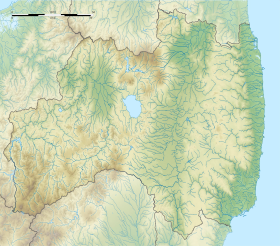
Bandai ( Japanese 磐 梯 山 Bandai-san ) , also known as Aizu- Bandai ( Japanese 会 津 磐 梯 山 ) , Aizu- Fuji ( Japanese 会 津 富士 ) and Aizu-ne ( Japanese 会 津 嶺 , "Aizu Peak") [ 2] - a stratovolcano in Japan , in Fukushima Prefecture .
| Bandai | |
|---|---|
| jap. 磐 梯 山 | |
 Volcano Bandai (November 29, 2008). | |
| Characteristics | |
| Volcano shape | Stratovolcano |
| Education period | Late Pleistocene |
| Last eruption | 1888 |
| Highest point | |
| Absolute height | 1819 [1] m |
| Location | |
| A country |
|
| Region | Fukushima |
| Mountain system | OU |
| Ridge or array | |
| |


During the eruption of Bandai on July 15, 1888, the valley of the Nagase River over an area of 71 km² was covered with mud avalanches, killing 461 people. The volcano gave the name to one of the types of eruptions - the Bandaysan (Bandai) [3] type with the manifestation of the so-called highly explosive volcanism . In 1987 and 2000, earthquakes were observed near the vicinity of the volcano.
Links
- Volcano Bandai : [ eng. ] // Global Volcanism Program . - Smithsonian Institution .
- Volcano Live - John Search
- Volcano World - Oregon State University
- Peakbagger.com
Notes
- ↑ Volcano Bandai : [ eng. ] // Global Volcanism Program . - Smithsonian Institution . - Date of appeal: 07/23/2012.
- ↑ In Russian, the name Bandaysan is sometimes found. San in Japanese "mountain." The volcano is accordingly literally called "Mount Bundai" and in accordance with the rules of transliteration from the Japanese language should be called Bundai.
- ↑ In the geological literature, the name Bandaysan or Bandaysan (Bandai) type of eruptions is often used, although it would be correct to call the Bandai (see previous note)