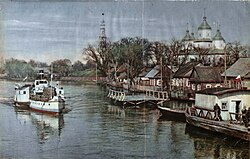
Davyd-Gorodok ( Belorussian. Davyd-Garadok ) - a city (since 1940 ) in the Stolin district of the Brest region of Belarus . Located on the river Goryn . The population of 5892 inhabitants (as of January 1, 2017) [2] . Located on the highway P88 Zhitkovichi - David-Gorodok - the border of Ukraine (Upper Terebezhov).
| City | |||
| David Gorodok | |||
|---|---|---|---|
| Belor. Davyd-Garadok | |||
| |||
| A country |  Belarus Belarus | ||
| Region | Brest | ||
| Area | Stolin | ||
| Chairman of the City Council | Vyacheslav Vasilievich Stadnik [1] | ||
| History and Geography | |||
| First mention | 1127 | ||
| City with | 1940 | ||
| NUM height | |||
| Timezone | UTC + 3 | ||
| Population | |||
| Population | ▼ 5892 [2] people ( 2017 ) | ||
| Digital identifiers | |||
| Postcode | |||
| Car code | one | ||
| Other | |||
| River | Horyn | ||
![Coat of arms [d]](http://upload.wikimedia.org/wikipedia/commons/thumb/d/d5/Coat_of_Arms_of_Davyd-Haradok%2C_Belarus.png/90px-Coat_of_Arms_of_Davyd-Haradok%2C_Belarus.png)

Content
History
David-Gorodoksky castle arose in the late XI or early XII centuries. It was archaeologically explored by R. Yakimovich in 1937-1939 and P.F. Lysenko in 1967. Detinets , surrounded by ramparts, is located on the cape. The cultural layer of the child has a thickness of up to 3.5 m. The street estate layout of the buildings is investigated. Manor houses are fenced with picket fences, courtyards are paved with boardwalks. Several street pavements are open. All buildings - land logs up to 20 square meters. m. In the dwellings, the collapse of adobe furnaces was investigated. A log cabin wooden church was opened [3] .
The founder of the city is Vladimir-Volyn prince David Igorevich , who, after the congress of princes in Vitachev (1100), also owned Pogorynye, it was in honor of him that the city received its name. According to local legend, David-Gorodok was built by a certain Yatvyaz prince who accepted the name Davyd in baptism, who also founded Turov. The area around David-Gorodok belonged first controlled directly from Kiev, then moved to the Volyn principality . In the XII-XIII centuries. - the center of the specific principality, then the city became part of the Grand Duchy of Lithuania . In 1509, it was part of the Pinsk principality .
In the middle of the XVI century. the Polish king Sigismund II Augustus granted the place to tycoon Nikolai Radziwill (Black), and in 1558 the award was confirmed by a letter. In 1586, the David-Gorodok residency was formed from this estate (i.e., a majorate: a possession transferring in succession to the eldest or the eldest of the sons), approved by the Polish king Stefan Batory . The last of the ordinates, Karol-Nikolai Radziwill , emigrated to South Africa in 1947.
During the first Russian invasion of Lithuania on the outskirts of the city, a detachment of governor of Prince D. A. Volkonsky met the Lithuanian army on September 16, 1655. Volkonsky defeated the Litvinians and drove them back to the city, surrounded David the Town and ordered him to be set on fire. Many residents who did not have time to flee died.
After the 2nd division of the Polish-Lithuanian Commonwealth, in 1793 he moved to Russia and became the center of the county of Minsk province . The inhabitants of the town came out of serfdom and were attributed to the middle class as early as 1836. At the town there was a marina on the river. Groyn, which in 1860 loaded on 12 ships and 6 rafts 27,835 pounds of goods worth 11,153 rubles.
As of 1865, there were 3,566 residents of both sexes in David Gorodok, 2 Orthodox churches, a Catholic church, 3 Jewish prayer schools, 629 courtyards, a brick and a brewery .
Soviet power in David Gorodok was established in November 1917. In the years 1918-1920. David Gorodok was occupied by German and later Polish troops; from 1921 to 1939 was part of Poland .
The city became part of the Byelorussian SSR in September 1939 . C 1940 received the status of a city; Since January 1940, David-Gorodok has been the center of the Pinsk region of the Byelorussian SSR.
July 7, 1941 David-Gorodok was abandoned by the Red Army and occupied by Nazi forces. He was released on July 9, 1944 by the troops of the 1st Belorussian Front during the Belarusian strategic offensive operation .
In 1937-1938, excavations were carried out of the children of David-Gorodok. The remains of log houses and farm buildings - Zarubinetskoe village, log street pavements, wooden chapels; many fragments of clay vessels (some had the mark of a master). Wooden crafts were found (for example, maple-headed club tops ornamented with spiral patterns, ridges with a circular ornament, etc.), bone awls, knitting needles for weaving nets, as well as numerous crafts made of iron and bronze. Findings of glass bracelets and slate spindles confirm the urban character of the David-Gorodok settlement in the 11th – 12th centuries. Excavations (R. Yakimovich in 1937-1938 and P. F. Lysenko in 1967) uncovered the remains of log houses, a wooden church, wooden bridges, several rich burials. Found many products from wood, bone, iron, bronze, glass, as well as fragments of clay vessels.
Population
| Population [4] [5] [6] [7] : |
| year | 1897 | 1931 | 1959 | 1970 | 1979 | 1989 | 2001 | 2011 | 2018 |
|---|---|---|---|---|---|---|---|---|---|
| population | 7800 | 11 701 | 9200 | 7068 | 7894 | 7700 | 7220 | 6460 | 5851 |
In 2017, 67 were born in David Gorodok and 82 died. The birth rate is 11.4 per 1000 people (the average in the district is 13.4, in the Brest region is 11.8, in the Republic of Belarus is 10.8), the mortality rate is 14 per 1000 people (the average in the district is 14 , 9, in the Brest region - 12.8, in the Republic of Belarus - 12.6). The birth rate in David Gorodok is slightly higher than in Stolin, the mortality rate is almost twice as high [8] .
Economics
The largest industrial enterprise in the city is OJSC David-Gorodok Electromechanical Plant (460 employees; manufactures electric soldering irons, heaters, bells, drives for microwave ovens and other devices, components for Atlant refrigerators [9] ). There is also a bakery - a branch of Beresteysky Baker OJSC [10] .
Education
The education system includes 2 secondary schools. There are also music and youth sports schools. The House for arts and crafts for children.
Heraldry
On January 22, 1796 (Law No. 17435), the coat of arms of the town of Davyd-Gorodok was approved (together with other emblems of Minsk Viceroyalty).
“At the top of the shield is the coat of arms of Minsk. In the lower field there is a river Pripyat in a black field, on the banks of which there is a silver pier with two gates and a mooring gold vessel, loaded with goods, in three bundles tied. ”
The coat of arms of David-Gorodok was approved on June 28, 1997 by Decision No. 17 of the David-Gorodok City Executive Committee. The coat of arms was entered in the State Emblem of the Republic of Belarus on December 1, 1997 under No. 10:
"In the black field of the" Russian ", or the" French "shield, the Goryn River, on the banks of which there is a silver pier with two gates, a golden vessel with bales of goods adheres to it."
Jewish community
In 1521-1551 years. David Gorodok was the property of the Polish Queen Bona Sforza . With her favors, Jews from Western Europe began to come and settle in David-Gorodok and its environs. They were engaged in crafts and trade.
In the Grand Duchy of Lithuania, Jews enjoyed significant benefits in the economic sphere, had their own self-government - they lived Kagal , professed Judaism . So it was in David Gorodok. There was a rabbi, there were two synagogues, Jewish schools. The legal status of Jews was legalized in the Constitution of 1588 .
In the 1920s-1930s, the Jews of David-Gorodok lived along the central Yuryevskaya (now Sovetskaya) street in houses with access directly to the street.
After the advent of Soviet power, Jews took an active part in local elections.
During the Nazi occupation in David-Gorodok, a ghetto was created for local Jews, and subsequently almost all of them were killed.
Attractions
- St. George's Church - wooden, late XVII - early XVIII century
- Kazan Church - 1913
See also
- Ghetto in David Township
Notes
- ↑ David Gorodok celebrated its 915th anniversary | Media Polesie
- ↑ 1 2 Population as of January 1, 2017 and the average annual population for 2016 in the Republic of Belarus by regions, districts, cities and urban-type settlements. // National Statistical Committee of the Republic of Belarus. - Mn., 2017.
- ↑ Lysenko P.F. Cities of the Turov land. Minsk. 1974. S. 118-142.
- ↑ Belarusian Savetskaya Entsyklapedyya: at 12 tons / gal. red P.U. Brock. - T. 12: BSSR. - Мn .: Belarussian Savetskaya Entsyklapedyya, 1975 .-- S. 697.
- ↑ Drugi Powszechny Spis Ludności z dnia 9 grudnia 1931 r: alfabetyczny wykaz miast w Polsce w granicach administracyjnych z dn. 1.V.1933 r: wyniki tymczasowe . - Warszawa: Główny Urząd Statystyczny, 1933 .-- S. 1-5.
- ↑ Statistical Yearbook of the Brest Region. - Mn. : National Statistical Committee of the Republic of Belarus, 2018. - P. 39-41.
- ↑ Statistical Yearbook of the Brest Region. - Mn. : National Statistical Committee of the Republic of Belarus, 2013. - S. 42-44.
- ↑ Demographic Yearbook of the Republic of Belarus. - Mn. : National Statistical Committee of the Republic of Belarus, 2018. - P. 157–159.
- ↑ Open Joint-Stock Company “David-Gorodok Electromechanical Plant”
- ↑ Industry
Literature
- Rassadzin S. Ya. , Mikhalchanka A. M. Coats of arms and scrubs of garadoў and raionў Belarus. - Mn., 2005.
- Herbovik P.P. von Winkler
- Dzyarzhauny kamitet pa maemasci Republic of Belarus, RUE “Beklkartagrafiya” Vyaliki gistarychny atlas Belarusi, volume 1.- Mn, 2009.
- Geographical and statistical dictionary of the Russian Empire. - T.II. - St. Petersburg, 1865.- P.2