Ceriantaria [3] ( lat. Ceriantharia ) - a detachment of coral polyps from a subclass of six-beam ( Hexacorallia ). The bottom stages of the life cycle lead a burrowing life in loose soils, exposing the mouth end with numerous tentacles for nutrition [2] . Larvae of ceriantarius — cerinules — exist for a long time in plankton, where they lead a predatory lifestyle [2] . Currently, about 100 species have been described, many of which are known only for planktonic stages [2] .
| Ceriantharius | |||||||||||||||
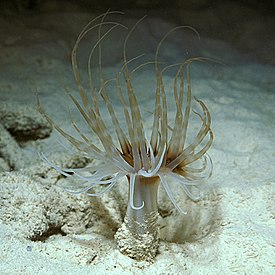 Arachnanthus nocturnus | |||||||||||||||
| Scientific classification | |||||||||||||||
|---|---|---|---|---|---|---|---|---|---|---|---|---|---|---|---|
| |||||||||||||||
| International scientific name | |||||||||||||||
Ceriantharia Perrier, 1883 | |||||||||||||||
| Families [1] [2] | |||||||||||||||
| |||||||||||||||
Building and Lifestyle
At the polyp stage, ceriantaria are single bottom organisms lacking a developed solid skeleton. Most of the elongated body is dressed with a tube consisting of mucus and the contents of special stinging capsules - poultry cysts , which are found only in representatives of this squad [4] . Around the mouth are tentacles combined in two concentric nimbuses [5] [6] . Tentacles of the outer corolla ( marginal , or marginal ) - have a longer length than the labial tentacles that make up the inner corolla [5] [6] . The end of the body opposite the mouth is expanded into the physicus - a formation that serves to anchor the polyp in the ground [6] . Due to its presence, disturbed ceriantarians are able to draw the front end of the body along with tentacles into the tube [6] .
Gallery


Ceriantharia in Monterey Bay Aquarium
Corollas of tentacles close-up
Cerianthus membranacea in the aquarium

Notes
- ↑ The Ceriantarius squad in the World Register of Marine Species . (Retrieved August 27, 2011)
- ↑ 1 2 3 4 Daly, M., Brugler, MR, Cartwright, P., Collins, AG, Dawson, MN, Fautin, DG, France, SC, McFadden, CS, Opresko, DM, Rodrigues, E., Romanos, SL, Stakes, JL (2007). The phylum Cnidaria: A review of phylogenetic patterns and diversity 300 years after Linnaeus, 127–182. In: Zhang, Z.-Q., Shear, WA (eds.) (2007). Linnaeus Tercentenary: Progress in Invertebrate Taxonomy. Zootaxa 1668 : 1-766. Text (English) (Retrieved August 27, 2011)
- ↑ Ceriantarios - an article from the Great Soviet Encyclopedia .
- ↑ Mariscal, RN, Conklin, EJ, Bigger, CH (1977). The ptychocyst, a major new category of cnida used in in tube construction by a cerianthid anemone. Biological Bulletin 152 : 392–405. Text (English) (Retrieved August 27, 2011)
- ↑ 1 2 Westheide V. , Rieger R. From protozoa to mollusks and arthropods // Invertebrate Zoology. = Spezielle Zoology. Teil 1: Einzeller und Wirbellose Tiere / Per. with him. O. N. Bölling, S. M. Lyapkova, A. V. Mikheev, O. G. Manylov, A. A. Oskolsky, A. V. Filippova, A. V. Chesunov; under the editorship of A.V. Chesunova. - M .: Partnership of scientific publications of KMK, 2008. - T. 1. - P. 169. - iv + 512 + iv p. - 1000 copies. - ISBN 978-5-87317-491-1 .
- ↑ 1 2 3 4 Ruppert E.E., Fox R.S., Barnes R.D. Protists and lower multicellular // Invertebrate Zoology. Functional and Evolutionary Aspects = Invertebrate Zoology: A Functional Evolutionary Approach / Per. from English T. A. Ganf, N. V. Lentsman, E. V. Sabaneeva; under the editorship of A. A. Dobrovolsky and A. I. Granovich. - 7th edition. - M .: Academy, 2008. - T. 1. - 496 p. - 3000 copies. - ISBN 978-5-7695-3493-5 .
Links
- Photos of cerinized larvae Arachnacthis albida on cotebleue.org (fr.) (Retrieved August 27, 2011)