The rebel movement under the leadership of Nestor Makhno , known as the Makhnovist movement , the Makhnovism (from the fall of 1919 - the Revolutionary Rebel Army of Ukraine (RPAU) [4] ) is an anarchist-peasant movement in southeastern Ukraine during the Civil War .
| Rebel movement led by Nestor Makhno | |
|---|---|
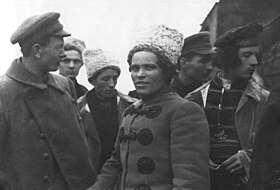 Commander-in-Chief Revolutionary insurgent army of Ukraine Nestor Makhno among his associates, 1919 | |
| Years of existence | 1918 - 1921 |
| A country |  Free territory Free territory |
| Subordination |  July 1918 - February 1919 July 1918 - February 1919 Ukrainian soviet army Ukrainian soviet army(February-May 1919) June 1919 - October 1920 Red Army (November 1920) December 1920 - August 1921 Red Army (November 1920) December 1920 - August 1921 |
| Included in | |
| Type of | Partisan ( rebel ) army |
| Function | Fighting the occupying forces (1918), ensuring the creation of an anarchist society (1919-1920) |
| Dislocation | Southeastern Ukraine |
| Nicknames | Makhnovists |
| Patron | Kropotkin, Peter Alekseevich |
| Participation in | Civil war in Russia :
|
| Commanders | |
| Famous commanders | Makhno, Nestor Ivanovich Belash, Victor Fedorovich Karetnikov, Semyon Nikitich Schus, Theodosius Justinovich |
It arose in the summer of 1918 during the period of the Austro-German occupation. It was held under the slogans of “a powerless labor federation”, “complete freedom”, etc. It was characterized by a deep distrust of political parties, unearned or privileged groups of society, a denial of dictatorship and statehood, and complete local self-government of workers in the form of “free labor councils” of peasants and workers organizations [4] .
| History of the Ukrainian army | |
|---|---|
 | Army of Ancient Russia |
 | The army of the Galicia-Volyn principality |
 | Army Zaporizhzhya |
| Haidamaki | |
| Oprishki | |
 | Cossack troops: Black Sea , Azov , Bug , Danube |
 | Transdanubian Sich Slavic Legion |
 | Banat Sich Russian battalion of mountain shooters |
 | Armed forces of Austria-Hungary |
 | Ukrainian Sich Riflemen |
 | Russian imperial army |
 | Ukrainization : 1st and 2nd Ukrainian Corps |
 | Workers 'and Peasants' Red Army |
 | Army of the Ukrainian People's Republic |
 | Army of the Ukrainian State |
 | Ukrainian Galician army |
| The revolutionary rebel army of Ukraine |
 | Carpathian Sich |
| Partisan movement |
 | Polesskaya Sich |
 | Ukrainian rebel army |
| Soviet army |
| Counties: KVO • OdVO • PrikVO • TavVO • HVO |
 | Armed forces of Ukraine |
The main social base of the movement was the peasantry of the Yekaterinoslav province . The rebels were also supported by representatives of the urban population, the intelligentsia. A significant part of the rebel army was made up of declassed elements and deserters from the White and Red Army.
The rebel forces acted against the Austro-German forces and the army of Hetman Skoropadsky (1918), the UPR Directory, the army of General Denikin (1919) and Wrangel (1920). The attitude of the Soviet government towards Makhno was ambiguous and controversial: on the one hand, the Soviet command, if necessary, interacted with rebel forces during operations against the Petliurists and white troops, and on the other hand, actively suppressed Makhnovism.
The center of the rebel movement was the village of Gulyai-Pole of the Yekaterinoslav province - the birthplace of Nestor Makhno .
Content
- 1 Revolutionary rebellion in Ukraine
- 2 History
- 2.1 1918
- 2.2 1919
- 2.2.1 January - May
- 2.2.1.1 Offensive of the Ukrainian Front
- 2.2.1.2 Makhno and Anarchism
- 2.2.1.3 Reorganization of the rebel army
- 2.2.1.4 Actions as part of the Ukrainian Front
- 2.2.1.5 Makhno and Soviet power
- 2.2.1.6 Grigoryevsky rebellion
- 2.2.1.7 Fighting against white forces in April - May
- 2.2.2 June - December
- 2.2.1 January - May
- 2.3 1920-1921
- 3 Organization and tactics
- 4 Composition
- 4.1 Revolutionary rebel army of Ukraine
- 4.2 Brigade named after Old Man Makhno (3rd brigade of the 1st Zadniprovsky Ukrainian Soviet Division)
- 4.3 The first Ukrainian rebel division named after Old Man Makhno (as part of the 2nd Ukrainian army)
- 4.4 3rd brigade of the 7th Infantry Division of the Red Army (after Makhno was outlawed and reorganized)
- 4.5 The revolutionary insurgent army of Ukraine (part of the Makhnovists who opposed the Soviet regime)
- 5 Banners
- 6 Leaders of the Makhnovist movement
- 7 See also
- 8 Notes
- 9 References
Revolutionary Insurgency in Ukraine
The occupying Austrian-German troops that entered Ukraine in March - April 1918 at the invitation of the Ukrainian Central Council, not only ousted all Soviet and other revolutionary armed formations from Ukrainian territory, but also established full control over the country's political and economic life. The main objective of the invasion was to export food supplies. To ensure this, the occupying authorities overthrew the Central Rada itself and restored the power of the landowners and nobles, which was overthrown in 1917, placing the autocratic power of the hetman Skoropadsky over the Ukrainian people [4] .
The food robbery of Ukraine, organized by the Austro-Germans with the full assistance of the Skoropadsky government, took on enormous proportions. Where the peasantry opposed this robbery, they subjected him to repression and executions. In addition to open military robbery and violence by the occupiers, the occupation of Ukraine was accompanied by a landlord reaction. The hetman regime was a complete return to the past, the destruction of all the revolutionary gains of the peasants and workers [4] .
This situation led to the emergence of the revolutionary movement of the Ukrainian peasantry, which became known as revolutionary rebellion. In the summer of 1918, the peasantry everywhere rebelled against the landlords, killed or banished them, taking their land and property. German and Hetman authorities responded with massive repressions against hundreds of rebellious villages. The peasantry, who did not want to submit to the authorities, switched to a guerrilla struggle. Almost simultaneously, in many places a lot of partisan detachments arose, adopting the tactics of sudden raids on landowners' estates, state guards (“Wartu”) and other government officials [4] .
Both spontaneous riots and partisan actions were carried out exclusively by the peasants themselves, without any political organization, which, in the opinion of Makhno’s associate and historian of the Makhnovist movement P. Arshinov , shaped the character of the entire revolutionary rebellion: the main feature of the rebel movement where it it didn’t fall under the influence of the “party or nationalist element”; there was a revolutionary self-government of the people. The fierce repression of the landowner counter-revolution only made this movement widespread, led to the rallying of partisan detachments capable of acting according to a single plan. In practice, this led to the unification of the peasantry in districts by the merger of individual partisan detachments. In the Yekaterinoslav province, the center of such an association was the Makhno detachment, operating in the Gulyaypol district [4] .
It was the insurgent detachment, led by Nestor Makhno, that played an exceptional role in the development of revolutionary insurrection in southern Ukraine. At a time when the Skoropadsky regime fell into decay, and the greatest danger to the region began to be threatened by the white troops of Denikin, Makhno became the center of the union of millions of peasants in several provinces. At the same time, while in the south of Ukraine the rebellion raised the black banner of anarchism under the slogans of anarchy and self-government of workers, in the west and north-west of Ukraine (in the Kiev, Volyn, Podolsk and parts of the Poltava provinces) the rebellion came under the influence of the national -democratic forces and served as a support for Petliurists [4] .
History
1918
On June 29, 1918, in agreement with the All-Ukrainian Bureau of Rebel Movement Management and implementing the decision of the Taganrog Anarchist Conference, Nestor Makhno went to Ukraine to organize an armed struggle against the German-Austrian and Hetman troops. By this time, dozens of scattered peasant detachments were already operating in Ukraine. Soviet Russia, bound by the terms of the Brest Treaty, helped the rebel movement of weapons, food, and money.
Having illegally entered Ukraine with the assistance of the Russian Bolsheviks, Makhno and his group joined the partisan detachment already existing in the Gulyai-Pol area. After the first successful military operation against German punishers, Makhno was elected commander of the detachment. To acquire weapons, Makhno conducted a series of expropriations in the banks of the Yekaterinoslav province, and later partisans obtained weapons, horses, etc., attacking the landowners' estates and detachments of the occupying forces. Courage, experience, organizational talent and the conviction of the rightness of their cause made Makhno a real leader of the rebel movement, attracted new fighters to him [5] .
Until the fall, the Makhnovists acted mainly within the Aleksandrovsky district , attacking the Austrian detachments and the “Warta” of the hetman Skoropadsky. In September - October 1918, under the command of Old Man Makhno, several partisan detachments united, led by the Gulaypol anarchists Viktor Belash , V. Kirilenko, Fedosy Schus , Petrenko-Platonov and others [4] . By this time, Makhno had actually led a rebel movement not only in the Gulyaypol district, but throughout the Yekaterinoslav province. The peasants of the Yekaterinoslav region and Northern Tavria rendered all possible assistance to the rebels, fed, supplied weapons, horses for cavalry, engaged in reconnaissance, and, if necessary, whole villages joined the Makhnov units for two or three days. By November, the units of Makhno totaled up to 6 thousand people. The growth of Makhno’s popularity was facilitated by acts of expropriation and distribution of property and products taken from the “bourgeois” to the population [5] .
The November Revolution of 1918 in Germany led to its defeat in the First World War. By this time, the troops of the Hetman Skoropadsky were demoralized and did not want to fight, and the command of the occupation forces sought to withdraw their units from Ukraine as soon as possible. Soviet Russia declared the Brest-Litovsk treaty annulled.
From that moment on, three main social forces began to operate in Ukraine - the Petliurists, the Bolsheviks and the Makhnovists, each of which, over time, entered into irreconcilably hostile relations with the other two [4] .
In mid-November, Ukrainian bourgeois-nationalist parties formed their own government - the Directory , which began an armed struggle for power in Ukraine. On November 28, a group of members of the Central Executive Committee of the Councils of Ukraine proclaimed the Provisional Worker and Peasant Government of Ukraine , which announced the restoration of Soviet power in Ukraine. In the current situation of "Ukrainian dual power" Makhno tried to maintain independence [5] .
On November 27, Makhno occupied Gulyai-Pole , declared it in a state of siege, formed and headed the “Gulyaypol Revolutionary Headquarters”. The rebels, attacking the retreating Austro-German units, managed to capture a large number of weapons and various equipment and represented considerable force, controlling most of the territory of the Ekaterinoslav province [5] . Peasant youths flocked to the masses to Makhno. There were no hetman troops in the area. State Warta, due to the extraordinary growth of the rebel army, fled. Makhno advanced his units to the north, occupied the nodal stations of Chaplin, Grishino, Sinelnikovo, reached Pavlograd and turned west towards Yekaterinoslav, where he ran into representatives of the Directory [4] .
The Petliurites, who formed their army from many rebel groups and seized power in a number of Ukrainian cities, considered the Makhnovist movement as an integral part of the all-Ukrainian national revolution and hoped to draw it into the sphere of their influence and leadership. However, to the proposal of the Directory about joint actions against the Red Army, Makhno answered: "Petlyurovschina is a gamble that distracts the attention of the masses from the revolution." According to Makhno and his comrades-in-arms, Petliurism was a movement of the Ukrainian national bourgeoisie, with which the people's revolutionary movement was completely out of the way [4] .
Makhno accepted the proposal of the Yekaterinoslav Committee of the Communist Party (b) U for joint armed action against the Petliurists in Yekaterinoslav. On December 26, the armed detachments of the Yekaterinoslav gubernial party committee of the Bolshevik party and the gubernial committee, together with the Makhno detachments, knocked out Petliurists from Yekaterinoslav. At the same time, workers revolted in the city. As a result of this operation, the seven thousandth Petliura garrison was defeated. The rebels opened a city prison and released criminals, who immediately began to rob the population. By agreement with the Provincial Committee of the Communist Party (b) U, Makhno’s units were entrusted with the task of defending the Yekaterinoslav fortified area and restoring normal life in the city. Makhno was included in the composition of the military revolutionary committee and was appointed commander of the Soviet revolutionary workers 'and peasants' army of the Yekaterinoslav region. Makhno was ordered to strengthen the front, but he was primarily concerned with providing his army with weapons and ammunition. Taking advantage of the carelessness of the rebel command, the Petliurites, after two or three days, pulling up reinforcements from Aleksandrovsk , launched a large-scale counterattack and drove the Makhnovists out of the city. Old Man, having actually surrendered Yekaterinoslav without a fight, returned to his "capital" Gulyai-Pole. Meanwhile, the Petliurites brutally cracked down on the participants in the Yekaterinoslav uprising. The rebels also suffered considerable losses. From the army of Makhno, a cavalry detachment of 100 sabers and 400 infantrymen participated in the campaign. Only about two hundred people returned to Gulyai-Pole [5] .
Since that time, on the northwestern border of the territory controlled by Makhno, a front arose between the Makhnovists and Petliurists. However, due to the fact that the Petlyura troops, consisting of the majority of rebel peasants and forcibly mobilized, began to decompose quickly upon contact with the Makhnovists, the front was soon liquidated [4] .
1919
January - May
Offensive of the Ukrainian Front
On January 4, 1919, the Soviet Government formed the Ukrainian Front , which organized an attack on Poltava - Lozova and Kiev - Cherkasy . Kiev was taken on February 5, and the entire left-bank Ukraine was taken over the next few weeks.
After the fall of the Hetman Skoropadsky’s government, the Directorate that succeeded it did not at first succeed in creating stable regular military units. The Directory Army consisted of scattered detachments of peasant rebels who took part in an anti-Hetman uprising. During the offensive of the red forces, the rebel units, attracted by the social slogans of Soviet power, massively sided with the Bolshevik government of Soviet Ukraine. As a rule, insurgent units that declared their Soviet orientation, in full force, led by their commanders (“chieftains”, “fathers”), by mutual agreement, were included in the army of Soviet Ukraine, receiving a number and an official name, followed by rebel units to the Red Army and the appointment of Bolshevik commissars.
Makhno and Anarchism
In the meantime, the influence of anarchism on the rebel army of Makhno increased due to the constant influx of ideological supporters of anarchy. These people enjoyed special privileges with Makhno, held leading positions in the rebel movement, contributed to the formation of the father’s views and behavior, exalted him as a “people's leader”, “a great anarchist”, and “second Bakunin”. Anarchist ideas predetermined the development of Makhnovism, which inevitably led it to conflict with Soviet power [6] . In February - March 1919, Makhno invited the anarchist Pyotr Arshinov , with whom he served penal servitude in the same cell of the Butyrka prison and met in the summer of 1918 in Moscow, to join the Ukrainian rebellion and organize an anarchist newspaper for the rebels and workers and peasants. Arshinov, who arrived in April in Gulyai-Pole, was elected chairman of the cultural and educational department of the Military Revolutionary Council and the headquarters of the Makhno brigade, and was appointed editor of the newspaper “The Way to Freedom”; since the spring of 1919 he became one of the main ideologists of the Makhnovist movement [7] .
Reorganization of the rebel army
On January 3-4, a congress of rebel groups was held in Pologi , which, on behalf of the Military Revolutionary Council of the Makhnovists, was organized and conducted by V. Belash , the head of the Novospasovskaya group of anarchists and one of the organizers of the anti-Hetman rebel movement, who advocated replacing the detachment-partisan system with disciplined and organized revolutionary units with a single supply and management system. According to his report, the congress decided to reorganize the troops into five rebel regiments and chose the operational headquarters, headed by Belash. Since that time, Belash became one of the leading leaders of the Makhnovist movement, the leader of the part that was most tolerant of the Soviet regime and advocated close alliance with it to combat the white counter-revolution [7] .
After the Yekaterinoslav operation, the Makhnovists settled in Gulyai-Pole, where Makhno planned to begin practical implementation of the ideal of anarchism - the creation of a free, powerless communist society in the Gulyaypol district. Makhno's detachments continued to grow at the expense of the local peasants joining them. As V. Belash claimed in his memoirs, by the end of January the father had 29 thousand soldiers and up to 20 thousand unarmed reserve. However, the position of the rebels was not easy: the Petliurites continued to exert pressure on Makhno, trying to lure him to their side, the Volunteer Army of General Denikin was approaching from the southeast and south, and from the north ousted Petliurists and the Soviet Ukrainian front was approaching Makhnovo territory. Поэтому Махно в течение всего января пытался выиграть время, усилиться за счёт потенциальных союзников и найти более выгодную линию поведения [6] .
12 января белые ( 3-я дивизия Добровольческой армии генерала В. З. Май-Маевского ) начали наступление со стороны Донбасса на махновский район, 20 января взяли Пологи , а 21—22 января атаковали Гуляй-Поле. Ожесточённые бои за Гуляй-Поле продолжались несколько дней, в ходе которых село несколько раз переходило из рук в руки. Повстанцы потеряли убитыми, ранеными, пленными до 1000 бойцов и были вынуждены отступить на станцию Гайчур, после чего махновско-белогвардейский фронт стабилизировался [8] .
Действия в составе Украинского фронта
Тем временем части советского Украинского фронта , продвигаясь на юг, освободили Екатеринослав и ряд районов губернии. Махно наконец принял решение пойти на союз с красными, объявив петлюровцев и деникинцев наиболее опасными противниками. 26 января по поручению штаба повстанцев Белаш выехал в Харьков , где провёл переговоры с командованием красных войск о военном союзе, а также установил контакт с секретариатом Конфедерации анархистов Украины (КАУ) «Набат» , договорившись о регулярной доставке в контролируемый махновцами район анархической литературы и агитаторов [7] .
В результате переговоров с советским командованием отряды Махно, получившие оружие и патроны для крестьянского пополнения [9] , были в феврале переформированы в 3-ю стрелковую бригаду 1-й Заднепровской Украинской советской дивизии , образованной советским командованием из повстанческих отрядов юга Украины (командир дивизии Павел Дыбенко ).
Согласно воспоминаниям Аршинова, повстанческая армия вошла в состав Красной армии на следующих принципах: а) внутренний распорядок её остаётся прежний; б) она принимает политических комиссаров, назначаемых коммунистической властью; в) она подчиняется высшему красному командованию лишь в оперативном отношении; г) армия с противоденикинского фронта никуда не уводится; д) армия получает военное снаряжение и содержание наравне с частями Красной армии; е) армия продолжает называться Революционной Повстанческой, сохраняя при себе чёрные знамёна [4] . Это соглашение, таким образом, рассматривалось руководством повстанцев как исключительно военное, не затрагивающее общественного устройства махновского района [4] .
At the second district congress of peasants, workers and insurgents, meeting on February 12 and discussing the danger imposed by Denikin, a decision was made to organize voluntary mobilization. At the same time, despite the large number of people who wanted to join Makhno, there were not enough weapons in the area to form new rebel units in time. The Makhnovist rebel army, according to Arshinov, had about 20 thousand volunteer fighters in their ranks by this time, many of which, however, were "extremely overworked and frayed", participating in continuous battles for five to six months [4] .
The command of the division suggested that Makhno renounce the election of commanders, abolish the Military Revolutionary Council, and allow commissars and regiments of commissars for political agitation among rebel fighters [6] . Makhno received the communist commissars and the chief of staff sent by Dybenko, the Left Social Revolutionary I. Ozerov, but retained the election of commanders and the Military Revolutionary Council [9] .
By a directive of the Commander-in-Chief I.I. Vatsetsis of March 12, the Ukrainian Front was ordered to join forces with the Southern Front to eliminate the white group in the Donbass. Antonov-Ovseenko ordered "to strengthen the Makhno group to eliminate Berdyansk - Mariupol" (the ships of the French Navy [10] entered the ports of Mariupol and Berdyansk in December 1918) as part of the 2nd brigade operating in the Crimean direction, and the 16th regiment of 1 Grigoryev’s brigade.
On March 14, the 1st Zadniprovsky division took control of Melitopol , cutting the Azov front in two.
On March 15, the Makhnovists occupied Berdyansk and on March 19 they approached Mariupol . On March 17, units of Makhno captured Volnovakha .
On March 20, the commander of the troops of the Kharkov Group of Forces A. Skachko set the Zadniprovsky division and its 3rd brigade to enter the Platovka – Mariupol line and gain a foothold on it [11] . The division completed this task, and the Makhno brigade proved itself heroically. Mariupol fell on March 29. On March 27, during the battle between the Makhno brigade over Mariupol, the Entente naval forces stationed on the Mariupol raid intervened in the hostilities, fired on the advancing Makhnovists, and landed a small landing force. However, on March 29, an agreement was signed with the Makhnovist delegation, which established a one-day truce for the evacuation of the port. During this day, French ships removed from the port of Mariupol several unfinished ships, valuables and refugees [10] .
The 9th Greek regiment , which took part in the liberation of Mariupol from the White Army, was awarded the honorary Red Banner, and regiment commander V. Takhtamyshev was thanked [12] .
Meanwhile, the commander in chief of the Red Army, Watsetis, demanded more decisive action from the Southern Front in the Donetsk and Lugansk directions. On March 27, he issued an order: to take possession of the Donbass as soon as possible. The offensive by the forces of the Soviet 13th and 8th armies , according to the plan, was to begin on March 29. Parts of Makhno were sent to the right flank of the 13th Army to attack the Donbass from the southwest. However, on March 27, the white corps of Pokrovsky launched a preemptive strike against units of the 8th Army and forced them to retreat north to Lugansk. At the end of March, the 9th Division , withdrawn from the Ukrainian Front, was sent from Yekaterinoslav to strengthen the 13th Army. Meanwhile, the 1st Caucasian Cavalry Division of General Shkuro (2 thousand sabers) broke through the front of the Reds, took Debaltseve on March 30, and defeated units of the 13th Army from Yuzovka on April 4-5. The 9th division fled from position, opening the flank of the Makhno brigade.
V. Belash, who was appointed chief of staff of the combat unit of the Makhnovsky brigade in the Volnovakha area on April 9 and actually acting as the commander of the combat unit (12 thousand bayonets, 600 sabers, 4 guns, an armored train), led the battles against Shkuro cavalry at st. Rozovka and the advance of the Makhnovists on Volnovakha [7] .
On April 15, by order of the troops of the Ukrainian Front , the 2nd and 3rd Ukrainian Soviet armies were created. The 2nd Ukrainian Soviet Army (Commander A. Skachko ) was formed from parts of the Kharkov Group of Forces (including the 3rd brigade of the 1st Zadniprovsky Ukrainian Soviet Division), which were reduced to 2 full-time divisions. The former 3rd Brigade of the 1st Zadniprovsky Division became part of the 7th Ukrainian Soviet Division , with Makhno being appointed the head of it [13] .
Makhno and Soviet Power
In words, recognizing submission to the Red Command, the Old Man often did not fulfill his requirements, constantly emphasizing his independence and independence. As early as February, the 2nd regional congress of Soviets convened by Makhno in Gulyai-Pole adopted a resolution expressing an anarchist negative attitude to all state power, including the Soviet one [6] .
Almost all the Makhno rebel detachments were deployed in March in the Alexandrovsky district of the Ekaterinoslav province, in the front line of the Denikin front. Dad's headquarters remained in Gulyai-Pole. This territory, according to Makhno, was to become the center of a new "powerless" anarchist state . The command of the Ukrainian Front set K. Ye. Voroshilov , who at that time was the People’s Commissar of Internal Affairs of the Ukrainian SSR, the task “to split the army of Makhno with the help of reliable units” and issued an order to transfer the rebel headquarters from Gulyai-Pol to Pologi. Makhno, however, refused to obey this order. He did not want to leave Gulyai-Pole, considering his main task to import as much property and material values into his capital and neighboring settlements as possible. The Makhnovists set up detachments on the railroad and intercepted wagons with flour, bread, other food products, coal, and straw. Moreover, they themselves refused to supply bread from the surplus stock available in Berdyansk and Melitopol counties, demanding industrial goods for it [6] .
As a result of the offensive of the Makhno troops in the Ukrainian front, the territory controlled by them increased to 72 volosts in the Yekaterinoslav and Tauride provinces with a population of more than two million people.
If the Soviet authorities chose not to pay attention to the frankly anti-Bolshevik nature of the resolutions of the February regional congress of Soviets, then in April, when the front stabilized, the authorities headed for the liquidation of the special situation of the Makhnovsky district. However, already the first attempt by Dybenko to disband part of the Makhnovist detachments caused unrest [9] .
Subsequent events did not reduce tension. On April 19 (at Arshinov - on April 10 [4] ), the executive committee of the Military Revolutionary Council of the Gulyaypol district [4] , contrary to the prohibition of the red command, convened the 3rd district congress, which was attended by representatives of 72 volosts of Aleksandrovsky, Mariupol, Berdyansk and Pavlograd districts, as well as delegates from the Makhnovsky military units. The congress proclaimed an anarchist platform, declaring categorically not recognizing the dictatorship of any party [6] and speaking out against the military-communist policy of the RCP (B) [9] .
Upon learning of the resolution, the Commander Dybenko announced: “Any congresses convened on behalf of the military revolutionary headquarters dismissed in accordance with my order are considered clearly counter-revolutionary, and the organizers will be subjected to the most repressive measures, up to and including outlawing” [9] .
The response of the Military Revolutionary Council, who believed that Dybenko had no right to interfere in the work of the congress, according to historian A. Shubin, resembled in spirit the letter of the Cossacks to the Turkish sultan. Hinting at the weak position of the Bolshevik party in the Sea of Azov, the Makhnovists said: “... If the Bolshevik idea is successful, then the military revolutionary council, from the Bolsheviks point of view, the organization is clearly counter-revolutionary, will be replaced by another, more“ revolutionary ”Bolshevik organization. But for the time being do not bother us, do not force us. " This message was perceived by the commissars seconded to the headquarters of Makhno as a declaration of war. Some even chose to leave the area [4] [9] .
On April 29, the commander of the Ukrainian Front V. Antonov-Ovseenko went to Gulyai-Pole. Contrary to fears, Makhno met him with an honor guard, and during the negotiations made concessions - he condemned the most drastic provisions of the resolution of the congress and promised to impede the election of the command staff. At the same time, Makhno put forward a fundamentally new idea of the long-term coexistence of various political movements within the same power system: "Before a decisive victory over whites, a revolutionary front must be established, and he (Makhno) seeks to prevent strife between various elements of this revolutionary front." This idea, however, was not accepted by the Soviet leadership, and Lev Kamenev, the plenipotentiary representative of the Republic’s Defense Council, who visited the Makhnovsky district on May 4-5, again demanded the liquidation of the political organs of the movement and, above all, the Military Revolutionary Council [9] .
Grigoryevsky rebellion
A new reason for mutual distrust arose in connection with the beginning of the rebellion of Ataman Grigoriev in Right-Bank Ukraine. On May 12, Kamenev, whose actions in organizing grain procurements in Ukraine in many ways pushed Grigoryev to rebellion, sent Makhno a telegram, with a clearly distrustful tone: “The traitor Grigoryev betrayed the front. Not following a combat order, he turned his weapon. The decisive moment has come - either you will go with the workers and peasants throughout Russia, or open the front to the enemies. Oscillations have no place. Immediately inform the location of your troops and issue an appeal against Grigoryev, telling me a copy to Kharkov. I will consider non-receipt of an answer as a declaration of war. I believe in honor of the revolutionaries - yours, Arshinov, Veretelnikov, etc. ” [9] .
The "Father" gave a rather ambiguous answer: "The honor and dignity of the revolutionary force us to remain faithful to the revolution and the people, and Grigoryev’s feuds with the Bolsheviks because of power cannot force us to leave the front." After the representatives sent by Makhno to the area of the Grigoryevsky rebellion were intercepted by the authorities, the Makhnovists' final determination of their attitude towards Grigoryev was delayed until the end of May. In his appeal, “Who is Grigoryev?” Makhno criticized the Universal for the rebels: “Brothers! Don't you hear in these words a grim call to the Jewish pogrom ?! Do not you feel the desire of Ataman Grigoriev to break the living fraternal relationship of revolutionary Ukraine with revolutionary Russia? ” At the same time, Makhno blamed the incident on the actions of the Bolshevik authorities: “We must say that the reasons that created the entire Grigoryev movement are not in Grigoryev himself ... Any resistance, protest and even independent initiative were stifled by emergency commissions ... This created bitterness and protest among the masses and a hostile mood to the existing order. Grigoriev took advantage of this in his adventure ... we demand that the Communist Party be held accountable for the Grigoriev movement ” [9] .
Fighting against White Forces in April - May
However, on May 25, the Council of Defense of Ukraine, at the direction of Lenin and Trotsky, decided "to eliminate the Makhnovism in a short time."
June - December
By order of June 4, 1919, the Ukrainian Front and the Ukrainian Soviet Army were disbanded, and the 2nd Ukrainian Army was transformed into the 14th Army of the Red Army and remained part of the Southern Front . On June 7, the 14th Army was led by K.E. Voroshilov [14] .
On June 6, the RVSR chairman L. D. Trotsky issued an order in which he declared the head of the 7th Ukrainian Soviet Division N. I. Makhno out of law “for the collapse of the front and disobedience to command” [15] .
His chief of staff and seven commanders were shot. Makhno with the most loyal supporters fled, while most of the Makhnovists continued fighting with the white troops in the 14th army.
After the defeat of the Grigoryevsky uprising, Ataman Grigoryev met with the remnants of his troops with the Makhnovists in the village of Kamyshovatoye, Elizavetgrad district, counting on the support of Makhno. During the negotiations, Makhno insisted on uniting the troops. Grigoriev became the commander of the combined armed forces, and Makhno became the chairman of the revolutionary council. Grigoriev, therefore, became subordinate to Makhno. The new headquarters of the "partisan-rebel army" was created, which mainly included the Makhnovists.
In the summer of 1919, the insurgent brigade deployed in the RKKA infantry division was defeated by Denikins, after which the remnants of the rebels retreated to the Kherson province.
In mid-September 1919, units of the rebel army, numbering up to 20,000 soldiers and a large convoy with wounded, were forced out under Uman , where they clashed with units of the Army of the Ukrainian People’s Republic . Since both sides did not show hostility to each other, it was decided to start negotiations on the beginning of military cooperation. On September 20, an agreement on cooperation was signed at the headquarters of the UPR army in Zhmerynka following the results of negotiations, according to which:
- the parties pledged to jointly fight against the White Guards;
- the UPR army handed over to RPAU 125,000 cartridges for free and another 575,000 cartridges for 50,000 Karbovanets ;
- for recreation and reorganization of RPAU she was given territory in the area of the village of Tekucha (south of Uman);
- RPAU transferred more than 3000 of its wounded and sick fighters to military hospitals of the UPR.
On September 21, Makhno ordered his units to regroup so as to be ready for joint operations with the UPR against the White Guards. However, by September 25, insurgent units had actually been encircled in the Olshanka - Ostrovets - Rogovaya area and lost contact with the UPR troops. After several days of active fighting, the Makhnovists broke through the encirclement under Peregonovka and began to make their way to Yekaterinoslav [16] .
| The war of the Makhnovists with the Armed Forces of the South of Russia . | |||
|---|---|---|---|
| Main Conflict: Civil War in Russia | |||
| date of | 1919 - 1920 | ||
| A place | Southeastern regions of Ukraine. | ||
| Cause | White terror . | ||
| Total | Formation of a "free territory" . Perekop-Chongar operation (1920) . | ||
| Opponents | |||
| |||
| Commanders | |||
| |||
| Forces of the parties | |||
| |||
According to the chief of staff of Makhno Viktor Belash , the Makhno army in the fall of 1919, being in the rear of the Armed forces of the South of Russia , consisted of four corps. 1st Donetsk had 15500 bayonets, 3650 sabers, 16 guns and 144 machine guns; 2nd Azovsky - 21,000 bayonets, 385 sabers, 16 guns and 176 machine guns; 3rd Yekaterinoslavsky - 29,000 bayonets, 5100 sabers, 34 guns and 266 machine guns; 4th Crimean - 17,500 bayonets, 7,500 sabers, 18 guns and 154 machine guns. In the reserve of the army headquarters were: machine-gun regiment (700 machine guns), cavalry brigade (3,000 sabers), convoy troops, labor regiments, curfew companies and squadrons with a total number of 20,000 people. In total, the army had 103 thousand bayonets, 20 thousand sabers, 1,435 machine guns, 84 guns. The Makhnovist formations consisted of infantry and horse regiments, most of the units were formed in accordance with the Red Army states and were not reorganized. New shelves were created according to their model.
At the decisive moment of White’s advance on Moscow, the regiments of the Revolutionary Insurgent Army of Ukraine under the command of Nestor Makhno struck at the rear units and ammunition depots of the All-Union Military Forces of Ukraine. In his memoirs, A. I. Denikin wrote [17] :
... in early October, the rebels were in the hands of Melitopol , Berdyansk , where they blew up artillery depots, and Mariupol - 100 miles from Stavka ( Taganrog ). The rebels approached Sinelnikov and threatened Volnovakha - our artillery base.
... To suppress the uprising, it was necessary, despite the serious position of the front, to remove parts from it and use all the reserves. ... This rebellion, which took on such a wide scale, upset our rear and weakened the front in the most difficult time for him.
1920-1921
In the fall of 1920, the RPAU cavalry corps under the command of Semyon Karetnik took part in the battles for Crimea on the side of the Red Army. On the night of November 8, the cavalry rebel brigade and machine-gun regiment on carts crossed the bottom of Sivash and breaking the horse corps gene. Barbovich near Yushun and Karpova Balka , went to the rear of the Wrangel forces, defending the Perekop Isthmus , which contributed to the success of the entire Crimean operation . The commander of the defense of Crimea, General A.P. Kutepov, could not restrain the offensive, and parts of the Red Army occupied Crimea .
| The war of the Makhnovists with the Bolsheviks. | |||
|---|---|---|---|
| Main Conflict: Civil War in Russia | |||
| date of | 1920 - 1921 | ||
| A place | Southeastern regions of Ukraine. | ||
| Cause | The Red Terror , the surplus-surplus , the dictatorship of the proletariat , the desire of the Bolsheviks to liquidate the rebel army of Ukraine. | ||
| Total | The elimination of the "free territory" and the rebel army of Ukraine by the Bolsheviks. | ||
| Opponents | |||
| |||
| Commanders | |||
| |||
| Forces of the parties | |||
| |||
The independent and anti-Bolshevik position of the Makhnovists could not be satisfied by the government of Soviet Russia . Large forces of the Red Army — 5 regular armies, totaling more than 350 thousand personnel with armored trains, armored cars, artillery, and aviation — were thrown to destroy the Makhnovists [18] . For almost a year, Makhno escaped persecution, raiding south-eastern Ukraine and the southern part of the RSFSR. On June 18, 1921 near Nedrigailovo, the army of Makhno suffered a final defeat from the Reds. By the end of the summer of 1921, the Makhnovists ceased to exist as an organized force. Makhno himself, having barely escaped death, left with his family and a small armed detachment of loyal rebels to Romania and was interned there [4] .
Organization and Tactics
The Makhnovists used mainly partisan methods of struggle. Separate partisan detachments were reduced to units and formations of varying numbers and an indefinite structure. Their skeleton was made up of horse-drawn units and machine-gun detachments on carts , equipped on a permanent basis and possessing high mobility (transitions took place up to 100 km per day).
Composition
Revolutionary Rebel Army of Ukraine
The Congress of Rebel Detachments, held on January 3-4, 1919, decided to reorganize the detachments into five insurgent regiments.
January 3 - February 19, 1919
- 1st Rebel Regiment named after Old Man Makhno ( T. Ya. Vdovichenko )
- 2nd Rebel Regiment named after Old Man Makhno (Dermenzhi)
- 3rd Rebel Regiment named after Old Man Makhno (Patalakh)
- 4th Rebel Regiment named after Old Man Makhno (Onishchenko)
- 5th Insurgent Regiment named after Old Man Makhno (F. Zubkov)
Old Makhno Brigade (3rd Brigade of the 1st Zadniprovsky Ukrainian Soviet Division)
As a result of negotiations with the Soviet command, the Makhno detachments were reorganized in February into the 3rd Rifle Brigade of the 1st Zadniprovsky Ukrainian Soviet Division , formed by the Soviet command from the rebel detachments of southern Ukraine (division commander Pavel Dybenko ).
February 19 - May 12, 1919
- 7th Zadniprovsky Infantry Infantry Regiment ( A. Kalashnikov )
- 8th Zadniprovsky Infantry Infantry Regiment ( V.V. Kurilenko )
- 9th Zadniprovsky Infantry Infantry Regiment ( V.F. Takhtamyshev )
- 10th Infantry Don Regiment (E.P. Bondarenko)
- 11th Ignatieff Regiment ( M.T. Davydov )
- 12th Cavalry Don Regiment ( M. Morozov )
- 2nd Greek Regiment
- Pokrovsky Regiment ( P. Petrenko )
- Special team
- Armored train number 8
- Armored train Lontsova
- Armored train "Grozny"
- Squadron
- Armored division
- Artillery
- 1st Yekaterinoslav Cavalry Division
The First Ukrainian Insurgent Division named after Old Man Makhno (as part of the 2nd Ukrainian Army)
On April 15, 1919, an order for the troops of the Ukrainian Front formed the 2nd Ukrainian Soviet Army (commander A. Skachko ) from parts of the Kharkov Group of Forces, which were reduced to 2 full-time divisions. The former 3rd Brigade of the 1st Zadniprovsky Ukrainian Soviet Division became part of the 7th Ukrainian Soviet Division , of which Makhno was appointed the head. On April 27, the 2nd Ukrainian Soviet Army was transferred to operational subordination to the Southern Front .
May 12 - June 9, 1919
- 1st brigade (Kurylenko)
- 1st Rebel Regiment
- 2nd Mariupol Regiment
- 3rd Zadniprovsky Soviet Ukrainian Regiment
- 2nd Brigade (Belash)
- 1st Cavalry Soviet Regiment
- 1st Cavalry Rebel Regiment
- 4th Kremenchug Regiment
- 5th Ignatieff Insurgent Regiment
- 6th Don Regiment
- 3rd brigade (Antoshchenko)
- 1st Great Mikhailovsky Regiment
- 3rd Grigoryevsky Regiment
- 7th Zadniprovsky Infantry Regiment
- 1st shock Berestovsky battalion
3rd brigade of the 7th Infantry Division of the Red Army (after Makhno was outlawed and reorganized)
From June 9, 1919 under the command of Krussser
- Novospasovsky Regiment (Vdovichenko)
- 8th Zadniprovsky Regiment (Bondarets)
- 7th Zadniprovsky regiment (Kalashnikov)
- 9th Greek Regiment (Takhtamyshev)
- 10th Don Regiment (Bondarenko)
- 11th Ignatieff Regiment (Rovaz)
- three regiments
- Patalahi Group (Patalaha)
- Petrenko Group (Petrenko)
- 3 armored trains
- three field batteries
From the former Makhnovist units it was supposed to form a new brigade, the formation of which Voroshilov instructed Davydov. The commanders of the regiments were to be Bondarenko, Takhtamyshev, Petrenko (Platonov). The 3rd brigade, however, gradually decomposed. By mid-summer, part of the Makhnovists went underground, and the rest retreated along with the red units.
The revolutionary insurgent army of Ukraine (part of the Makhnovists who opposed the Soviet regime)
Since June 9, 1919
- Squad Makhno
- Nikiforova Group
- Kovalevich group
- Chernyak Group
From September 1, 1919 to January 11, 1920:
- 1st Donetsk Corps (RPAU) (Kalashnikov)
- 2nd Azov Corps (RPAU) (Vdovichenko)
- 3rd Yekaterinoslav Corps (RPAU) (Gavrilenko)
- 4th Crimean Corps (RPAU) (Pavlovsky)
- 5th Kherson Corps (RPAU) (Vashchenko)
- 6th Kiev Corps (RPAU) (Ryabonov)
- 7th Chernihiv Corps (RPAU) (Fur coat)
- 8th Poltava Corps (RPAU) (Christ)
- Middle Dnieper Group (RPAU)
Banners
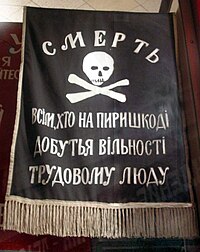
Nestor Makhno in 1927, in the Parisian magazine “The Work of Labor” published an article “To the Jews of all countries”. In it, he wrote: “For example, a photograph:“ Makhnovschina on a campaign ”- in addition to having nothing to do with pogroms, it is not at all Makhnovist, just as the photograph of a banner with a skull emblem does not belong to the Makhnovist movement. These alien photographs appear in the document of the Jewish society under the name of the Makhnovsky. ” [19]
V.F. Belash , who arrived in Gulyai-Pole in early January 1919, later recalled: “ The headquarters hung heavy black banners with the slogans:“ Peace to huts, war against palaces, ”“ Always oppressed against oppressors, ”“ Emancipation of workers ” - the work of the workers themselves. ”Then there were red flags interspersed with black ones, apparently hanging from the buildings of civil organizations. Near the headquarters, at the entrance to the“ Volost Council of Workers, Peasants and Rebel Deputies, ”two flags hung - one black with the inscription : "Power gives birth to parasites. Long live anarchy ! ”, The other is red with the slogan:“ All power to the local councils! ”
После разрыва с советской властью, последовавшего в июне 1919 г., Н. Махно вновь возвращается к анархистской символике, а чёрный цвет становится неизменным символом махновского повстанческого движения. [twenty]
Лидеры махновского движения
- Нестор Иванович Махно
- Виктор Фёдорович Белаш
- Пётр Андреевич Аршинов
- Всеволод Михайлович Волин
- Феодосий Юстинович Щусь
- Семён Никитич Каретник
- Лука Никифорович Бондарец
- Дмитрий Иванович Попов
- Лев Николаевич Задов
- Иуда Соломонович Гроссман
- Арон Давидович Барон
- Мария Григорьевна Никифорова
- Иван Марков
See also
- Вольная территория
- Civil war in Russia
- Революция и Гражданская война на Украине
Notes
- ↑ Н. Махно, Дело Труда, № 23-24, апрель-май 1927, с. 8-10
- ↑ Яланський В. Верьовка Л. Нестор і Галина, розповідають фотокартки, Київ-Гуляйполе: «Ярмарок», 1999. 544 с. — ISBN 966-95615-0-7 (укр.)
- ↑ Кравец Ю. П. Знамена повстанческой армии Н. Махно. 1918—1921 гг // Музейний Вісник No 7. — Запоріжжя, 2007. — 190 с.
- ↑ 1 2 3 4 5 6 7 8 9 10 11 12 13 14 15 16 17 18 19 Аршинов П. История махновского движения (1918-1921 гг.) . — Берлин, 1923. — 258 с.
- ↑ 1 2 3 4 5 Комин В. В. Нестор Махно. Мифы и реальность. Глава «Рождение батьки». М., 1990
- ↑ 1 2 3 4 5 6 Комин В. В. Нестор Махно. Мифы и реальность. Глава «Гуляй-поле». М., 1990
- ↑ 1 2 3 4 Махно.ru, Именной указатель
- ↑ Савченко В. А. Двенадцать войн за Украину. — Харьков: Фолио, 2006. Глава девятая. Война белогвардейцев против армии УНР и махновцев (декабрь 1918 — январь 1920)
- ↑ 1 2 3 4 5 6 7 8 9 Шубин А. В. Махновское движение: трагедия 19-го // Община № 34, 1989 год
- ↑ 1 2 Савченко В. А. Двенадцать войн за Украину. — Харьков: Фолио, 2006. Глава четвёртая. Военный конфликт в Северном Причерноморье. Война украинских повстанческих войск против войск Антанты и белогвардейцев (февраль — апрель 1919)
- ↑ Жигалов И. Дыбенко. Жизнь замечательных людей. Серия биографий. Выпуск 18. М., «Молодая гвардия». 1983.
- ↑ Белаш Виктор, «Дороги Нестора Махно», стр. 137
- ↑ Гражданская война и военная интервенция в СССР. Энциклопедия. М.: Советская энциклопедия, 1983.
- ↑ Владимирский М. В. Красный Крым 1919 года. — М. : Издательство Олега Пахмутова, 2016. — С. 38. — 304 с. — ISBN 978-5-9908031-2-1 .
- ↑ Аршинов П. А. История махновского движения (1918—1921). — М.: ТЕРРА; «Книжная лавка — РТР», 1996.
- ↑ Михайло КОВАЛЬЧУК. Українсько-білогвардійська війна: трагічний початок (вересень 1919 р.) // Військово-історичний альманах. — 2004. — Ч. 2 (9). — С. 15 — 47.
- ↑ А. И. Деникин «Очерки русской смуты» ISBN 985-13-1148-0 ISBN 985-13-2439-6
- ↑ В. Азаров . Памяти Старобельского соглашения (недоступная ссылка) . Дата обращения 30 июля 2013. Архивировано 6 августа 2013 года.
- ↑ Махно Н. К евреям всех стран // Дело труда". — № 23-24, апрель-май 1927 г.
- ↑ Знамена повстанческой армии Н. Махно. 1918-1921 гг. . makhno.ru .
Links
- Аршинов П. А. История махновского движения (1918—1921 гг.) — Берлин, 1923. — 258 с.
- Махновское движение (махновщина) / С. Ю. Щукарёв // Большая российская энциклопедия : [в 35 т.] / гл. ed. Ю. С. Осипов . — М. : Большая российская энциклопедия, 2004—2017.
- В. Антонов-Овсеенко. Записки о гражданской войне. — М.: Государственное военное издательство, 1924—1933.
- Гражданская война на Украине 1918—1920. Сборник документов и материалов в трёх томах, четырёх книгах. — Киев: Наукова думка, 1967.
- Грациози А. Большевики и крестьяне на Украине, 1918—1919 годы. Очерк о большевиках, национал-социализмах и крестьянских движениях. — М.: «АИРО-XX», 1997. — С. 28-30, 63, 137.
- Кубанин М. И. , Махно Н. И. Махновщина. Крестьянское движение в степной Украине в годы Гражданской войны. — Центрполиграф , 2017. — 320 с. — ISBN 978-5-227-07503-1 . (в книге также напечатан ответ Н. И. Махно)