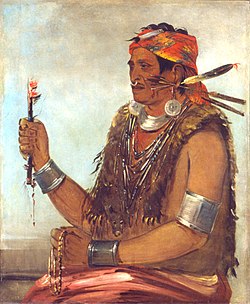
Tenskwatawa ( Eng. Tenskwatawa ; 1775 - November 1836 ) is the religious and political leader of the Shauni Indian people, also known as the Prophet or the Prophet Shauni.
Content
Biography
Early life
Tensquatava was born in 1775 , at birth he received the name Lalavatika - Generating a lot of noise, multi-noise. It is not precisely established to which people his mother belonged. According to some sources, she was from screams or Cherokee , according to others - came from pekovi, one of the groups of shawnee. [1] [2] She left her son and left her family, and Lalavatika's father died before his birth.
Lalavetika grew up surrounded by his brothers and sisters. He was not famous as a hunter or warrior , unlike many other Shawnee men. In addition, he lost his eye during a hunting accident. As a result of all this, Lalavatika became an object of ridicule in his tribe and began to drink alcohol.
Vision
Lalavatika's life changed in May 1805 . During the next booze, he fell into a fire and his fellow tribesmen considered him dead. But Lalavatika woke up and told about his vision, which came to him in a dream.
He soon began to preach among the shauni. His spiritual teachings called for the abandonment of tribal wars and the restriction of contacts with white people, who, in his opinion, caused many troubles of the Indians. He called for the abandonment of alcohol, clothing and white goods. Lalavetika changed his name to Tenskvatava - Open Door. Followers of the teachings of the Prophet executed several Indians who converted to Christianity , accusing them of witchcraft and cooperation with the Americans.
After he predicted a solar eclipse in 1806 , the number of his followers increased rapidly. But some Native American leaders did not want to enter into a military conflict with the United States, among them was the leader of the Shawnee Blackhoof , who called on Tensquatawa and his brother Tekumsa , the military leader of the Shawnee, to leave the area in order to avoid a war with the Americans. [3] The leader of the Potawatomi tribe, Winamak, invited Tenskwatawa, Tecumseh, and their followers to the lands of his tribe, in northwestern modern Indiana . Tensquatava accepted and founded the settlement of Profetstown or the City of the Prophet , not far from the confluence of the Wabash and Tippecanu rivers .
The Tecumseh War
Tensquatawa's growing popularity attracted new followers. [4] As a result, an Indian tribal union formed in the Prophetstown area, which became known as the Tecumseh Confederation . The military leader of the Indian Alliance was Tecumseh. The union included: shauni , delaware , potawatomi , fawkes , sauki , kikapu , vea , miami , ottawa , piankasho , mingo , seneca , ojibwe , chikamoga cherokee and wyandota . The Confederation numbered about 3,000 warriors scattered throughout the Old Northwest .
In early November 1811, William Harrison assembled a detachment of 1,200 soldiers and militias and moved to Prophetstown. Going to a meeting with representatives of the Five Civilized Tribes , Tecumseh forbade his brother from engaging in an armed conflict with the Americans, however several Indian soldiers attacked the White settlements located near the City of the Prophet. The attack of the Indians served as a pretext for the armed invasion of the Americans. Tensquatava, in the absence of Tecumseh, faced a choice - to prepare for battle or to go for peace agreements with the Americans. In the end, the Indians decided to attack the army of Harrison. On November 7, 1811, the Battle of Tippecan took place, in which the Americans won, Profetstown was burned. Tensquatava lost many of his followers, and the Indian Union was never able to restore its former power.
The last years of life
In October 1813, in the battle on the River Thames, the brother of Tensquatawa - Tecumseh died. The Prophet himself in the following years unsuccessfully tried to regain leadership among the Indians. In 1825, with his assistance, many Shawnee left their former area and moved west of the Mississippi River . In 1826, he founded a new Native American settlement on the site of the modern city of Kansas City .
Tensquatawa passed away in November 1836 in his settlement in the east of modern Kansas .
Notes
- ↑ Schutz, Noel. "The Family of Tecumseh & Tenskwatawa"
- ↑ Sugden, John. Tecumseh: A Life . New York: Holt, 1997. ISBN 0-8050-4138-9 (hardcover); ISBN 0-8050-6121-5 (1999 paperback).
- ↑ Owens, Robert M. Mr. Jefferson's Hammer: William Henry Harrison and the Origins of American Indian Policy . - Norman, Oklahoma: University of Oklahoma Press, 2007 .-- S. 210. - ISBN 978-0-8061-3842-8 .
- ↑ Sugden, John. Tecumseh: A Life. - New York: Holt, 1997 .-- S. 168. - ISBN 0-8050-6121-5 .
Literature
- Edmunds, R. David. The Shawnee Prophet . - Lincoln, Nebraska: University of Nebraska Press, 1985 .-- ISBN 0-8032-1850-8 .
- Cave, Alfred A. Prophets of the Great Spirit. - Lincoln: University of Nebraska Press, 2006. - ISBN 080321555X .
- Funk, Arville. A Sketchbook of Indiana History. - Rochester, Indiana: Christian Book Press, 1969, revised 1983.