
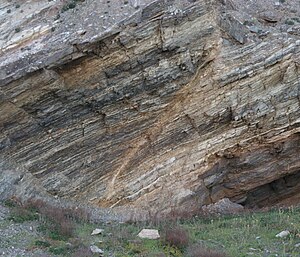
Geological fault , or fracture - violation of the continuity of rocks , without displacement (crack) or with displacement of rocks along the surface of the fracture. Faults prove the relative motion of the earth's masses. Large faults of the earth's crust are the result of a shift of tectonic plates at their joints. In active fault zones, earthquakes often occur as a result of the release of energy during rapid glide along the fault line. Since faults most often do not consist of a single crack or rupture, but of the structural zone of the same type of tectonic deformations, which are associated with the fault plane, such zones are called fault zones .
Two sides of a non-vertical fault are called the hanging side and the sole (or lying side ) - by definition, the first occurs above and the second below the fault line. This terminology came from mining .
Content
Fault Types
Geological faults are divided into three main groups depending on the direction of movement. A fault in which the main direction of motion occurs in a vertical plane is called a fault with a displacement along the dip ; if in the horizontal plane - then by a shift . If the displacement occurs in both planes, then this displacement is called a fault-shift . In any case, the name applies to the direction of movement of the fault, and not to the modern orientation, which could be changed under the influence of local or regional folds or slopes.
Fall Offset Fault
Faults with a fall offset are divided into faults , reverse faults , and overthrusts . Discharges occur when the earth's crust is stretched, when one block of the earth's crust (the hanging side) falls relative to the other (the sole). A section of the earth's crust, lowered relative to the surrounding dumping areas and located between them, is called a graben . If the plot is on the contrary raised, then such a plot is called a handful . Discharges of regional significance with a small angle are called stalling or peeling . Thrusts occur in the opposite direction - in them the hanging side moves upward relative to the sole, while the angle of inclination of the crack exceeds 45 °. During thrusting, the crust shrinks. Another type of fault with a displacement along the dip is a thrust , in it the movement occurs similarly to a thrust, but the angle of inclination of the crack does not exceed 45 °. Overthrusts usually form ramps, rifts and folds . As a result, tectonic covers and clippings are formed . A fault plane is a plane along which a break occurs.
Shifts
When shifting, the sides move horizontally relative to each other (left or right). Separate [ clarify ] the type of shear is a transform fault .
Fault Rocks
All faults have a measurable thickness, which is calculated by the magnitude of the deformed rocks, which determine the layer of the earth's crust where the break occurred, the type of rocks subjected to deformation and the presence of mineralization liquids in nature. A fault passing through different layers of the lithosphere will have different types of rocks on the fault line. A long fall bias leads to overlapping rocks with characteristics of different levels of the earth's crust. This is especially noticeable in cases of breakdowns or large thrusts .
The main types of rocks during faults are as follows:
- Cataclasite is a rock whose texture is determined by the structureless fine-grained material of the rock.
- Milonite is a shale metamorphic rock formed during the movement of rock masses along the surfaces of tectonic discontinuities, during fragmentation, grinding and crushing of the minerals of the source rocks.
- Tectonic breccia is a rock consisting of acute-angled, neo-rounded fragments of rocks and cement connecting them. It is formed as a result of crushing and mechanical abrasion of rocks in fault zones.
- Discharge mud is an unbound, clay-rich soft rock, in addition to ultrafine-grained catalysis, which may have a flat structural pattern and contain <30% of visible fragments.
- Pseudotachilite is an ultrafine-grained, vitreous rock, usually black.
Faults are often geochemical barriers - therefore, clusters of solid minerals are confined to them. They are also often insurmountable (due to displacement of rocks) for brines, oil and gas, which contributes to the formation of their traps - deposits.
Deep Fault Indication
The location of deep faults is determined and mapped (mapped) on the Earth's surface using the interpretation of satellite images, geophysical research methods - various types of seismic sounding of the earth's crust, magnetic surveys, gravimetric surveys. Geochemical methods are also often used - in particular, radon and helium imaging. Helium , as a decay product of radioactive elements saturating the upper layer of the earth's crust, seeps through cracks, rises into the atmosphere, and then into outer space. Such cracks, and especially their intersections, have high concentrations of helium. This phenomenon was first established by the Russian geophysicist I.N. Yanitsky during the search for uranium ores, recognized as a scientific discovery and entered in the State Register of Discoveries of the USSR under No. 68 with a priority of 1968. in the following wording: “A previously unknown regularity was established experimentally, which consists in the fact that the distribution of abnormal (elevated) concentrations of free mobile helium depends on the deep, including ore-bearing, faults of the earth's crust.” [one]
See also
- Plate tectonics
- Tectonic dislocations
- Heliometry
- Outcrop (geology)
Notes
- ↑ State register of discoveries of the USSR Scientific discovery No. 68 "The regularity of the distribution of the concentration of helium in the earth's crust."
Literature
- McKnight, Tom L; Hess, Darrel (2000). “The Internal Processes: Types of Faults”, Physical Geography: A Landscape Appreciation. Upper Saddle River, NJ: Prentice Hall, pp. 416-7. ISBN 0-13-020263-0 .
- Davis, George H .; Reynolds, Stephen J. (1996). Folds, Structural Geology of Rocks and Regions. New York, John Wiley & Sons, pp. 372-424. ISBN 0-471-52621-5 .
Links
- Repin, A.G. Faults, lineaments, dislicates of the north of Western Siberia. (2005). Date of treatment September 9, 2012. Archived on September 9, 2012.