Cortinárius erythraéus is a fungus of the Cobweb family ( Cortinariaceae ). Included in the subgenus Myxacium of the genus Cortinarius .
| Cortinarius erythraeus |
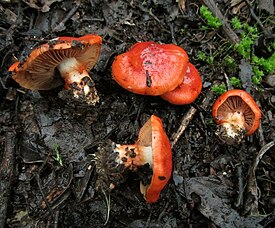 |
| Scientific classification |
|---|
| Kingdom : | Higher mushrooms |
| Department: | Basidiomycetes |
| Subdivision : | Agaricomycotina |
| View: | Cortinarius erythraeus |
|
| International scientific name |
|---|
Cortinarius erythraeus Berk. 1854 non Carteret 2001 |
|
Content
It has a mucous red-orange private veil, which allows this species to be attributed to the Pyromyxae section of the subgenus Myxacium .
The following name is a taxonomic synonym for C. erythraeus :
- Cortinarius ruber Cleland 1927
The name Cortinarius erythraeus was also used in relation to the following species:
- Cortinarius suberythraeus Carteret 2002, nom. nov.
- [ syn. Cortinarius erythraeus Carteret 2001, nom. illeg. ]
- The hat usually does not exceed 5 cm in diameter, convex in young mushrooms with a tucked, then unbent, wavy edge, with a mucous surface painted in blood-red, red-orange or red tones.
- The plateau hymenophore , plates with a weakly pronounced notch, adhered to the peduncle, are quite frequent, yellow-olive in color.
- Leg up to 4 cm high, about 1.3 cm thick in the upper part, fleshy, with a bulbous thickening up to 1.9 cm at the base, mucous, hollow or made. The upper part of the leg is whitish, with slightly noticeable veins, the lower part is colored mucous, red or red-orange in color, like a Cortin hat.
- The flesh of the cap is white, thick above the leg, and thinner towards the edges. The pulp is red.
- Spore powder is rusty brown. Spores 8-11 × 6-8.5 microns, light brown in color, elliptical in shape, with a slightly warty surface. Four-spore basidia , club-shaped, 23-51 × 8.5-13 microns. Cystides are absent. Gifs with buckles.
- The toxic properties of Cortinarius erythraeus have not been studied.
It usually grows in small groups, less often singly or in large quantities, from June to July, on the ground. Forms mycorrhiza with eucalyptus .
- CA Grgurinovic (1989). Studies on JB Cleland's Fungal Herbarium - 2 .. Mycotaxon 36 (1): 47–61.
